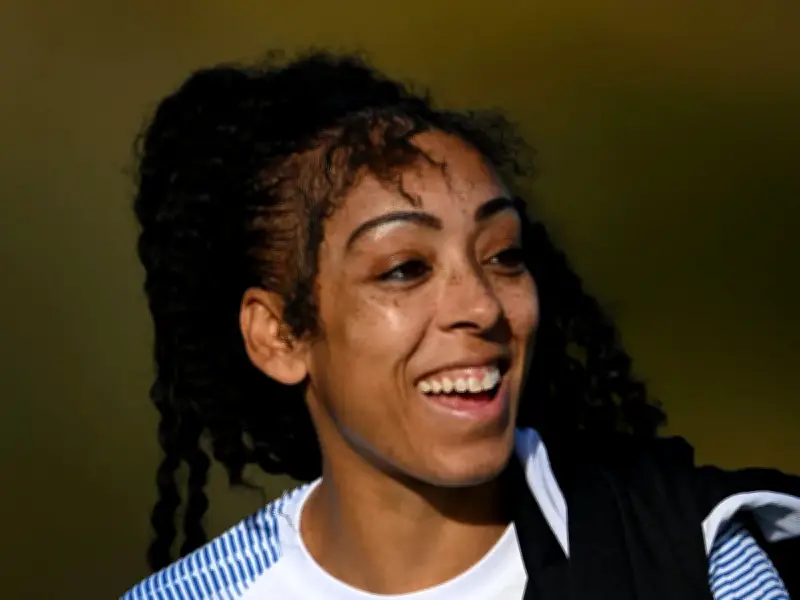
Former England forward Jess Clarke has said she did not see her skin colour growing up in a white British home, and only became conscious of being different when she started school.
Clarke, who won 51 England caps and scored 11 goals between 2009 and 2015, said unfamiliar social settings made her aware of how others viewed her and the assumptions they made about her Caribbean heritage.
Assumptions about heritage
“I was brought up in a white British home. Yes, I am a woman of colour, but I was brought up in a white British home,” she said.

“And a lot of the time people will just make the assumption that I’ve got a strong connection with my Caribbean side. I haven’t. I’d love to know more. Of course I would.
“But that assumption. So don’t assume. Get to know the person because our exterior sometimes doesn’t convey actually who we are.”
Clarke was raised in Leeds by her mother, whom she describes as “golden”, and most of her family is white British.
“I did not see my skin colour. I was loved for who I was and who I am. You can’t ask for more than that,” she said.
“And that’s a credit to my mum. That’s a credit to my family because I didn’t feel indifferent until I started going off and doing my own things and experiencing new things, and then going into school and thinking, ‘Oh, I am different.’
“But prior to that, I did not see myself any different.”
Facing challenges in football
Clarke joined Leeds as a young player and started the 2006 FA Women’s Cup final at the age of 16.
“From a young age, I did face challenges. I feel like I never quite fit in. I always navigated between that kind of cultural space. I looked different. I acted differently because I played football, and I did have my challenges along the way,” she said.
“But what I would say is that I wouldn’t change one thing. I would never change because it shaped me, but it hadn’t defined me.
“I think I’ve been able to use them moments as fuel, as inspiration. I now sit here today thinking, well, if it wasn’t for all those difficult times, I wouldn’t be the person I am today.”
She recalled attending a talent camp watched by England scouts, where the pressure left her unable to sleep.
“I remember when I was a young girl and I think maybe it was a talent camp that I was going to, and all the England scouts were there. Because I was so absorbed by that, I lost loads of sleep. I lost so much sleep. The next day I didn’t perform. I didn’t get selected,” she said.
“But the one time where I was relaxed, I went into a game playing for Leeds United at the time and I had no idea that any scouts are there, and I was just free to express because I didn’t put that pressure on myself.
“And that’s something that I’ve learned and I use more now. Especially in high-pressurised situations, I’m like, ‘Okay, right, Jess, I need to take a moment just to distance myself from it, relax into it, and then I know that I’m going to be in the right frame of mind to perform.’”
Injury and recovery
Clarke made her senior England debut against South Africa in March 2009. Her domestic career included spells with Leeds, Lincoln, Notts County, Liverpool, Sheffield United and Durham.
At Liverpool, a cartilage injury left her facing the possibility that she might never play again. She recovered and returned to football.
“I’ve always used injury, rejection as a platform. And I know for some it’s really difficult. I think I’ve just had this inherent capacity within me just to reframe it,” she said.
“I love proving people wrong. And even more importantly, I love proving myself wrong. So I kind of just try to see the positive from it and how I can learn and how I can grow.
“And when I do reach that success, or I come back from injury, or say I’ve been dropped out of the squad and I come back and I score that winning goal, there’s no feeling like it in the world.”
Life after football
In November 2023, Clarke stepped back from full-time football after accepting a job outside the sport. She remained involved with Durham through its sister club, Cestria.

“The one thing that I would say for those that feel like things are out of their control, what’s in your control is the way you think and feel and how you deal with a situation,” she said.
“Everybody’s perspective is different, but you’ve got the ability to change your perspective. And it sounds easier than it is done. Of course it does, but it’s just the habits that you formulate.”
Clarke turned to self-inquiry, meditation, breath-work and self-regulation, while considering her future beyond football.
“When I come to retirement and the awful news what I had with my injury as well, it was like, how do I recreate that so I can create something new in my life? How can I then create that distance to actually figure out who I am?
“Because, yeah, I’m Jess Clarke the football player, but I’m also more than a football player and I could add value in whatever I do. And it took me a long time to recognise that.”
She now speaks publicly about identity, resilience and inclusion.
“I have been in situations where I’ve been told I’m not good enough. I’ve been in undesirable situations where somebody doesn’t believe in me,” she said.
“But the most important thing is I believe in myself. And it’s kind of navigating through that, not the conditioned beliefs of other people. It’s the relationship that you have with yourself that’s the most important thing in any adversity that you have.”