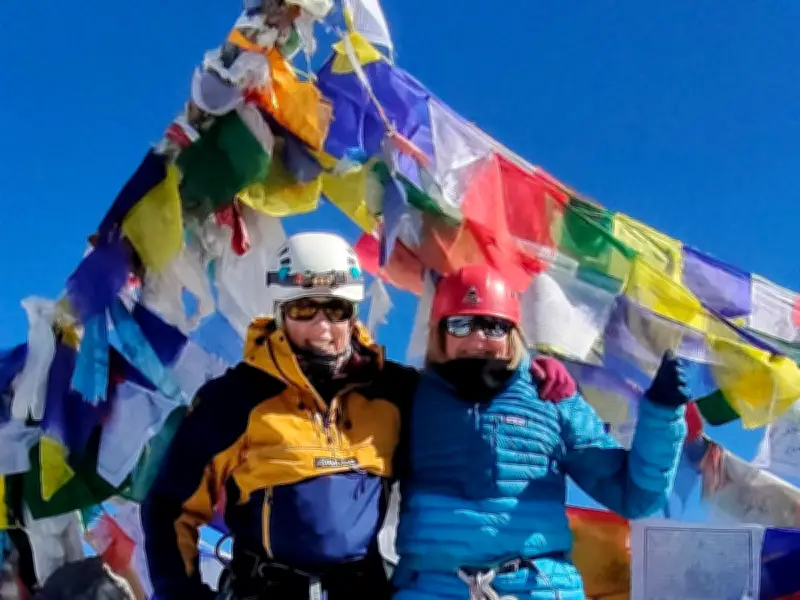
"She's not big enough," said one journalist when he heard about Samina Baig's plan to climb Everest. "To climb the stairs." Forty-nine days later, the young climber was at the summit, fuelled by courage, skill and a determination to prove the doubters wrong.
"Resilience runs through the history of female mountaineering," says author Rosemary J Brown, whose new book Moving Mountains: Intrepid Women Climbers and the Peaks Named in Their Honour, published by The History Press, explores this legacy and uncovers the hidden heroines of exploration. "All of them are unique in their own way," said Rosemary, "but they're all bonded by courage, resilience, determination and willingness to defy convention."
Sacagawea: The Guiding Light
A climber herself, Rosemary used the idea of mountains named after female pioneers to trace their forgotten impact. She begins the journey with Sacagawea, the teenage Native American girl who often rescued the 33-man famous Lewis and Clark expedition from 1804-06, whether she was braving churning waters to rescue vital instruments during a sudden squall, foraging for food to ward off hunger, or reassuring rival tribes by her presence that the expedition came in peace.

"What I really want to show is her amazing resilience and her connection to nature - traits shared by all the women in the book. But she really is the guiding light."
Meta Brevoort: Activist and Mountaineer
Decades later, Marguerite Claudia "Meta" Brevoort was born into immense New York wealth before discovering climbing at 39. "Meta Brevoort could have just stayed in New York," says Rosemary. "But she actually wasn't just a mountaineer. She started her life as an activist and a humanitarian." Settling in France, Meta took up the sport alongside her sickly teenage nephew, William Coolidge, whom the mountain air completely revived. In 1865, Meta became the first American woman to stand atop Mont Blanc. At the summit, her party popped champagne to toast the peak before Meta, a committed republican, led her party in singing the banned lyrics of La Marseillaise across the silent summit.
In a 12-year career, Meta completed 20 first ascents and first female ascents, pioneered winter climbing, and scaled peaks with her beloved dog, Tschingel.
Mary Isabella Charlet-Straton: First Winter Ascent of Mont Blanc
The alpine snows also drew British heiress Mary Isabella Charlet-Straton, who used her financial independence to achieve what no man or woman had before - the first winter ascent of Mont Blanc in January 1876. The brutal climb almost cost Mary Isabella two fingers to frostbite, and newspapers initially credited her historic triumph to men who had failed in their attempt. But Mary Isabella wrote a letter to The Times, forcing a correction. To bypass strict rules, Mary Isabella had quietly taken a forbidden route to the summit - a secret she kept hidden for 30 years to protect her guides' livelihoods.
During the gruelling climb, Mary Isabella's guide of 15 years, Jean Charlet, warmed her frostbitten hands back to life; the two fell in love and married later that year.
Annie Smith Peck: Wardrobe Rebellion on the Matterhorn
While Mary Isabella fought low temperatures and rigid gender roles in the Alps, American Latin professor Annie Smith Peck was staging her own revolution on the Matterhorn in 1895. But her climbing achievement was entirely overshadowed by public outrage over her wardrobe. Annie had worn hand-sewn, baggy canvas trousers instead of a skirt at a time when women were actively jailed for wearing men's clothing.
Annie turned climbing into a freelance profession, funding her expeditions through lecture tours. Rosemary said: "She would never give up. Never. She was doing it for other women so people could see the strength of women." At 58, Annie conquered Peru's Mount Huascarán on her sixth attempt, though her guide climbed ahead to steal credit. Annie later scaled a Peruvian volcano at age 61 just to beat a dismissive male rival who had insulted her, triumphantly planting a "Votes for Women" banner at the summit.

Lizzie Le Blond: Pioneering Filmmaker and Club Founder
The battle over mountain attire was shared by Elizabeth "Lizzie" Le Blond, an elite Irish heiress who abandoned London high society after being sent to the Swiss Alps for a respiratory complaint. "She was filthy rich and she attracted the most eligible bachelor of the day," Rosemary said. "But in the end, it seemed quite clear he just wanted her to help him with his political career." Lizzie operated under the "slipping on and off" school of dress - wearing a standard skirt over her climbing gear to start the day and hiding it on the mountain to climb in trousers. In 1900, Lizzie made the first all-female, guideless traverse of Piz Palü, an achievement contemporary authorities deliberately left out of official records to avoid scandal.
Lizzie went on to help found the Ladies' Alpine Club in 1907, served as a wartime humanitarian, and became the world's first mountain filmmaker.
Gertrude Benham: Global Wanderer on a Shoestring
For other women, the mountains offered liberation only after lifetime domestic duties were completely fulfilled. Gertrude Emily "Truda" Benham spent her youth caring for her aging parents in London, but the moment they passed away, Truda unleashed a fierce wanderlust. During a 34-year journey, Truda circled the globe seven times and walked across Africa four times on a shoestring budget of under £250 a year.
Traveling completely unarmed, Truda carried only an umbrella, a pocket Shakespeare, and Kipling's Kim. On Kilimanjaro in 1909, Truda forged ahead entirely alone to reach the Mawenzi crater edge after her guides abandoned her out of fear. "I hadn't even heard of her," Rosemary said, "Because she just was too busy traveling and climbing mountains. She barely did an interview. She never wrote a book." Truda died at sea at age 70, leaving behind 800 rare artefacts she picked up on her travels.
Gertrude Bell: From Mountaineer to Diplomat
Gertrude Bell was known as 'Queen of the Desert' after spending years mapping uncharted Arabian deserts and negotiating with powerful tribal leaders. Following the First World War, she became a highly influential British diplomat who helped draw the borders of modern Iraq. But she discovered her foundational grit in the heights, enjoying a five-season mountaineering career. Gertrude tackled France's notoriously difficult La Meije as her very first serious ascent, stripping down to her underclothes mid-climb when her skirt proved too hazardous.
Her finest and most terrifying hour occurred on the Finsteraarhorn in 1902, where a violent blizzard trapped Gertrude and her guides on a razor-edged ridge for 53 hours roped together, surviving two nights exposed on a freezing glacier without matches. Her guides said they would have died if she hadn't been there. Though a staunch anti-suffragette who chain-smoked, Gertrude's calculated mountain survival skills directly translated to her later diplomacy before her death at 58.
Junko Tabei: First Woman on Everest
Junko Tabei, a frail child from Fukushima, shattered rigid Japanese social expectations. Barred from traditional male climbing clubs, Junko founded the Joshi-Tohan all-female climbing club in 1969, eventually organising an all-women expedition to Mount Everest in 1975. Six weeks into the climb, an avalanche buried their camp, knocking Junko unconscious. Refusing evacuation, Junko crawled along a knife-edge ridge just nine days later to become the first woman to stand on Everest's summit.
"Junko, less than five-foot-tall Japanese woman who is the first woman to climb Everest in 1975. That's really going against all odds," Rosemary said. "Five minutes more, maybe even three minutes more, she would have been dead. And they said, 'You've got to come down...' and she said no way." Later in life, Junko became the first woman to complete the Seven Summits.
Samina Baig: Defying Modern Doubters
Samina Baig is the young climber from Pakistan's remote Shimshal Valley who defied the modern doubters. Starting mountaineering with second-hand bazaar boots, Samina made history on Everest in 2013 at just 22 years old during a dedicated Gender Equality Expedition. In a remarkable display of solidarity, her brother Mirza Ali stopped 248 metres from the summit, deliberately letting Samina step onto the top of the world alone to show global audiences what Pakistani women could achieve.
Samina was also pushed to her absolute limits during a harrowing attempt on K2 in July 2024, when she developed severe high-altitude pulmonary edema at base camp. With her lungs filling with fluid and an army rescue helicopter failing to arrive, her brothers Gul Muhammad and Mirza mounted a desperate 48-hour rescue, bringing Samina back down the mountain on horseback.
Told she would not be able to climb anything big in 2025, Samina said how much she missed the mountain. Samina said: "Life feels like a challenge in its own way, but turning those challenges into something positive is always a choice. I miss the mountains deeply. The mountains taught me resilience, presence and purpose. And though I'm far from them now, their spirit still climbs with me every day." Just months later she became the first Pakistani woman to ski to the South Pole. After completing her epic challenge she said: "I hope my journey reminds others, especially young women, that dreams are worth pursuing, no matter how long they take."
Moving Mountains by Rosemary J Brown will be published on August 13 by The History Press.