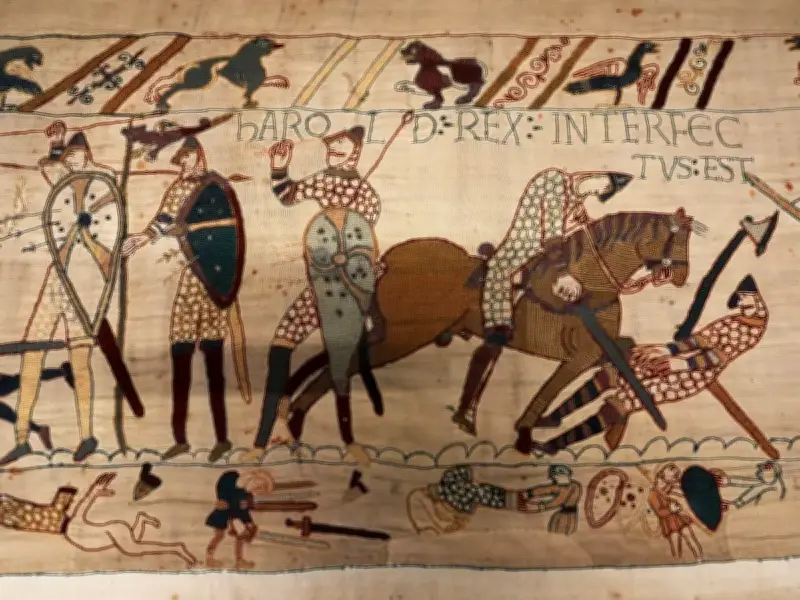
The Bayeux Tapestry, depicting the Norman conquest of England in 1066, has been studied for centuries, yet it still contains parts that baffle experts. From hidden genitalia and mystery dwarfs to the artwork’s lost ending, here are five secrets to look out for.
The Controversial 94th Penis
History buffs have spent years analysing the genitalia featured on the Tapestry. Oxford historian Professor George Garnett is adamant that there are 93 penises in the embroidery, with 88 belonging to horses and five dangling off naked men. However, a hidden appendage has been theorised by other experts.
Dr Christopher Monk, who specialises in sexuality and nudity in early medieval culture, points to a large, protruding sausage-shaped object hanging out of one soldier’s tunic. He argues that its shape, position and flesh-like colour indicate it is a penis, rather than a scabbard for his sword as previously believed.

The Mysterious Woman and the Priest
The Tapestry features a mysterious woman labelled as Ælfgyva, whose identity is hotly contested. Scholars have suggested she might be Emma of Normandy, William the Conqueror’s great-aunt. She is depicted having her face caressed by an unknown priest, who appears in the border below fully naked and displaying an erect penis.
Researchers have suggested the scene may have been intended to undermine William’s claim to the throne, or could simply reference a now-lost bit of gossip that would have amused 11th-century viewers.
The Dwarf Turold
One of the more mysterious figures is Turold, a mischievous-looking dwarf who appears to be swinging from the reins of a horse. Little is known about the real figure, but the name Turold is used in texts from the time to refer to storytellers, prompting some historians to suggest he may be the Tapestry’s chief creator.
Others have suggested the name may refer to the nobleman standing next to the horse, meaning the dwarf’s true identity may be lost forever.
The Disputed Arrow
The Tapestry’s most famous scene shows King Harold getting shot in the eye by an arrow, helping William secure victory at the Battle of Hastings. However, many historians believe the iconic arrow may have been added centuries later by 19th-century restorers.
Experts have analysed the stitching around Harold’s eye and found that the golden arrow was almost certainly added during restoration in the 1800s, although they believe some form of projectile was originally stitched there. Some academics have argued that the original weapon may have been a spear.
The Missing Ending
While almost all of the surviving 68.3m tapestry remains in good condition, the final parts have disappeared, with historians having no clue what might have happened to them. Most agree that the final moments probably showed William the Conqueror’s coronation in Westminster Abbey on Christmas Day 1066.
What fascinates those who study the Tapestry is why the ending scene disappeared, and whether this was due to a deliberate conspiracy as opposed to some medieval mishap. It has been suggested that a possible act of sabotage may have been committed to undermine the Norman king’s claim to the throne, although exactly who would have committed this protest is not known.