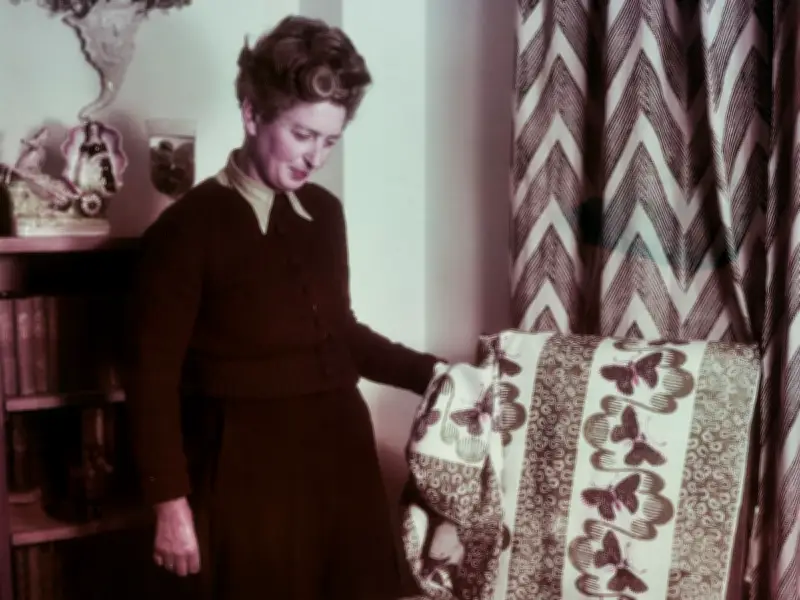
A new exhibition at Compton Verney Gallery in Warwickshire aims to revive the legacy of designer Enid Marx, whose work is still visible on London Underground seats, post-war furniture, Christmas cards and stamps.
Pioneer of pattern design
Lead curator Dr Az Crawford said: “Enid was a pioneer when it came to modern pattern design; she’s both an important and fascinating figure and her influence is all around us - not least on the capital’s Tube trains.” She was well known in her lifetime but later overlooked, and “most people have no idea who she is - hopefully the exhibition redresses that.”
Tube seat designs
In 1937, the London Passenger Transport Board asked Marx to design seating for new train carriages as part of an effort to modernise the Tube. Her geometric patterns used moquette, a durable thick-pile fabric, and replaced dreary greys and browns with brighter colours that disguised commuter dirt. She recalled the brief was “fun but strict,” and had to avoid patterns that might nauseate passengers in motion.
Art historian Dr Az noted: “She'd been making block printed fabrics throughout the 20s and 30s and her work was known for being versatile, modern and dynamic… Enid’s designs fitted the brief perfectly. The patterns are very rich. She chose green as a key colour, as it was believed it was soothing for passengers. You are sitting on Enid's legacy when you sit on the Tube.”
Early life and career
Born in London in 1902, Marx studied at the Royal College of Art but failed her Final Diploma Assessment, with her work judged “vulgar” for rejecting traditional fine art. She received an honorary degree from the college almost 60 years later. In 1944 she was awarded Royal Designer for Industry status for her Tube seat design and patterns for wartime utility furniture.
Dr Az explained: “There was rationing, including for all textiles, so when people were bombed out of their houses they needed new furnishings that were affordable… Even today, people will remember this stuff - it’s a cultural memory.”
Later work and challenges
Marx went on to design Queen Elizabeth II’s early commemorative stamps, Christmas cards, clothing fabric patterns, wrapping paper, and illustrated children’s books. She faced hurdles as a woman, including unequal pay. Dr Az said: “Her positioning as a textile designer has been denigrated by what people see as ‘legitimate art’.”
She lived in a lifelong partnership with Margaret Lambert and was private about her sexuality. Dr Az noted: “Enid was in a lifelong partnership with Margaret Lambert, always had a short back and sides and tended to wear men's or women's clothes, but never wanted to be labelled or known for her sexuality.”
Reviving her legacy
Marx’s reputation faded as her designs fell out of fashion due to their association with austerity. “People thought ‘we want something fresh and new, not things that are kind of associated with wartime and rationing,’” said Dr Az. Now curators hope a new generation will appreciate her. Asked what Marx would think of the exhibition, Dr Az said: “I think she’d hate it! … I'm definitely going to be haunted by Enid holding a sherry glass!”
The Pattern of Life: Enid Marx and Modern British Design is open now at Compton Verney in Warwickshire.