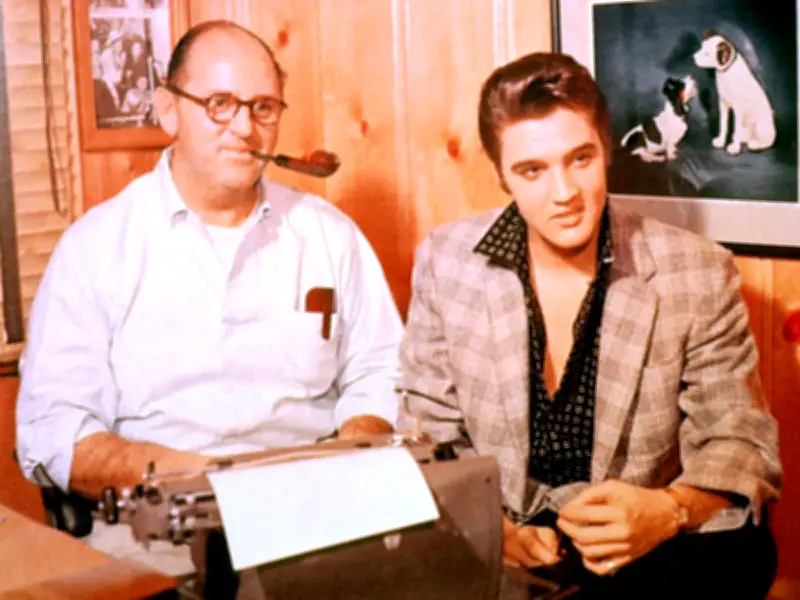
Elvis Presley's legacy lives on 49 years after his death, but he could have left so much more, according to an expert who says fame became like a prison for the star. As the world marks the anniversary of the King of Rock 'n' Roll's passing, author Sally A Hoedel has claimed controversial talent manager Colonel Tom Parker "artistically starved and isolated" Elvis after his meteoric rise to fame.
Generosity exploited
Elvis was well known for being flash and generous with his wealth throughout his lavish career. From watches to cars, Elvis often gifted those close to him - and strangers - with lavish gifts at the height of his fame. Sally says this was a way for him to still feel in control after his raw generosity was "exploited" by certain people, including the Colonel.
Speaking exclusively to the Mirror, Sally, who is the author of Elvis: The Destined Series, tells us: "The Colonel takes something really good about Elvis and exploits that. He exploits his generosity for publicity, and Elvis knew it... And I think that bothered Elvis, too."

Isolation and artistic starvation
Elvis first met the Colonel in February 1955 at Palumbo's Café in Memphis, Tennessee. Elvis had grown up in severe poverty in Tupelo, Mississippi before his music gave him a chance of success. After becoming Elvis' special advisor in August 1955, the Colonel officially took over as his sole manager in March 1956. Despite their huge worldwide success together, Sally says the Colonel forced the star into a form of isolation - something she is adamant the musician wasn't looking for.
"Elvis did want more human interaction," she says. "And he was told not to have it... he [the Colonel] was absolutely the wrong manager for Elvis, without question... It hurt him artistically in unimaginable ways." She goes on: "He was so artistically starved. His art was not always fulfilling for him, because of what he got locked into."
She claims the Colonel drilled into Elvis that he can't appear anywhere if he's not getting paid - something she says is noticeable with his huge movie deals. In total, Elvis appeared in 31 feature films as an actor between 1956 and 1969.
"When the Colonel keeps telling him that he can't appear anywhere if he's not getting paid, I personally think that keeps Elvis from creating, say, a St. Jude like Danny Thomas did," Sally says. "But again, he was told to 'you can't appear unless you're getting paid'. And that distance with Elvis was so bad because he was so good with people."
Dysfunctional inner circle
But it wasn't just the Colonel who caused Elvis to feel this way, according to Sally. She also says that by the 70s, after the peak of his fame, his inner circle had turned "incredibly dysfunctional". "It worked great for that 20-year-old guy who just encountered fame," she says. "It doesn't work so great for the 40-year-old guy who's trying to find his settled version of life."
When Elvis first burst onto the scene in 1956 with hits such as Heartbreak Hotel, he was flanked by what became known as the Memphis Mafia. These were childhood friends, family members and early associates who acted as his bodyguards, fixers, and companions. Sally says: "The whole point of having all those people around him is to have privacy. Because he doesn't want anybody to tell the press what he ate for dinner every night, let alone the other serious stuff. He wants real human privacy, as every human needs. And when that started to get violated, it was very hurtful and destructive for him."
She claims this destructive side caused Elvis to want to whittle down those around him - but sadly he was unable to do so before his death on August 16, 1977, aged just 42. Explaining how his trust issues were evident, Sally says his hairdresser, Larry Geller, was sure the star was getting ready to cut ties with some of those he felt had wronged him. Sally adds: "Larry Geller, his hairdresser, says that Elvis was planning to. After that next tour that he never made it on, he was planning to make a lot of changes, and one of them was to get rid of most of his entourage and really make it small with people he could trust."

Sally, who has released a new book titled Destined To Give: The Legendary Generosity of Elvis Presley, believes that the star reached a level of success and fame that were both difficult to deal with. "Fame made it difficult for him to stay the course at times," she says. "But again the struggle reveals his humanity. He was forced to live in an alternate universe of his own making. It was dysfunctional at times, but he did the best he could. It was difficult being Elvis Presley, but Elvis Presley handled it beautifully most of the time. He did so with incredibly generous intentions rooted in very real care and concern for his fellow man."
Sally A Hoedel's latest and final edition in the trilogy, Destined To Give: The Legendary Generosity of Elvis Presley, is out now at www.ElvisAuthor.com.