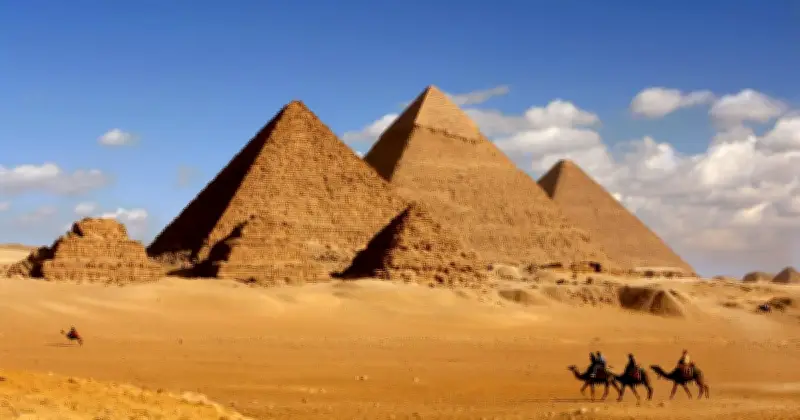
Archaeologists excavating a 5,000-year-old burial site on the eastern bank of the River Nile have uncovered two tombs featuring architectural designs that appear to anticipate methods later used in Egypt's monumental pyramid construction. The tombs, discovered at Jabal al-Tayr in Egypt's Minya Governorate, contain walls that are wider at the base and gradually become narrower towards the top, a design that would have increased their stability. Similar engineering principles were later used on a much larger scale in Egypt's step pyramids and the great pyramids of Khufu, Khafre and Menkaure.
Advanced Engineering Techniques
Archaeologists also found evidence of sophisticated stone-cutting techniques, along with huge wooden supports built into the tombs, with some extending along the full length of the walls. Oxidation marks on stone blocks may have been created as workers cut and prepared the material. A second tomb located further south was found in a much better state of preservation, allowing researchers to study its original design in greater detail.
Dr Hisham El-Leithy, secretary general of the Supreme Council of Antiquities, said early analysis had revealed similarities between the newly discovered structures and the tomb of King Den, one of the most powerful rulers of Egypt's First Dynasty. The First Dynasty was the earliest line of rulers of a unified ancient Egypt, beginning around 3100 BC after Upper and Lower Egypt were brought together under a single kingdom. King Den was among its most influential rulers.
Implications for Pyramid Construction
Researchers said the findings offer a rare insight into the experimentation that took place before Egypt's great stone pyramids emerged, as builders transformed burial sites into monuments intended to endure for millennia. The discovery could reshape understanding of ancient Egyptian architecture by suggesting that advanced engineering methods associated with pyramid construction developed earlier and spread more widely than previously thought.
Egypt's minister of tourism and antiquities, Sherif Fathy, said the structures could help experts understand how burial architecture changed throughout ancient Egyptian history. El-Leithy described the first tomb as an exceptional discovery with a unique design, while saying the second tomb had a similar layout and remained remarkably well preserved.
The site also contained part of a cemetery dating from before Egypt became a unified kingdom. Several individuals had been buried in curled positions and wrapped in woven plant mats, alongside black-topped pottery from the Naqada II and Naqada III periods. Researchers also uncovered individual and mass burials from Egypt's Late Period, with some remains placed inside wooden coffins, fragments of which survived despite extensive decay. The discoveries suggest Jabal al-Tayr remained a significant burial ground across multiple eras of ancient Egyptian history.