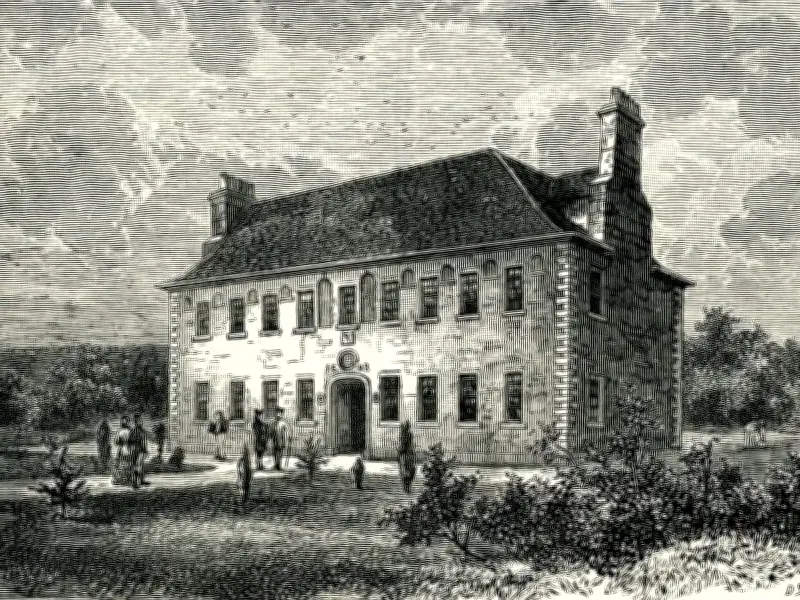
Darien House, on the corner of Bristo Place and Teviot Place in Edinburgh, has a dark history that spans from economic disaster to mental health tragedy. Originally built as the headquarters for the ill-fated Darien scheme, it later became a notorious asylum known as the Edinburgh Bedlam.
From Darien Scheme to Workhouse Asylum
The Darien scheme was a plan in the 1690s to establish a Scottish trading colony on the territory of present-day Panama. The project was abandoned in 1700 due to disease, hostility from the Spanish Empire, and a lack of support from England. The failure severely damaged the Scottish economy and is often cited as a reason for the 1707 Act of Union with England.
After the company's ruin, Darien House was incorporated into Edinburgh's nearby workhouse system to serve as an asylum for the mentally ill. BBC News states: "The company came to ruin five years later through English obstruction, Spanish hostility and Scottish mismanagement. Originally built as the headquarters for the ill-fated Company, it later became a lunatic asylum for paupers in the nearby workhouse."

Conditions at the Edinburgh Bedlam
Often referred to as the Edinburgh Bedlam, Darien House had more in common with a prison than a mental hospital. Patients were subject to overcrowding, poor sanitation, and a severe lack of food. They would even reportedly be locked up and chained to walls in freezing cells.
Among its ill-fated patients was Robert Fergusson, one of Scotland's most iconic poets. Born in Edinburgh in 1750, Fergusson was renowned for his Scots-language poetry and was described by Robert Burns as his "elder brother in the muse".
Robert Fergusson's Tragic Death and Legacy
Fergusson suffered from a head injury and what is believed to have been depression, withdrawing from society in the early-1770s. He was reportedly admitted to Darien House against his will, where he was left in a damp and cold cell with straw on the ground. He died suddenly just a few weeks later, on October 17, 1774.
His death prompted change. Doctor Andrew Duncan, a friend from Fergusson's student days, was appalled by the conditions and treatment of patients. After his friend's death, Duncan campaigned for better mental health facilities, leading to the construction of the Edinburgh Lunatic Asylum in 1813, where Bedlam's patients were later transferred.
From Asylum to Theatre
The Edinburgh Lunatic Asylum was destroyed in 1896, and the site later became the Royal Edinburgh Hospital, which now houses the Andrew Duncan Clinic and the Robert Fergusson Unit. No physical remnant of Darien House remains, but its legacy lives on in an unexpected way: the New North Free Church, built in 1848 near the site, was later acquired by the University of Edinburgh and reopened as the student-run Bedlam Theatre in 1980.
Bedlam Theatre continues to operate today as the oldest student-run theatre in Britain and is used as a venue for the Edinburgh Fringe.