At 1am, less than 24 hours before leaving London to make her Edinburgh Fringe debut, actor Clare Stenning was still painting the set in her garden. Once she gets to Edinburgh, things are unlikely to become much more restful. Alongside performing almost every day for the best part of a month, she’ll continue working her normal day job remotely because, unlike her theatre work, that job actually pays her.
Her co-star Davy Roderick is preparing to spend hours thrusting flyers at strangers despite admitting the prospect makes them ‘feel ill’, while writer Katrina Bennett has spent months juggling the production with multiple other roles and a full-time job. All three will also be sharing Edinburgh with an enormous inflatable whale named Gail, who they hope might convince a few passing strangers to buy a ticket.
A costly dream
Somehow, for many young creatives, this is the dream. Dreambite Collective are among thousands of performers who descend on the Scottish capital every August hoping to find an audience at the Edinburgh Festival Fringe, an event that still occupies an almost mythical place in British theatre. It can be a proving ground, a networking event, a month-long endurance test and, if the planets align, the thing that changes your career.

It is also increasingly an extraordinarily expensive way to find out how badly you really want to make art. For Dreambite, bringing their new play Cruising to Pleasance Courtyard will cost over £10,000. Almost nobody involved is getting paid.
‘It’s really hard,’ Bennett tells Metro. ‘Our budget, I think, is costing us 13 grand, and that is with no one getting paid, apart from a director.’ The money disappears with impressive speed: accommodation, PR, insurance, set, props, costumes, software licences and all the small, deeply unsexy costs involved in transforming something that once lived in a Google Doc into an actual professional production.
From open access to marketplace
Bennett says she was told early on that simply having a good play was nowhere near enough. You need buzz. You need previews. You need reviewers. It makes the Fringe’s origin story feel very far away. The festival grew out of eight companies turning up in Edinburgh uninvited in 1947 and performing anyway, after being excluded from the inaugural Edinburgh International Festival. Its mythology is built on open access, scrappiness and the idea that nobody needs to give you permission to make something strange or unique.
Technically, that is still true. Financially, ‘anyone can do it’ now comes with a fairly substantial asterisk. Bennett knows that better than most. Four years ago, she was offered the chance to bring another play to the Fringe through a partnership with Pleasance and regional theatres. She had to turn it down because she couldn’t afford to go.
This time, things aligned differently. After a reading of Cruising at the Omnibus Theatre in January, Bennett invited Pleasance’s head of theatre along. A follow-up conversation ended with the suggestion that they bring it to Edinburgh, at which point excitement was swiftly followed by the slightly less romantic task of opening a spreadsheet and asking whether any of this was financially sane.
The show and its costs
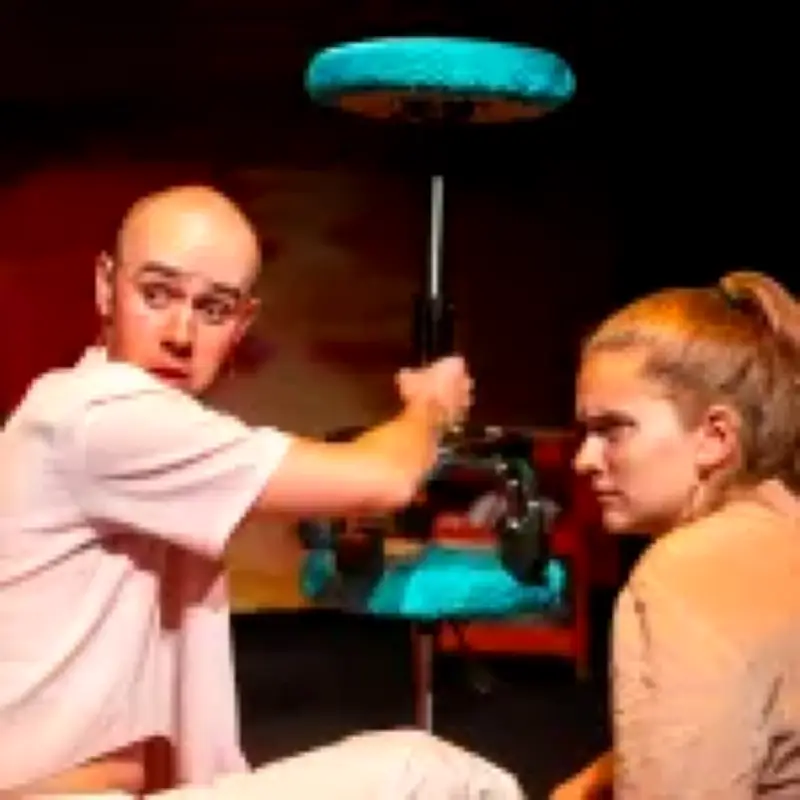
Thankfully, Cruising is the sort of show that makes you understand why people put themselves through Edinburgh Fringe. It’s laugh-out-loud funny, sexy, and bravely optimistic without being naive. Bennett describes it as ‘a queer rom-com about two climate activists trying to destroy a cruise ship’, although that barely covers it. Amelia, a dancer working aboard a Mediterranean cruise, meets Sam, who is there on holiday. Margaritas are drunk, flirting happens, and everything is heading neatly towards a holiday fling until they discover they are both in an open relationship with the same person.
Naturally, this leads to competitive eco-sabotage. Their rivalry and attraction escalate alongside their campaign against the mega-polluting ship, with the play sneaking questions about climate collapse, anti-protest laws and collective action inside something warm, funny and gloriously messy.

Roderick, who plays Sam, jokes that it sounds like ‘such a Fringe show’, although in Edinburgh’s ecosystem of glorious nonsense, it may actually be comparatively restrained. They say the festival feels like a safe place to pitch something that sounds a bit bonkers because somebody else has probably just told you about a show involving ‘walruses having sex post-nuclear Armageddon’.
That freedom to make something weird, political, formally playful or commercially unproven is still the best argument for the Fringe. The less appealing argument is the bill. The company has managed to keep accommodation costs relatively low through friends of friends, while crowdfunding and creative fundraising have helped absorb some of the rest. Stenning will work her day job throughout the festival, and Bennett has put some of her own money into the production. The actors are not being paid.
Coping with the financial strain
Stenning is matter-of-fact about it. ‘I’m lucky that they’re super chill and let me work remotely,’ she says of her employer. ‘I didn’t have to take a holiday for a month.’ She points out that theatre is struggling everywhere, that everything is more expensive and more saturated, and that dwelling too heavily on the financial reality can become paralysing. ‘If you spend too long thinking about it, then you’re not going to get anything done because it’s just going to crush you down with the hard truth of reality.’
Which is both admirably pragmatic and a fairly bleak mission statement for British theatre. The problem is that this pressure changes what Edinburgh can be. Roderick says their understanding of the Fringe was once of a place where artists could arrive with something half-formed, experiment in front of audiences and let the show evolve over the month. Now, with so much money and career capital riding on the trip, it feels ‘much more like a marketplace’.
‘Everything has to be perfect when I get there because the stakes are so high,’ they say. ‘We’ve spent all this money and this is my chance for the show to move forward in some way.’ That, they add, is probably ‘not the ethos under which it was created’.
And yet that marketplace is precisely why emerging artists keep coming. For Bennett, one of the biggest draws is simply having so many industry people in one city at the same time. In London, getting producers, programmers or literary managers to see a new fringe show can feel like asking a Cabinet minister to come round for dinner. In Edinburgh, at least there is a chance they’re already nearby, probably clutching six flyers and running late for something.
The hope is reviews, meetings, connections, perhaps a London transfer. Nothing especially modest, but nothing delusional either. Nobody in Dreambite seems to think Netflix is going to kick down the door of Bunker Three and buy the rights before the applause ends. Well, not entirely. ‘Netflix, dude, baby,’ Stenning jokes when asked about her dream outcome, before admitting she and Roderick have already discussed how well Cruising could work on screen and predicting they would be swiftly replaced by ‘Carey Mulligan and Stanley Tucci’.
The flyering grind and Gail the whale
Before global financial institutions come calling, however, people actually have to see the show. That means flyering, Edinburgh’s great democratic humiliation ritual, in which actors spend hours trying to persuade increasingly dead-eyed pedestrians that their production is the one worth sacrificing 60 minutes for.
Dreambite has a plan. There are deliberately eye-catching T-shirts. There is charm. There is confidence, or at least a convincing imitation of it. And, most importantly, there is Gail. Gail is a giant inflatable whale who is ostensibly part of the production but has already developed the energy of an actor with top billing and a difficult rider. Roderick describes her as ‘a massive diva’ and recalls finding her abandoned in a bar after one preview, propped up against a table with two drinks in front of her as though she’d had an especially ruinous evening.
The team hopes she will catch people’s attention during flyering. What they will feel about this strategy in week four is another matter. ‘Acting is inherently just like eating s**t every day,’ Roderick says cheerfully. ‘The thought of doing flyers makes me feel ill, but it’s like, well, you’re already eating s**t, so you might as well eat some more and enjoy it.’
Then there is the uniquely brutal possibility that, after all that money, labour, begging, emailing and whale-based marketing, nobody turns up. Stenning has already performed shows where there were more people onstage than in the audience, so considers herself psychologically prepared. Sort of. Roderick thinks performing Cruising to two people would be funny. ‘I think it sounds mortifying,’ Stenning says.
That uncertainty is part of Edinburgh’s cruelty and charm. A packed room on Tuesday does not mean anyone is coming on Wednesday. A nice preview doesn’t guarantee a nice review. A brilliant show can disappear without trace while something involving a naked accordion player and a laminated picture of Theresa May becomes the hottest ticket in town.
Dreambite aren’t expecting to make a profit from Edinburgh. Thanks partly to the money made from previews, however, they currently aren’t expecting to lose money either. ‘And that is a huge f**king deal,’ Stenning says. It may be the most telling measure of success at the modern Fringe. You can spend months preparing, work two jobs at once, perform nearly every day, flyer until you lose the will to make eye contact and reach September with exactly as much money as you started with — and genuinely feel you’ve pulled off a financial miracle.
Why they keep coming back
Which raises the obvious question: why do it? That’s where the easy critique stops working, because everyone I spoke to still sounded genuinely thrilled to be going. Bennett has only experienced Edinburgh from the other side before, working front of house at Assembly as a student, but she remembers it as ‘the best month of my life’. She says it was the first time theatre seemed bigger than the Shakespeare and Arthur Miller she’d encountered at school, a place where it could be strange and funny and political and built by people who looked more like her. Now she’s going back with her own play.
‘It feels like a huge luxury to actually get to spend a month doing the thing I want to do and meeting other creative people and doing it with my two besties,’ she says. Roderick feels the same contradiction. Being surrounded by thousands of people all desperately trying to make theatre work can be slightly horrifying if you think about it for too long. Turn the thought around, though, and you are surrounded by thousands of people making things because they love making them. ‘That’s really invigorating,’ they say.
And, almost too neatly, the amount of work required to get Cruising to Edinburgh has ended up embodying the argument of the play itself. It is, at heart, a show about collective action; about what happens when people stop trying to fix enormous problems alone and start relying on one another. The production has been built in much the same way. Friends have helped paint the set. Parents have contributed money and volunteered to flyer. People donated to the crowdfunder. One friend turned up to help paint a canvas drop despite having a broken arm. Six people may get the primary production credits, Stenning says, but the thing really exists because of everyone standing behind them. ‘It’s such a labour of love,’ she says.
Perhaps that is also why Edinburgh remains so hard to dismiss. The economics are absurd and the barrier to entry is real. The amount of unpaid work expected of young artists would be considered deranged in almost any other industry. The festival that once promised you could simply turn up and put on a play now requires months of planning, fundraising, marketing, networking and financial risk before you’ve even found out whether anyone likes it. But the original impulse is still there somewhere. Make something odd. Find a room. Convince a stranger to come inside. Hope they laugh. And if all else fails, bring a whale.
Cruising runs at Pleasance Courtyard, Bunker Three, at 12.50pm until August 31. Tickets start at £11.