Across the globe, iconic landmarks draw millions of visitors each year with their distinctive and striking architectural designs. However, many of these world-famous structures were originally conceived with completely different appearances that were never realised. Astrak, a global supplier of heavy machinery parts, has now utilised digital reconstruction technology to bring these abandoned architectural visions vividly back to life.
Revealing Hidden Architectural Histories
James Coughlan, Chief Marketing Officer at Astrak, explained the motivation behind this fascinating project. "These digital reconstructions invite travellers and enthusiasts to experience familiar destinations through an entirely new perspective," he stated. "They reveal the alternative skylines, architectural wonders and cultural landmarks that might have existed if today's advanced engineering, machinery and construction materials had been available centuries earlier."
Coughlan continued, "By resurrecting these long-lost designs, we aimed to illuminate the extraordinary ambition and imagination that underpinned the creation of the world's greatest landmarks. This project reminds us that every destination possesses a hidden story that travellers rarely get to witness."

Six Landmarks That Almost Looked Completely Different
St. Paul's Cathedral, London
Sir Christopher Wren, one of Britain's most celebrated architects, originally envisioned a far more ambitious design for St. Paul's Cathedral. His initial plans featured a substantially larger dome, a towering drum structure and a dramatically soaring interior that pushed beyond the engineering capabilities of the seventeenth century. Construction commenced in 1675, but as work progressed, practical limitations forced significant modifications.
The walls were thickened, aisles were narrowed and piers were enlarged to ensure structural stability. While the finished cathedral reflects these necessary compromises, the digital reconstruction showcases the grander, more expansive vision that might have permanently defined London's iconic skyline.
Sydney Harbour Bridge, Sydney
Before construction finally began in 1923, the Sydney Harbour Bridge project faced years of uncertainty and nearly didn't proceed at all. Early architectural proposals included a massive central tower and several sweeping approach bridges, but these concepts were ultimately rejected because the technology required to span the harbour simply didn't exist at the time.
It was J.J.C. Bradfield's innovative steel arch design that finally made the ambitious project feasible, successfully linking the city and creating what was then the world's longest steel arch bridge structure.
St Peter's Basilica, Rome
Construction of the current St Peter's Basilica began in 1506, replacing an earlier church that had stood in the Italian capital for over twelve centuries. The original fourth-century structure featured a wooden roof and was vast in scale, but had deteriorated significantly over time, with walls shifting metres out of alignment.
This earlier church was eventually demolished to make way for the Renaissance masterpiece visible today. The digital reconstruction provides a remarkable glimpse into how this earlier Basilica would have appeared to visitors and pilgrims many centuries ago.
Statue of Liberty, New York
Construction of New York's Statue of Liberty began in 1876, but the concept originated in a completely different location with an alternative purpose. French sculptor Frédéric Auguste Bartholdi initially designed a colossal figure intended to overlook the Suez Canal, titled 'Egypt Carrying the Light to Asia'.
When this ambitious plan ultimately fell through, the concept was creatively adapted into 'Liberty Enlightening the World' for New York Harbor. While the setting and symbolic meaning underwent significant transformation, the iconic torch-bearing female figure remained central to both designs.
Liverpool Metropolitan Cathedral, Liverpool
Construction commenced on Liverpool Metropolitan Cathedral in 1904, with the intention of creating one of the largest cathedrals in the world. Architect Edwin Lutyens proposed a truly monumental structure measuring nearly 530 feet in length, featuring a vast dome even wider than that of St. Peter's in Rome.

Unfortunately, the project was halted by wartime restrictions and subsequent economic hardship after only the crypt had been completed. The cathedral that exists today has a diameter of just 195 feet. The new digital images dramatically illustrate how much more imposing the structure would have appeared had the original ambitious designs been fully realised.
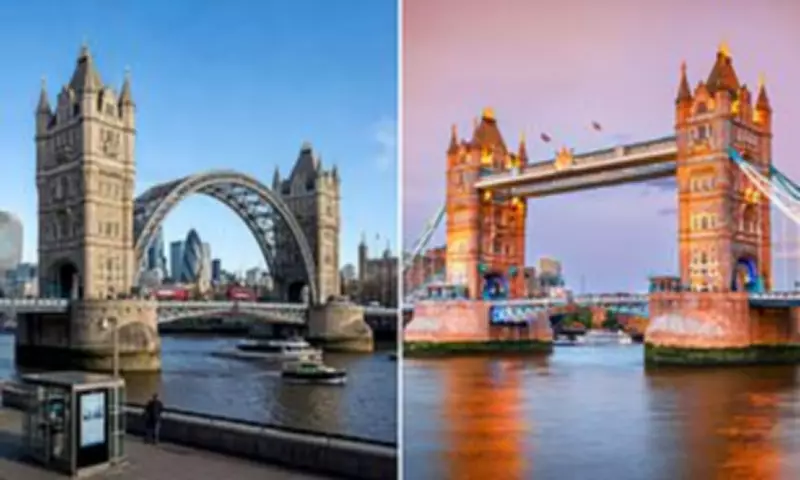
Tower Bridge, London
Following decades of debate about how to cross the River Thames without obstructing vital river traffic, construction of Tower Bridge finally began in 1886. Early architectural proposals featured large steel arches positioned between the towers, but these designs were ultimately rejected.
The final innovative solution – a hybrid bascule and suspension bridge design – successfully allowed ships to pass underneath while maintaining a crucial crossing point. These earlier plans reveal how dramatically different London's famous skyline could have appeared.
A New Perspective on Architectural Heritage
From forgotten bridge concepts to vanished super-structures, these digitally reconstructed designs reveal a hidden version of architectural history, where creative ambition often outpaced technological capabilities. They demonstrate how practical constraints, economic factors and evolving technologies have shaped the landmarks we recognise today.
This project provides a unique opportunity to appreciate not only what was built, but also what might have been – offering a fascinating glimpse into alternative architectural futures that remained on the drawing board.