In a rare act of local democracy, the audience at Arcola Theatre's Grimeborn festival became casting directors for Purcell's Dido and Aeneas. Two singers had each learnt the roles of Dido and her nemesis, a Sorceress; we were asked to vote for who should take which part. Most, like me, had no idea of either singer's talent, but it was an amusing jape that got people talking.
A Minimalist Concept
Dido and Aeneas is the first great English opera: its earliest known performance was at a School for Young Ladies in Chelsea in 1689. The conductor Raymond Leppard called it “Tristan and Isolde in a pint pot”, which sounds very Grimeborn. Escaping the Trojan War, Aeneas ends up in Carthage, where he has a doomed affair with Dido; she it is who dies (very Wagnerian). The whole drama is over and done with in barely an hour (very unWagnerian).
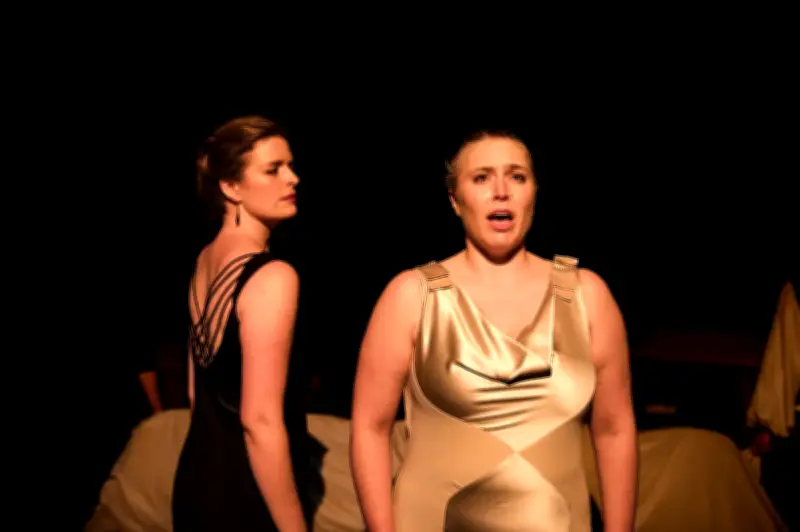
Ensemble Orquesta's founder, Marcio da Silva, is also artistic and musical director as well as taking the role of Aeneas. Commendable economy of means, no doubt, but perhaps he stretches himself a little thin. His production is avowedly “minimalist” but concept weighs more heavily than the often rather ham-dram stagecraft. Costumes are more or less contemporary with a hint of disco glamour, while the set is not much more than a sofa. That works fine, but movement relies too much on synchronised slo-mo, something of a betrayal of Purcell's irresistible dance rhythms.
Performances and Music
The theatre's brick walls don't do operatic voices any favours but the cast lacks nothing in commitment, even if words don't always come across clearly. Helen May (People's Choice as Dido) sings and acts with restrained dignity. Although a little volume modulation might have increased the soulfulness, her delivery of Dido's climactic lament is full of feeling; to see her final moments as she's wrapped in a winding cloth adds a shocking jolt of pathos.
Rosemary Carlton-Willis isn't given much menace to work with but she has the presence to show that the Sorceress controls the emotional ups and downs, while da Silva's Aeneas is on the blunt side. There's an amusing interlude – born of economy, no doubt – when he mimes the Sailor's brief song “Come away”, while the orchestra's recorder player, Paul Jenkins, sings the words.
In fact, it's the seven players of Ensemble Orquesta Baroque, directed from the keyboard by Predrag Costa, who set the musical and dramatic temperature. In particular, Michael Fields, playing lute, theorbo and baroque guitar, shows the kind of freewheeling imagination that is only intermittently evident onstage.
Until Saturday; arcolatheatre.com