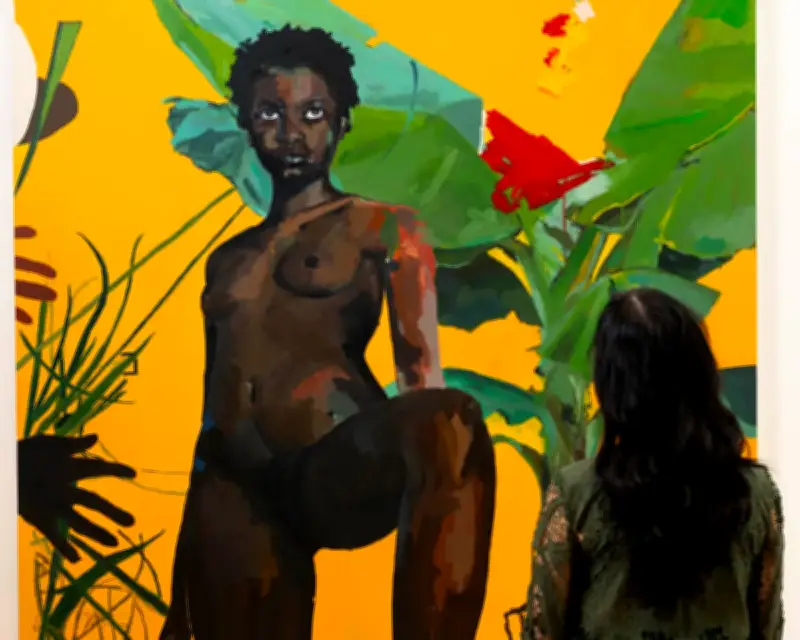
The British Art Show 10, curated by Ekow Eshun, is now open in Coventry, presenting work by 37 artists across three venues. The exhibition, which runs until 10 January at Coventry University and the Herbert and Mead galleries, before touring until 18 June 2028, explores the breadth and eccentricity of British identity.
A chorus of strangers
Eshun's starting point is a speech given to a rioting anti-immigration crowd by a fictionalised Thomas More four centuries ago. The show's title, A Chorus of Strangers, is lifted from a collaborative play attributed in part to Shakespeare, in which the under-sheriff of London implores the crowd to put themselves in the place of "the wretched strangers, / Their babies at their backs and their poor luggage, / Plodding to the ports and coasts for transportation."
This idea is knitted through the sprawling show – a call for empathy, to embrace difference. Each artwork evokes the messy fabric of this island: there are migrant stories melded to memes, uncanny artefacts and anthropomorphic architecture, images of protest, collapse, transcendence and regeneration.
Paintings and industrial language
The Mead Gallery is mostly dedicated to paintings and has the hazy ambience of a dream where images slip and meaning evades you. Matthew Krishanu's rhapsodic paintings depict the artist and his brother in Bangladesh, their tiny bodies almost swallowed by the lushness of the landscape. Kudzanai-Violet Hwami's mixed media works similarly collapse past into present, here into there with references to Shona cosmology, Christianity, Afrofuturism and magical realism in large-scale collages of found and personal photographs and painted figures. In the next room, there are paintings by Louise Giovanelli of ecstatic and erotic experience, shown with an army of anthropomorphic vessels by Shawanda Corbett.
At the Delia Derbyshire Building at Coventry University, the next venue for the show and the best of the three, the language is more industrial and direct. Two massive works by Hannah Perry take over a whole space of their own, including the vibrating, curving Rage Fluids, made with her metalworker dad, a car body wrap stretched and undulating on steel frames, which throbs with mechanical bass sounds.
Installations and sound works
Though giant in size, you may not notice Jasleen Kaur's mighty new commission, Peace and. It's an installation in several parts that merges with the building's architecture, and points to Coventry's role in peace and reconciliation after the blitz. The centrepiece is a sculpture made of scaffolding needles – used to stabilise buildings on the brink of collapse. Liz Johnson Artur has a whole room here, too, an installation that reconfigures her own archives and those of others, from nightclubs and dances, streets and home, threading them through notebooks and pieces of fabric, treating them as totems and sculptures.
The city's final venue is the fusty Herbert Art Gallery & Museum, where the voices of protest suggested in More's speech rise again. The space is bookended by two sound-based works, the beautiful music of Osman Yousefzada's Domestic Orchestra calling across the space to the elegiac vocal refrain preserved in Julianknxx's Shifting / Spirit / Time. In between, there are photographs and moving images of surveillance and protest by Mahtab Hussain and Guy Gunaratne, and Joy Gerrard; but just as it gets more direct and the fire is lit, the show pivots again, to the glittering copper-threaded totems of Shiraz Bayjoo, into Emma McNally's giant crumpled paper installation The Earth is Knot Flat.
Then you're out into a weird deconstructed reimagining of the British urban high street: Jesse Darling's vitrines of slowly decaying shop-bought bouquets; Alvaro Barrington's installations of shop shutters on top of a wallpaper of memes and Okiki Akinfe's paintings of plantain and foxes. These works don't sit comfortably together. They're singing in different keys. But that's the beauty of this show. A case for strangers, and strangeness.
Eshun has put his distinctive stamp on this hefty institution and he gives you an unpredictable experience that rejects a single definition of what British art might mean or look like. It's a joyful rebellion against the homogeneous. And, if it can be defined as anything at all, that's what I'd like to think Britain is.