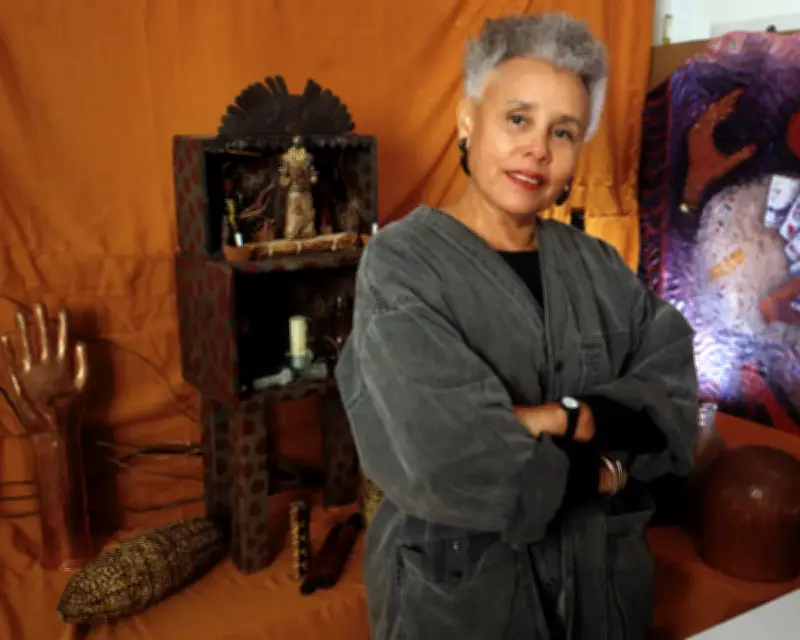
Betye Saar, the celebrated American artist whose assemblages of found objects explored racism, ritual and religion, has died aged 99.
Liberation of Aunt Jemima
In 1972, Saar was invited to take part in a group exhibition of Black artists at the Rainbow Sign community centre in Berkeley, California. She selected a figurine of Aunt Jemima from her collection of kitschy trinkets, placed the mop-carrying breakfast brand character in a glass-fronted box, and added a toy rifle to the other hand. “My intent was to transform a negative, demeaning figure into a positive, empowered woman … a warrior ready to combat servitude and racism,” Saar said. The impact of The Liberation of Aunt Jemima was such that the activist Angela Davis credited it as instrumental in launching the fight for Black female power.
More works appropriating racist imagery followed in the same year. The three-panelled Let Me Entertain You features a Black minstrel playing a banjo, while the second picture shows the same figure superimposed over imagery of lynchings. In the third panel a Black figure holds a gun in the same way as the musical instrument. For I’ve Got Rhythm, Saar took a mechanical metronome in a wooden case and attached a plastic toy skeleton to the needle. On the inside of the instrument’s lid she stuck a newspaper cutting that reads: “Lynched after refusing to dance on white’s command.”

Ritual and religion
Saar’s work dealt as much with ritual and religion as politics, the artist describing herself as a “conjure woman” (a traditional African-American folk healer). She built icons out of found amulets and assembled glass beads, broken necklaces, and scraps of every kind – “a hoarder who found her calling”, Saar joked – and room-sized art installations that doubled as shrines. After seeing examples of African art at the Field Museum in Chicago, in 1977 she travelled to Nigeria and subsequently made trips to Senegal, Brazil and Haiti. “Wherever I go, I say: ‘What’s the alternative religion?’ because every country has it,” she told the Guardian in 2021.
Gris Gris Guardian (1990-93), the title referring to a Voodoo shield against evil, features a miniature painted cabinet, presented like an offering, filled with candles, braided rope, stones, nails, feathers and corn husks; while in Mojotech (1987), charms, amulets and Voodoo symbols were placed alongside printed circuit boards, electronic components and assorted technological detritus to create a vast altar piece.
“The idea of the work, the accumulation of the materials, the putting them together, the sharing of a work are all part of a ritual. This process of objectification is … purification. Once in the world, the artwork can become part of someone else’s ritual,” Saar said.
Early life and influences
She was born in the Watts area of Los Angeles to Jefferson Brown, an administrator at the local YMCA and later an insurance clerk, and Beatrice (nee Parson), a seamstress. The family moved to Pasadena in 1930, but a year later her father died after being struck with uremic poisoning: according to Saar, the delay in getting him to a hospital that accepted Black patients proved fatal. The family went to live with Betye’s great-aunt Hattie, who became a major influence. After Hattie died in 1974, Saar made the beguiling Record for Hattie, a box of the older woman’s jewellery, quilting fabric, sewing pins, a baby picture and a crucifix.
In 1945, Betye enrolled to study art at Pasadena City College. She transferred to a design course at UCLA, followed by postgraduate study in education and printmaking at California State University, Long Beach, from 1958 to 1962.

After leaving City College, Betye became a partner in a homeware company with a friend. Through the business, she met Richard Saar, a ceramicist, whom she married in 1952. A visit to a Joseph Cornell exhibition at the Pasadena Museum of Art in 1967 exposed her to assemblage sculpture. “I saw his work and realised that it was OK to make art out of anything,” she said. In 1968, she took a job as a costume designer at the Inner City Cultural Center, a performance arts venue established after the Watts uprising, the anti-racist riots that had shaken LA three years earlier. “Theatre sets and lighting influenced my later work … I liked a certain kind of theatrical feeling to my installations.”
Later career and legacy
Saar credited Black Girl’s Window (1969) as being the first important work she made, a self-portrait of “my mystic self”. An old window frame holds a variety of images, one per pane: a phrenologist’s map; a lion holding a sun in its mouth; an eagle that bears a shield inscribed “LOVE”. The largest pane shows the artist’s own palms covered with mystical symbols.
In 1970, Saar co-founded the LA art collective Womanspace, alongside artists such as Judy Chicago and Miriam Schapiro; four years later she curated a group show of Black female artists there. In later years, she refused to describe herself as a feminist, saying, “In Black culture, as far as I know, women [always] worked.”
After the Rainbow Sign exhibition, Saar had a solo show at the Berkeley Art Center, exhibiting Black Girl’s Window. Her third solo exhibition followed at California State University, Los Angeles, in 1973. Much of that exhibition, which included paintings of rainbows, stars and moons on scraps of leather, was recreated in the 2017 exhibition Soul of a Nation: Art in the Age of Black Power 1963-1983 at Tate Modern.
Throughout the 1980s and 90s, Saar exhibited regularly, though mostly in smaller regional institutions in the US. Critics noted that for a while her work had lost “its punchy political edge but gained resonance in other areas. Aunt Jemima has given way to beautiful black women in old photographs,” a reference to the found prints Saar exhibited at the Museum of Contemporary Art, Los Angeles, in 1984. By 1998 the old motif was back in Workers and Warriors; The Return of Aunt Jemima, at Michael Rosenfeld Gallery, New York.
In 2005 Saar had her first major retrospective at the University of Michigan Museum of Art, with a second career survey a decade later at the Museum Het Nieuwe Domein in the Netherlands, her first solo exhibition in Europe. In 2016 Betye Saar: Uneasy Dancer was staged at the Fondazione Prada, Milan, and in 2020, the artist’s reputation was sealed with concurrent exhibitions at the Museum of Modern Art, New York, and the Los Angeles County Museum of Art. That year, Quaker Foods North America, a unit of PepsiCo, announced it was retiring the Aunt Jemima branding from its breakfast range. Saar’s first thought was: “Oh, finally.”
Her marriage ended in divorce in 1968. She is survived by three daughters, Alison, Lezley and Tracye, and six grandchildren. Betye Irene Saar, artist, born 30 July 1926; died 26 July 2026.