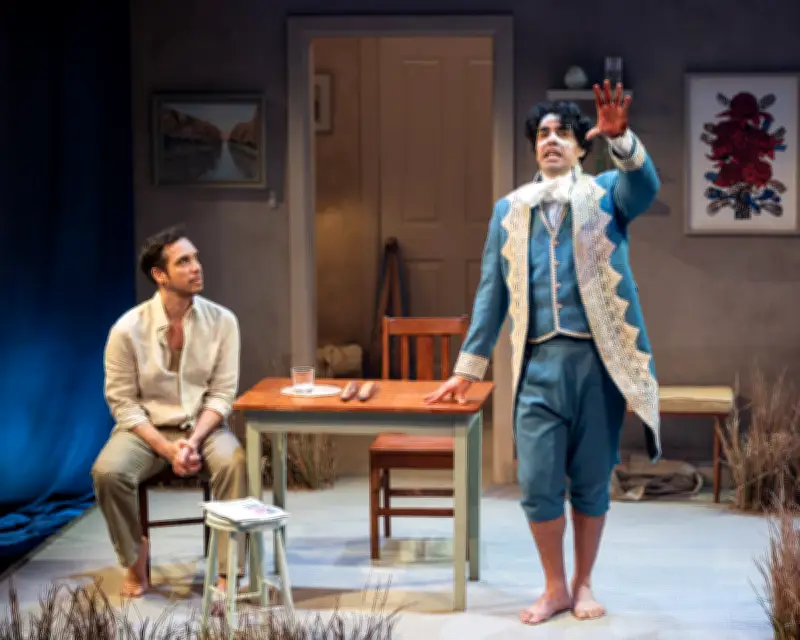
Sydney Theatre Company’s Wharf 1 Theatre hosts Bennelong in London, a play by Jane Harrison that stages a meeting between the Wangal leader Woollarawarre Bennelong and a contemporary actor preparing to play him. The production runs until 16 August.
Framework and characters
Harrison’s play uses a deceptively simple device: Sebastian (Guy Simon), a young actor in present-day Warrane/Sydney, summons the spirit of Bennelong (Googoorewon Knox) into his living room and interrogates him about his character and motivations. The play examines white interpretations of Bennelong’s story and tensions between past and present Blak perspectives, putting Bennelong himself centre stage to highlight the frustrations of not being able to tell one’s own tale.
Bennelong is presented as a complex but comprehensible man—proud, curious, clever, playful—a sophisticated operator in fraught territory. The play does not shy away from his drinking or accounts that he beat Barangaroo; in Bennelong’s words, he is a devil and an angel, but also just a man.
Comedy and staging
The show is very funny, exploiting the comedic potential of the setup and peppering the encounter with jokes about acting and Nida, making the most of both actors’ comedic chops. Ian Michael’s production, designed by Emma White, captures the liminal space between cultures and narratives. The set features a living room seeded with grass, walls decorated with a bark shield, a watercolour landscape, and a collage by Tony Albert that reclaims Aboriginal aesthetics co-opted by Margaret Preston.
Strengths and weaknesses
While Harrison’s framework is clever, it risks too much tell and not enough show. Bennelong and Sebastian’s conversation sometimes feels like a vehicle for exposition, delivering facts at the expense of emotional truth. For instance, Sebastian interrupts Bennelong’s heartbroken story of his wife’s death to mention that her ashes are buried under what is now Circular Quay—a moment that rings false and undercuts the emotion.
Emotional gravitas is also punctured by comedic segues and rushed pacing; as the exchange reaches its climax, the actors seem to sprint rather than let the weight of the words land. However, when the play slows down and tilts away from naturalism, it feels electric. In a sequence near the end, Sebastian “performs” as Bennelong, lighting shifts into a dreamlike register, and the soundtrack swells, merging the perspectives of Bennelong and Sebastian.
Conclusion
Harrison is alive to the challenges of telling Bennelong’s story; Sebastian himself doubts whether any play or performer could pull it off. Within the play, Harrison suggests the effort is as important as the result. As the stage cuts to black, the audience agrees.