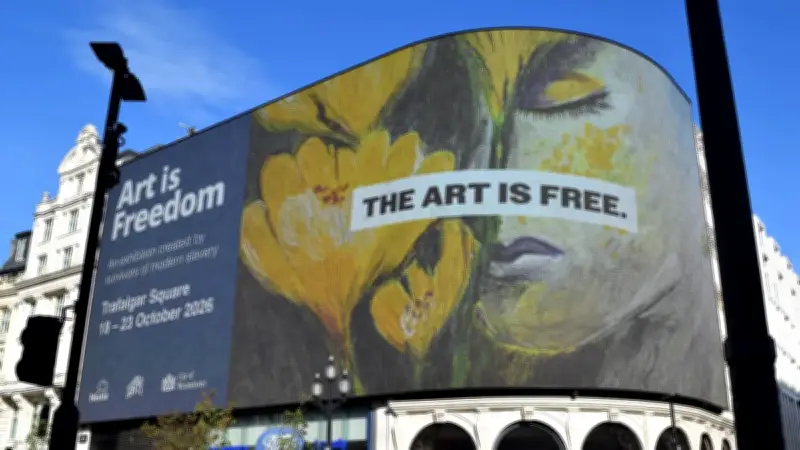
Artwork created by survivors of modern slavery is being displayed across London landmarks this month, in a powerful reminder of the importance of supporting survivors to reclaim their identities after exploitation.
The free exhibition, Art is Freedom, is currently on display in Trafalgar Square until 23 October, before moving to Aldwych until 8 November. It is organised annually by Hestia, a charity that supports people who have experienced crisis and trauma to find safety, hope and purpose, including survivors of modern slavery, which is defined as the exploitation of people for personal or commercial gain through force, coercion, deception or abuse.
Hestia CEO highlights hidden crime
Patrick Ryan, Chief Executive of Hestia, said: “Modern slavery is happening on our streets, often hidden in plain sight. More than 17,500 potential adult victims were referred into the government’s National Referral Mechanism in the last year, the highest annual number on record. Sadly, we know this is just the tip of the iceberg.
“We cannot end modern slavery without the public’s help. But Hestia’s research found that fewer than one in five people would know how to spot the signs. Art is Freedom brings survivors’ voices into some of London’s busiest and most iconic public spaces, encouraging people to stop, engage and recognise that modern slavery is happening in our communities.”
The hidden nature of modern slavery, the extreme psychological control exercised by traffickers, and practical barriers such as the lack of documentation often make it impossible for victims to provide proof of their exploitation, which can result in victims being prevented from accessing life-changing support.
Survivor JR shares his story
One survivor, JR, who has taken part in the exhibition, described his experiences: “I was born in London. When I was four, I was taken from my mother and sent abroad to be used as a slave. I was molested daily, and fed only one meal a day, which left me weak and malnourished. I worked from 8am to 10pm, every day, with no leave. Every single basic Human Rights were stripped away from me and I didn’t have any control over my life. It took me fifty years to find a way to escape and come back to my country.”
Once back, JR found there were new struggles to deal with: “After I arrived back in the UK, I claimed asylum. I first had to prove my identity as I didn’t have my birth documents. I lived in total isolation for seven years and I was struggling with severe mental health problems.”
However, he eventually came across Hestia and their workshops where survivors can create art, which had an incredible impact on his life. “The last time I drew, I was five, and I was bullied into stopping; I thought I had not talent at all,” he said. “Then Hestia called and invited me to the Art is Freedom workshops. They were welcoming, generous, and non-judgemental. I followed the instructor’s guidance and started drawing again after fifty years. I used watercolour and acrylic. I learned to make graffiti, and also joined the music making workshop. I also enjoyed knitting, an artform I’d learned in my teenage years - 40 years ago.
“I found myself through my artwork, which is liberating, and after fifty years, it feels like a rebirth. It took me out of the darkness I was living in. Now I'm a completely new person, with hope and dreams to pursue.”
Exhibition reaches iconic spaces
The Art is Freedom exhibition, which gathers together work from the survivors at these workshops, has already been displayed in London Bridge Station, St Pancras International and, on Anti-Slavery Day, 18 October, the artists’ work was displayed at the Piccadilly Lights for 10 minutes.
The theme for this year was “This is me,” inviting the artist-survivors to explore and celebrate who they are beyond their experiences. Curated by a panel of survivors and the Independent Anti-Slavery Commissioner, Eleanor Lyons, the exhibition highlights both the continuing reality of modern slavery in the UK and the strength, resilience and creativity of those who have experienced it.
Ryan added: “This year’s theme, This is me, was chosen by the artists themselves. Modern slavery is a terrible crime, but a person’s experience of it should never be allowed to define them. Each artist interpreted the theme in their own way, exploring the meaning of freedom, joy, or hope for the future. We call on people to pause and take the time to consider the people and stories behind the artwork.
“Art gives people a way to express things that are difficult to put into words. For survivors, that can be an important part of rebuilding confidence and reclaiming their identity. For the public, art can engage people in a new way with a subject like modern slavery. It helps us see the person behind the statistics, their creativity, their hopes and the human cost of modern slavery.”
For JR, bringing awareness to the issue is absolutely crucial, and he hopes this exhibition is a powerful means to connect and create change. “My captors were child traffickers operating in many European countries. Modern slavery is happening in plain sight in 2026 and it has many different forms like organ farming and sexual exploitation. It’s important that people learn how to clock it and report it – together we can stop this crime. I hope people see that victims of modern slavery are beautiful souls who’ve been through horrible tragedies. If we receive help, we can truly make a positive difference to this country.”
Hoping that Londoners take the time to visit the exhibition, enjoy the remarkable art on display and share the experience on social media to further spread the word, Ryan added: “We also want people to recognise that ending modern slavery requires action from all of us. This means learning to spot the signs and listening to survivors’ voices. By visiting and sharing Art is Freedom, people can help raise awareness of modern slavery; a human rights tragedy taking place on our streets every day.”
For more information on Art is Freedom and the issues discussed, visit Hestia.org. The exhibition is at Trafalgar Square until 23 Oct, and then Aldwych until 8 Nov.