Carrie McLaren, a veteran zine maker, has turned her attention to a topic she calls “bizarre”, disturbing and darkly funny: the tortured relationship between humans and monkeys. It’s all documented in Ape Sh*t, a new zine by McLaren, the longtime writer and designer behind the 90s/early 2000s zine Stay Free!, which covered “the politics and perversions of mass media and American (consumer) culture”. Ape Sh*t’s first issue, The Bizarre History of the Service Monkey, details the rise of a Boston organization that provided “helper monkeys” to people with quadriplegia, as well as the uncomfortable story of organ grinder monkeys, who were often abused into submission.
A Return to Zines
Stay Free! put out its last issue in 2008, around the time when McLaren had a child. But in recent years, McLaren began mulling a return to the zine format. “It was honestly a distraction from all the crazy stuff going on in the country,” she says. “Really what I’m interested in is that kind of human-non-human interaction.”
Initially it seemed very different from covering America’s obsession with consumerism, but eventually McLaren began to see parallels. Both worlds involve power dynamics that are so ingrained that we hardly notice them, a topic she hopes to explore in future issues.
The Helping Hands Story
There is plenty of fascinating weirdness here – enough to fill 70 pages. McLaren, who for years ran a listserv about monkeys with an Onion writer friend, was particularly interested in the media’s presentation of the Boston nonprofit, Helping Hands, as a joyful story.
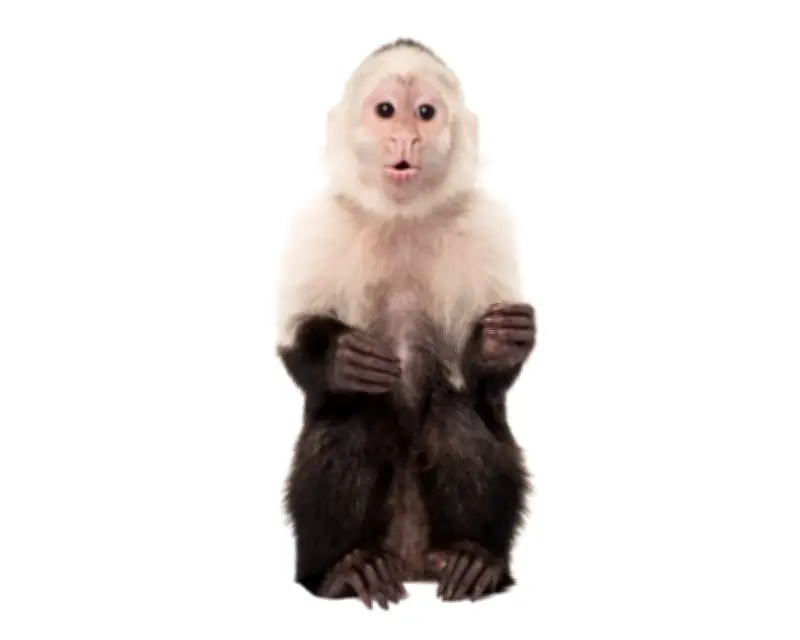
The idea behind Helping Hands, which emerged in the 1970s, was that capuchin monkeys, the small creatures associated with old-timey organ grinders, could assist people with everyday tasks, like picking things up and flipping light switches. The press loved the idea. But for the humans and monkeys involved, things weren’t so simple.
Clients apparently showed limited interest in the monkeys, who were difficult to control and inclined to make messes: in short, McLaren writes, “helper monkeys were not actually helpful”. As for the monkeys, life in a human home seemed a cruel fate. They often lived in small cages, had some of their teeth removed, and were trained using shocks. Yet Helping Hands endured until it rebranded in 2023.
“I was looking for that journalistic piece to say ‘this is a media creation’, and [that article] didn’t exist,” she says. “So I’m like: OK, well, I should write it then.”
That led to Ape Sh*t, whose first issue tells the “messy, complicated” story of the nonprofit’s founding, its struggle to place monkeys, and the adoring international media coverage. The lengthy tale of the organization, which received federal funding, is peppered with interstitial material, including a darkly comic guide to keeping “a terrible idea alive (‘problem: all monkeys bite. Solution: remove their teeth’)” and quotes from past congressional testimony opposing funding for the group: “Many quadriplegics have trachea tubes that are easily accessible to the monkeys,” noted one critic. “In addition, all have urine bags that can be opened by the monkeys. Driving controls on the quadriplegics’ wheelchairs have been used by monkeys to drive their owners into walls.”
Criticism and Response
The zine’s first issue includes an interview with Alison Pascoe, a former monkey trainer at Helping Hands who has become a critic of the organization. She describes the shock treatment used to train the monkeys and her concern that Helping Hands was fueling enthusiasm for keeping monkeys as pets. She discusses how the female monkeys, who would go into heat every month, had to have hysterectomies; a monkey she adopted, Amelia, would “hand me scissors” to push her to remove the bandage from her operation.
In a statement, Envisioning Access, formerly Helping Hands, wrote that it “respects Ms McLaren’s right to her own thoughts and opinions. However, we stand by the deep human-animal bonds that we have witnessed over almost half a century between recipients and their service monkeys.” The organization added that it recognized “that what was considered acceptable care for primates in the 1970s and 80s has evolved over the decades as we have learned more about these amazing animals.
“This is one of many reasons why the last monkey was born into our program in 1999, and why we are committed to the support and care of every monkey in the program through their natural lifetime.”
Organ Grinders and Monkey Mischief
The zine also explores the history of organ grinders in a series of blurbs and pictures. Monkeys, McLaren writes, would often bite the impoverished children who gave them coins. They’d also climb buildings, leading to accidents including when “a man in Newark accidentally shot a neighbor when trying to gun down a monkey climbing a building”; in other cases, kids fell out windows trying to hand pennies to the monkeys.
An excerpt from an interview with an organ grinder trainer describes how to “break the monkey’s spirit by rendering it entirely helpless” using “ropes or gags … a state of weakness and depression ensues, all resistance ceases.” A “switch” is also “brought into play”. Organ grinders “ordinarily” kill five to ten monkeys before finding one who can endure the lifestyle, according to the excerpt.
Sometimes, they get revenge. A 1952 account describes Gloria the capuchin punishing her owner for a long absence by unlocking a bookcase, taking all the pages out of a pair of books, and dumping them in a fish tank. In 2007, a New York Times story described a monkey named Oliver repeatedly breaking out of a cage at a Mississippi zoo; it took him 20 minutes to evade “$300 worth of new locks”. In 2001, the Chicago Tribune described a monkey who would “grab perfume bottles and empty them into his hands and rub all over himself”. He also enjoyed running around with a knife and waving it in a kid’s face.
But it’s not all mayhem and cruelty. The zine closes with a palate cleanser focused on capuchins in the wild, including research on their behavior and photography.
Inspiration and Future Plans
McLaren became interested in the relationship between humans and monkeys after stumbling on a book at a thrift shop by Leonard Williams, founder of a celebrated monkey sanctuary in Cornwall, southwestern England, about his interactions with the animals. Her interest in the topic led to the listserv and later to researching the history of pet monkeys and Helping Hands.
Ape Sh*t’s text and layout are almost entirely McLaren’s, though several friends helped with the editing process, including collaborators from her 90s zine. Of course, things have changed since then, when a 1,000-copy print run would sell out immediately. “People aren’t used to going picking up a paper artifact and thumbing through that,” she says.
Still, small, homemade zines are “alive and well”. “I follow the zines subreddit, and there’s just so many creative, amazing zines that people are doing,” McLaren says. She’s also planning to put new effort into a digital format, beyond a simple PDF. And while this is by no means a full-time job, she hopes that the user-friendly approach to telling a story can serve as a classroom teaching tool, as was the case with her earlier work. “I try to use humor and clear language to express complex ideas,” she says – in this case, our species’ strange relationship with some of our closest relatives.
McLaren acknowledges that “animal rights is a dirty word” in America. “There’s an assumption that if you want to advocate for animals, that you’re some kind of crazy person who’s gonna throw a bucket of blood on everyone,” she says. But “part of the fun” of writing Ape Sh*t is “trying to look at ways that animals – monkeys and apes specifically – have tried to communicate to us that they are individuals, that they are beings with perspective”. Ape Sh*t is available to order now.