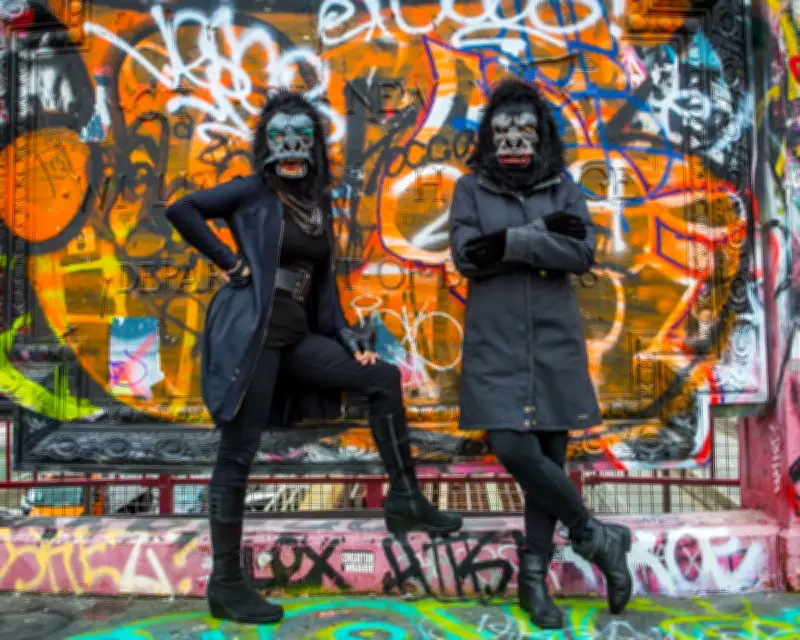
This week, a Guerrilla Girl made headlines by choosing to unmask herself on her own terms. She is 83-year-old artist Joyce Kozloff, who had used the codename Liubov Popova within the collective.
“I’d had a pact with another Girl that whoever died first, the survivor would bring her out,” said Kozloff. “But I suddenly realised that if I were dead, I couldn’t tell the story my way.”
The origins of the gorilla masks
In 1985, an anonymous group of women disguised in gorilla masks burst on to the New York art scene. At night, the Guerrilla Girls, as they named themselves, fly-posted around the city with funny, eye-catching posters highlighting gender and racial biases in museums and galleries. One now-famous poster asked: “Do women have to be naked to get into the Met. Museum?”
A founding member explained the group’s commitment to anonymity in an interview for their 1995 book: “Of course, we were afraid that if we blew the whistle on some of [the art world’s] most powerful people, we could kiss off our art careers. But mainly, we wanted the focus to be on the issues, not on our personalities or our own work.”
The collective is still active; 55 members have come and gone over the years. When giving interviews, members use pseudonyms borrowed from dead women artists: Frida Kahlo, Lee Krasner, Käthe Kollwitz. Only a handful of their true identities have been revealed over the years, mostly after their deaths or due to lawsuits.
Anonymity as self-protection
Anonymity isn’t a straightforward route for artists, especially now in a media culture ruled by the twin cults of celebrity and personal identity. Yet many visual artists, writers, musicians and film-makers have opted for the cloak of anonymity. Often, there’s an element of self-protection.
The anonymous author known as the Secret Barrister, who started blogging in 2015 to shed light on the legal system, has said that their hidden identity keeps them safe. “Put simply, anonymity buys me the ability to speak plainly, frankly and without fear or favour about the problems that I see in the criminal justice system,” they wrote.
When Banksy first picked up spray paints in the early 1990s, he was just another Bristol street artist using an alias to avoid legal trouble. These days, his acts of vandalism are unlikely to be prosecuted, given that an original Banksy is far more valuable than any property it may have defaced.
Letting the work speak
Others just want to focus on the work. For Elena Ferrante, the bestselling novelist behind the “Neapolitan quartet”, using a pen name was initially a way to deal with shyness but evolved into a crucial dimension of her practice. “Anonymity lets me concentrate exclusively on my writing,” she has said.
The French electronic duo Daft Punk never hid their names – Thomas Bangalter and Guy-Manuel de Homem-Christo – but they concealed their appearances with robot costumes for performances and press; in some early instances, a cloth bag over the heads. “One thing I like about the masks is that I don’t have people constantly coming up to me and reminding me what I do,” Bangalter once said. “It’s nice to be able to forget, but there are occasional downsides. Several years ago in Ibiza some guy ran up exorbitant bar tabs at clubs while claiming to be me.”
Some have more niche motivations for staying under the radar. In 1968, the Directors Guild of America introduced the pseudonym “Alan Smithee” as an alternative credit for any director who wished to disown one of their own films. This was usually because the artist felt that others had meddled to the extent that they did not have creative control over the final product, though the pseudonym itself became too notorious and has since been officially retired. A few high-profile authors including JK Rowling and Stephen King have published books under a different name in an attempt to avoid market oversaturation, or to see whether their success is just down to hype. In Rowling’s case, she would have already been used to having a pen name: the initials “JK” were suggested by her Harry Potter publishers – she doesn’t actually have a middle name – because they feared young boys wouldn’t knowingly buy a fantasy book by a woman writer.
The power of mystery
Then there’s the aura of mystery. It may seem counterintuitive, but anonymity can be a useful strategy to get everybody talking about you, particularly in this age of oversharing and content overload. People become desperate to figure out who you are. On a practical level, it’s nearly impossible to conduct your business nowadays without sharing personal data – unless you’re willing to be paid only in crypto. More than once, I’ve been told by someone in a given industry that of course they know who XYZ is.
A decade ago, an investigative journalist put forward a convincing, though unconfirmed, case identifying Ferrante as literary translator Anita Raja. Earlier this year, an in-depth Reuters investigation seemed to definitively confirm past reports that Banksy is a 50-something-year-old man called Robin Gunningham. Celebrities’ pseudonyms also rarely survive for long. The debut novel in the Cormoran Strike series by “Robert Galbraith” had barely sold 1,500 copies when Rowling’s authorship was leaked by a lawyer.
A joke that made a point
It was people’s incessant curiosity that in 1990 inspired the Guerrilla Girls to put out a new poster with the headline “GUERRILLA GIRLS’ IDENTITIES EXPOSED!” The work featured 10 columns with over 500 names of women involved in the art world at the time, concluding with the line “AND MANY MORE……..” This was obviously a joke, as it would have been impossible for so many to be involved, although each of the since-confirmed members are on there. But what a clever way to live up to the group’s original raison-d’être: by calling attention to the countless under-recognised women who have, in fact, wanted to make a name for themselves.