A clutch of children, one proudly astride a bike. Their clothes, bell-bottom jeans, a tartan skirt, and knee-high white socks are tell-tale signs of the era. The image was taken in a terraced street in Lower Broughton in 1970.
Two decades earlier in 1951 a little girl on a mission strides with purpose across the cobbled road to the ice cream shop in Grecian Street. Two young lads, the best of friends, are on Woden Street in 1929. They are well-booted and one has an arm around the other as the magic of childhood shines through.
In Princess Park in Irlam in the 1960s, before they were filled in on health and safety grounds, kids splash in the paddling pool. In Mandley Park in 1978 a solitary lad flies through the air on a rope strapped to a tree.
Images of children at play are just one theme among 100 photographs which make up a glorious exhibition to mark Salford's centenary as a city.
The collection has been chosen by the public from a digital archive of 30,000 images of the city. All of life is touched on - work, play, the sweeping away of terraced homes to be replaced by high rise blocks, theatres, pubs, royal visits, and once bustling docks. The oldest image dates from 1857.
A Community's Memories
Cath Stanley, a photography teacher at Pendleton College, was one of five people who chose the Lower Broughton picture. She said: "My mum, my brother and I moved to Salford in 1980 when I was four years old. This photograph brings vivid memories of my childhood, time spent outdoors much like this group of children on Watson Street."
"Summer holidays, sunny weekends and evenings spent out on the street carefree with our friends riding around on our second hand orange chopper bike. Siblings and friendship groups all together, the street, our playground."
"Brick walls were for climbing, the petals from rose bushes mixed in water to make perfume and mud mixed with water made thumb pots. Outside play only stopped if we were called back in for tea or if my brother ended up coming off the bike after trying to perform some kind of stunt in which one of our neighbours usually ended up bringing him and the bike home."
A picture of three boys taken in Broughton in Hill Street in the 1950s charmed Astrid Booth, an A-level student in photography at Pendleton College. She said: "Where we stayed young a little longer. Three young boys stand on a cobbled street, their faces bright with unfiltered happiness. Their clothes feel almost formal by today's standards, yet their expressions resist that neatness, they're young and carefree."
"One grips an umbrella like a small toy, while the other two seem distracted, but unmistakably caught in the moment of play. The black and white colour of the photograph draws attention to texture: worn brick, rough cobbles, the closeness of buildings leaning into shared space. It strips everything back, leaving connection at the centre of the image. There is something quietly moving here. Decades pass, streets change, but this moment holds."
"Brotherhood, or friendship, is shown clearly without colour, carried in shared moments and the simple act of being young together."
Then and Now
A drive to the Grade I Ordsall Hall where the exhibition is being staged is via a corridor of new apartment blocks from Lower Broughton Road, along Silk Street, Oldfield Road, and Ordsall Lane. On that route are billboards for thousands more high rise homes which have been approved: "The Crescent" and "Regent Plaza" plus 3,000 are to be built off Regent Road when a retail unit is bulldozed.
The ambience on the drive is one of slick and soulless. The cranes which have dominated Manchester city centre skyline for years have crossed the Irwell.
The exhibition captures aspects of the city which have vanished but also the essence of what it is to be a Salfordian.
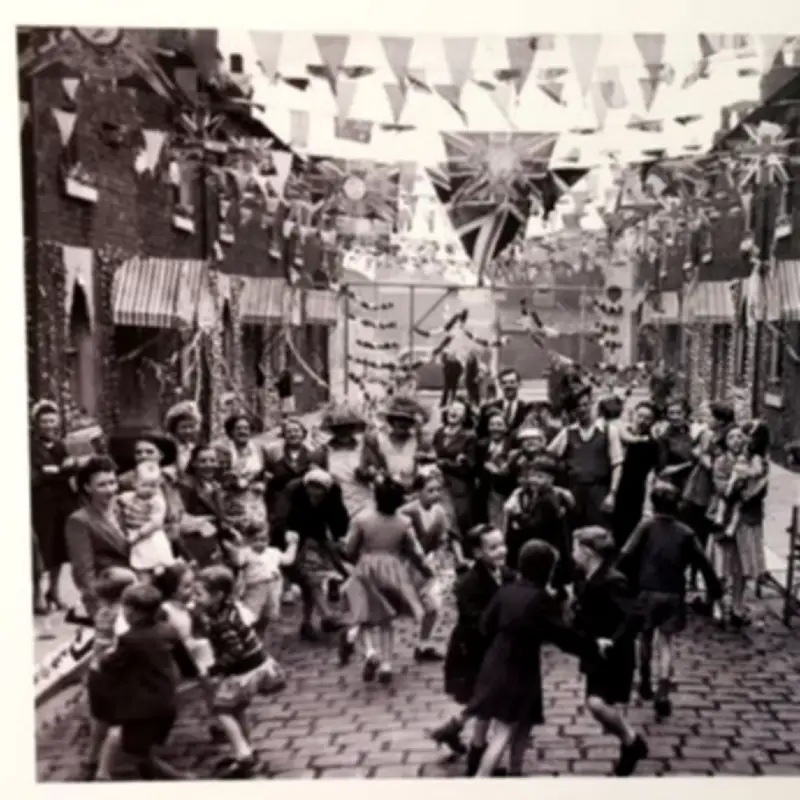
A 1953 picture of a raucous party outside in Stafford Street was chosen by several people. Pam Packard, an art and craft tutor based in Monton, was one. She said: "This image evokes the sense of pride in a community, it doesn't matter why this street got together to celebrate, all ages, no cares in the world, together."
"This neighbourhood knew each other's names, families grew up together, lives were shared. You see it all here in their faces and how they are connected with each other. Society has lost so much of this sense of togetherness, this image makes me realise how disconnected we have become. Humans are meant to be connected, being part of something bigger than ourselves is meaningful. There is a quiet ache that settles into places where community once thrived."
Taylor Mitchell commented: "Immediately looking at this photo you can sense the joy and community of people coming together on their street. To me, this is the charm of terrace houses. While often overlooked as just a style of house, they are such a uniquely British form of architecture that tells so many stories, like in this photo."
"We're seeing people be outside on what looks like a nice day, laughing, having fun, and overall celebrating being together. Each face tells a story in this image, just as how I view the terrace houses, filled with so many generations and stories that often we don't know and can be overlooked, but always providing togetherness."
Wildlife and Work
Wild stock also features. One Sunday morning in 1960 in Cross Lane, Salford, a herd of sheep cross the road. Polly Pig belonged to the Cock Hotel Worsley and was famed for drinking beer and being mother to over 200 piglets. She died in 1904.
Shire horses worked on farms and pulled trams. A 1940s picture shows workers in the fields at Chat Moss. It was chosen by Naomi Lewis, who said: "Salford may be known as an urban, industrial place, but it has its share of rural spaces too, including the Chat Moss area to the west of the city."
"Chat Moss was home to a thriving farming community from the 19th century, growing amazing vegetables in the rich peat that were sold across the country. The moss lands of Irlam and Cadishead were designated as a National Nature Reserve in 2025 due to their biodiversity and carbon storage. I love the sense of community endeavour in this photograph."
Amy Brunn, manager of the event, said: "It opens on June 14th and is on for a full year. My favourite picture is of a goat. It shows the animal with three children in Buile Hill Park's petting farm, which it once had. I love visiting a pets corner especially if there's a goat! I think the joy you can get from being able to interact with animals, especially at a young age, is magical."
"We had an exhibition at Salford Museum and Art Gallery of 100 different subjects selected from its collection by local people. As a follow on from that we decided to do the same thing with the film archive. They are all owned by the Salford Local History Library but have come from family albums, newspapers, and photographic studios."
A Historic Photograph
The earliest is of a tree-lined Whit Lane from 1857. It was taken as a result of a court case. In 1845 Peter Spence took out a patent on the alum process that he had accidentally discovered. To get cheaper supplies of fuel he established works at Pendleton; further patent in 1850. Soon became the leading manufacturer of alum.
In 1857 a lawsuit was taken out against the company due to nuisance caused by emissions resulted in moving the works away from Pendleton. The factory had been emitting toxic waste products such as hydrogen sulphide and sulphuric acid.
The Manchester photographers James Mudd and his brother Robert Mudd were commissioned to take photographs as evidence. The Mudd photographs highlighted the outline of trees stripped of their foliage, while the chimneys of the Alum works lurked in the background.
The jury returned a verdict of guilty on the charge of the Pendleton Alum Works causing a nuisance, but declared as not proven the charge that the nuisance was injurious to health. The Pendleton works were closed down, and the business removed to Newton Heath.
Pride in Terraced Homes
Thousands were destined to be bulldozed in huge clearance schemes. But the humble terraced house was for many Salfordians a source of pride. A 1963 image shows a woman kneeling on an otherwise empty Cromwell Road. Sam Kelly, chair of the Save Victoria Theatre Trust, chose it. She said: "If you look closely, you can see a woman kneeling on the pavement scrubbing her steps."
"When they demolished Salford they broke the continuity of how people lived and looked after each other and the community, and this photo for me sums up how people looked after our city before we were disinherited by the demolition and our community networks were destroyed."
"I remember women using red stones on their doorsteps and constantly washing the windows in their battle against the soot and grime. People were very house proud when I was a child and were invested in looking after their council houses. It was the privately owned housing stock that wasn't maintained by the landlords that were slums."
In their place came tower blocks like Arthur Millwood Court as part of the redevelopment of the Islington district. Victoria Howarth said: "This photograph is of Arthur Millwood Court being built, where I lived with my then boyfriend, between 1995 and 1999. One year, some local kids used mattresses to make a fort on the waste ground in front of the building and were lobbing potatoes at each other."
Cultural Highlights
A scene in Risdale Street evokes memories of Dora Bryan as the Helen in the film version of A Taste of Honey, adapted from Shelagh Delaney's groundbreaking play based in Salford. Taylor Mitchell commented: "I love the quiet street with the unexpectedness of the women leaving their home in the corner of the image all dressed up ready to go somewhere. There's only one car on the street, no one else seen, and the house across the street has a window boarded up but the women are fashionable, hair done, going about their day. This reminds me of the power of going out with your female friends, no matter the occasion, that even in an image when it seems quiet and alone, you still have each other and the day ahead."
Before The Lowry arts centre opened in 2000 the city already had a place where acting talent thrived. Salford Players Theatre opened in 1976 set back from Liverpool Street. Julie Kay, a proud Salfordian and library volunteer, said: "This is Salford Arts Theatre officially opened 6th September 1976 - celebrating its 50th birthday this year. The theatre opened as The Salford Players Theatre and was associated with actors such as Robert Powell, Sir Ben Kingsley, Albert Finney and Christopher Eccleston to name a few!"
"To celebrate its 50th anniversary there will be a production of Landscape with Chimneys, written by Ewan MacColl in 1949 - where the song Dirty Old Town came from. The theatre is now owned and run by Roni and Scott who have been there for many years and is the hub of the community."
"It has numerous activities going on including Crafts Made by You a community craft group run by and for the local people. There are also creative writing groups where participants can get involved in writing and/or performing. It's a great place, run by lovely people, lots of events."
Guardian of History
Duncan McCormick of Salford's Local History Museum is the guardian of the city's photography collection. He said: "We have around 70,000 images in the collection and some 30,000 have been digitised and are online at Digital Salford."
"The oldest photos we have would be the James Mudd images of the Regina V Spence court case, one is in the exhibition, but there are 11 plates. My favourite is this one. It's of two street sweepers on Hankinson Street in 1958. It just says so much of a different time: the sweepers (no idea who they are), the brickwork, the net curtains."
Kate Henderson chose a visit by Princess Anne. "It captures the Quays mid-transformation. A century earlier Queen Victoria opened the Manchester Ship Canal, heralding Salford's industrial story. But by 1982 the docks were silent."
"This royal visit feels like a moment from a fairytale: a princess arriving as the landscape begins to transform and I am also part of that story. I designed a public garden for a site within the photograph, inspired by 'The Ugly Duckling', a tale about unexpected beauty emerging through time. Urban regeneration reminds me of that. The Quays, previously defined by industry and neglect, have evolved into thriving Mediacity. This image reminds us that landscapes, like swans, can with time and care, change and flourish."
Her observations are so true. The Salford which I first walked when sent to the city as district reporter for the Manchester Evening News in 1988 was physically a harsh place in desperate need of regeneration. That has arrived and not without controversy. A city cannot stand still but its history should be as cherished.
Dark, gloomy clouds dominate another image of the docks taken in 1989 when the transformation began. Two blue cranes stand idle over still largely wasteland. The last two of the iconic, one-legged blue giants, weighing 140 tonnes each, they had been bought by the council in 1987 for £10,000. The town hall spent another £28,000 refurbishing them before moving them to the end of Ontario Basin as a monument to the Quays' history. But 25 years later, rusting and unstable, council officers recommended they were dismantled for scrap.
In October 2013, they were finally torn down, triggering a backlash against the then mayor Ian Stewart for allowing a mammoth piece of heritage to bite the dust. The image was chosen by Salford resident Rose. "Great grandfather and grandfather both worked as labourers at Salford Docks. My great grandfather around 1913 and I know my grandfather was still working at the docks as the night watchman at the dock gates in early 1970's."
My own favourite picture in the exhibition is of a steam train pulling freight through the tiny station of Roe Green, near Worsley in the 1960s. Black smoke from the engine dominates the sky as it moves past a junction box. My grandfather, Alexander, was a stoker on steam trains in the Black Country. My son, Patrick, now lives with his family in Roe Green.
Paul Hassall, Salford Local History Library volunteer, chose it too. He said: "I have lived in Roe Green all my life and this image brings back childhood memories. I have faint memories as a young child of catching the train at Worsley station, but also of my sleep being disturbed by passing trains. Roe Green Junction was an important one and Sanderson Sidings was nearby. After the closure of the railway the disused line became an excellent playground and now is a well-used walkway."
The exhibition runs until May 2027 at Ordsall Hall.