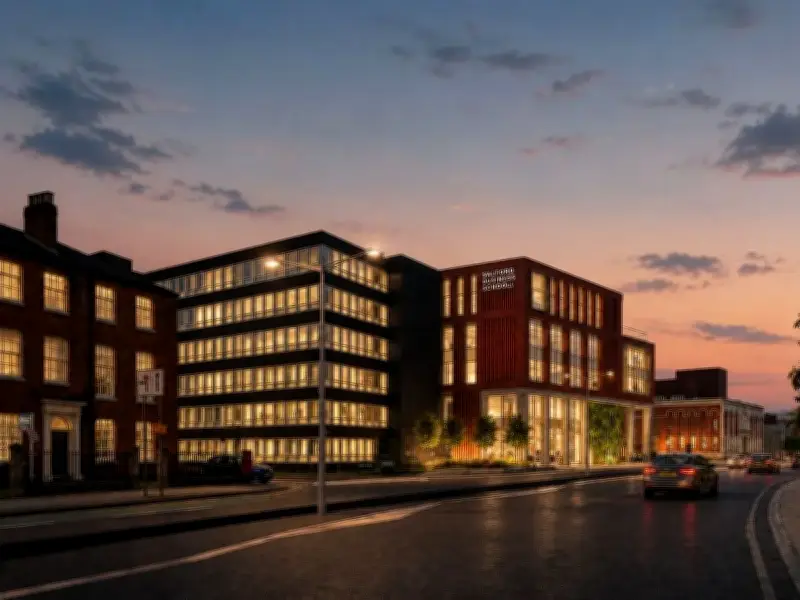
Salford University has submitted a planning application to demolish its former Humanities building on The Crescent to make way for a new purpose-built business school.
The concrete 1960s structure, known as Crescent House at 43-44 The Crescent, once housed the university's Humanities, Languages, and Social Sciences department and more recently administrative offices. It could now be flattened to provide a new teaching facility for the rapidly expanding Salford Business School (SBS).
Why the Current Facilities Are No Longer Suitable
A planning statement said: "In recent years, Salford Business School (SBS) has undergone a period of sustained growth, rendering its current configuration as no longer fit for purpose. Current facilities are dispersed within shared buildings and lack key amenities, such as cafes, lobbies, and storage."
The statement added: "The new purpose-built Business School will provide modern, fit-for-purpose teaching facilities for students, together with a new area of enhanced public realm, providing an attractive landscaped space for students, staff and visitors."
Plans for the New Building
The plans include 7,319 square metres of new educational space, roughly equivalent to one football field, along with a cafe and a small landscaped public realm. The ground floor would feature an open-plan 'knowledge exchange' workspace and two 40-person seminar rooms separated by a movable partition that can be combined into a larger event space with an overall capacity of 144 people.
A bleacher-style 'learning stair' would rise from the ground to the first floor, providing stepped seating or space for informal events. On the upper level, a series of 40-person seminar rooms would be arranged along the eastern side, alongside study areas.
Vehicles would access the site via a single-lane, one-way road that circulates anticlockwise around the building before exiting onto The Crescent to the east. To the north of the site, there would be electric vehicle charging points and six parking bays.
The project is part of the £2.5bn, 240-acre English Cities Fund regeneration project currently transforming the area around the university.