Homelessness in Wales has increased sharply over the past decade, driven by socio-economic pressures and a lack of house building. This has occurred under successive Labour-led Welsh governments despite ministerial statements and legislative efforts.
Plaid Cymru has now taken on responsibility for the issue after winning the May Senedd election, although without a majority in the chamber. The party has pledged to accelerate delivery of social homes over the next Senedd term, keep people out of unsuitable temporary accommodation, reduce housing waiting lists, and make housing more affordable.
North Wales Live examined the latest statistics on homelessness to assess the current situation.
Temporary accommodation numbers
From April 2023 there was a gradual increase in the number of individuals in temporary accommodation, reaching a peak of 11,721 in February 2024. Since then, numbers have decreased and are now slightly below the level seen in April 2023.
On 31 July 2026, 10,535 individuals were in temporary accommodation, which is lower than the number recorded during July in each of the last three years. Of these, 2,386 were dependent children aged under 16, also lower than the number recorded during July in each of the last three years. The number of dependent children in temporary accommodation has remained relatively stable and below 2,500 since November 2025.
Where people are living
The largest number of homeless individuals were living in temporary local authority stock (2,613), only marginally ahead of those in bed and breakfast accommodation and hotels at 2,539. A significant number were in hostels (1,954) and private sector accommodation (1,952), with smaller numbers in refuges or caravans.
Local authorities have struggled to move people into permanent homes, leading to longer stays in hostels, hotels and B&B environments that can be highly traumatising.
The previous Welsh Government passed the Homelessness and Social Housing Allocation (Wales) Act 2026 shortly before the end of the last Senedd term. The Act commits local authorities and other public bodies to scale up homelessness interventions and phase out the use of B&Bs and hotels, which are often unsuitable and expensive.
Breaking the cycle
Since April 2023, the number of homeless individuals moved into suitable long-term accommodation has fluctuated between roughly 600 and just over 900 each month, without a consistent trend. For children under 16, numbers have ranged from roughly 180 to just over 300.
In July 2026, 791 homeless individuals were moved into suitable long-term accommodation, lower than the figure recorded in July 2025 and July 2024 but higher than that recorded in July 2023. Of these, 236 were dependent children aged under 16, lower than the figure recorded during July in each of the last three years.
In July 2026, there were 1,407 placements of homeless individuals into temporary accommodation. Most resulted from individuals being moved from unsuitable accommodation (582 placements). There were also around 140 prison leavers needing accommodation and 120 who had been 'sofa surfing', with around 70 individuals moved off the street.
Rough sleeping figures
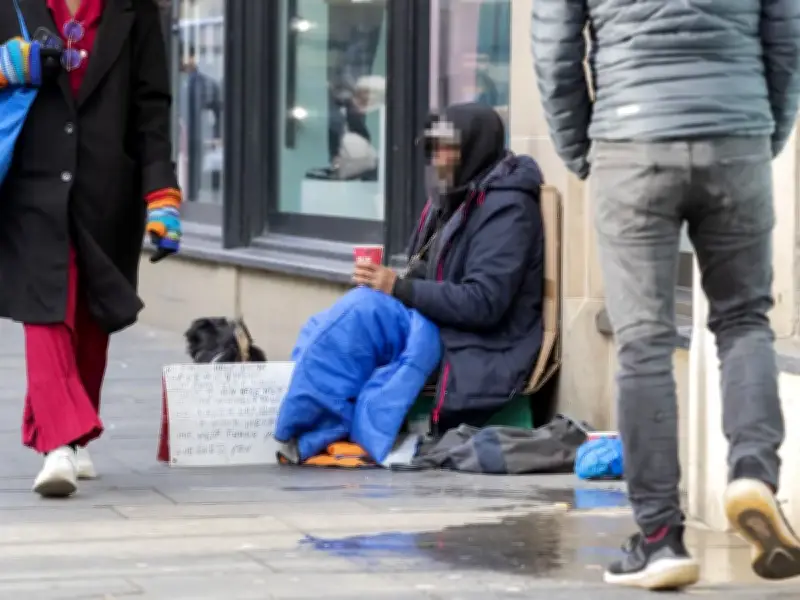
Many of those classed as homeless are not visible to most people in Wales, as they are off the streets even if not in suitable accommodation. However, smaller numbers have no accommodation at all, visible in town centres across the country.
Officially, on 31 July 2026, 155 individuals were estimated to be sleeping rough, lower than the number recorded on 31 July in each of the last three years. Numbers peaked at 204 in August 2024. The majority of local authorities reported eight or fewer individuals sleeping rough, with three local authorities reporting zero.
Homeless charities say official statistics are widely considered to be an undercount of the true number of people sleeping rough.
The future
The Welsh Government appointed Siân Gwenllian as cabinet minister for local government, housing and planning. She said the Welsh Government is committed to supporting the delivery of 20,000 additional social homes by 2030, ensuring they are of high quality and energy efficient.
The minister has confirmed plans to establish Unnos, the arm's length housebuilding agency proposed in Plaid Cymru's pre-election manifesto.
She said: "I am clear that this target will focus on delivering genuinely affordable homes that remain accessible to communities over the long term. It will therefore be limited to homes for social rent and intermediate rent where affordability is secured in perpetuity. This includes homes, that fall under those categories, that are delivered by community-led housing projects."
The minister says this forms part of wider action to increase the supply of social housing and reduce reliance on temporary accommodation that is unfit for long-term living. As with previous Welsh Governments, the challenge will be delivering on these pledges, and the Government's success or failure will be judged on how these numbers look in years to come.