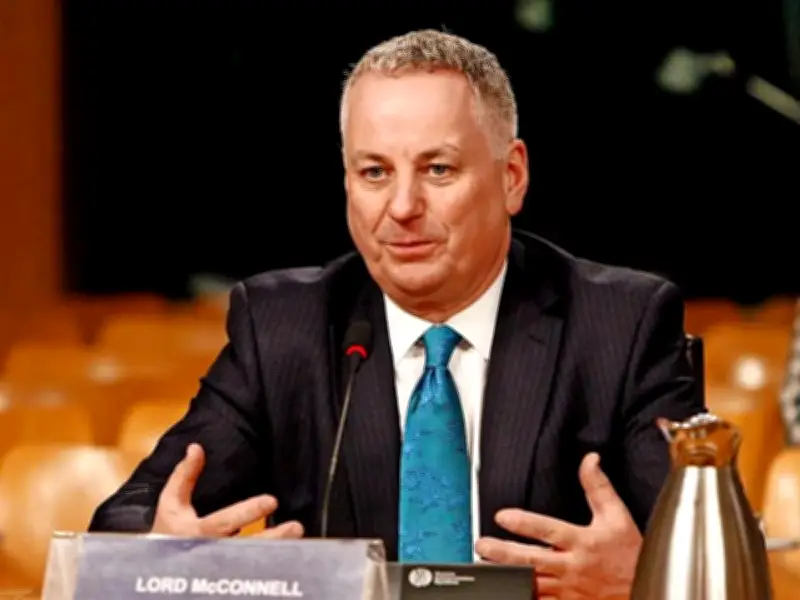
Former first minister Jack McConnell has accused the SNP of ignoring 20 years of repeated warnings that school curriculum reforms were being disastrously botched. The Labour peer and ex-maths teacher slammed the “shameful” decline in Scottish education standards which were once considered to be among the best in the world.
In an interview with the Sunday Mail, Lord McConnell said Nationalist ministers had turned the Curriculum for Excellence – which his Labour government devised prior to losing office in 2007 – into a “wishy-washy mash”. It comes after a recent Programme for International Student Assessment (PISA) report showed Scotland’s secondary schools are behind England’s on reading, maths and science.
‘Disastrous decisions’
McConnell, who was education minister before serving as FM from 2001-2007, said: “Successive Scottish Government education ministers have made disastrous decisions on this, turning the initial concept, which was of ambition and excellence, into a sort of wishy-washy mash.”
“They got it wrong right away, and I warned them privately at the time that they were implementing this in the wrong way. They didn’t listen and at every stage, experts have warned them they are going in the wrong direction, and we see today the impact in the results.”
“Twenty years ago, it would have been unbelievable that the English education system would be demonstrably better than the Scottish education system. We should be ashamed of that especially given the history of Scottish education. This is a potential disaster for young Scots and parents should be furious about it.”
Two strains of thought
McConnell said it became clear to him in 2007, during the election which he narrowly lost to Alex Salmond’s SNP, that there were “two emerging strains of thought” on how to implement the new curriculum which came in from 2010.
He said: “One of the strains of thought, which was what we wanted and had a lot of support for, was more autonomy, more excellence, more ambition, more specialisation, more flexibility between the years, closer working with colleges for those that weren’t as academic and so on. Then there was another strain of thought, which was to effectively dumb down the curriculum and the level of knowledge in the curriculum.”
“I was deeply worried about that strain of thought. We had made a conscious decision we were not going down that road. But I think Scottish Government education ministers fell for it after 2007. And we’ve seen a progression over the last nearly 20 years that has led to this crisis in Scottish classrooms today. It makes me very angry.”
Priority for schools
He welcomed a commitment last month by Michael Marra, Scottish Labour’s new leader, to make fixing schools his “foundational priority”, saying he “punched the air” when he heard the remarks.
McConnell, who is also Chancellor of Stirling University, added: “I am delighted we have a senior politician now prepared to say that this should be our number one priority. We need to inject the learning of knowledge as a basic back into the curriculum. We need to get a fresh injection of interest in Maths and English.”
“The numbers of young people studying mathematics and taking basic Maths qualifications is at a disastrously low level for the country as well as for them personally. To pile on top of that the crisis in our colleges, the fact that our universities are struggling to compete because of an unsustainable financial package, then I think we’ve got some really serious problems.”
Education Secretary Mairi McAllan – who has pledged the biggest curriculum reforms since CfE was launched – said this year’s exam results showed “rising attainment across the board”. She said: “We are determined to continuously drive improvement in Scottish education – raising standards, empowering schools and reducing variation across council areas and schools. There is a great deal to be proud of already.”
Recent statistics show the number of young people in work, training or study nine months after leaving school is at a joint record high and record numbers of young people are being accepted into university. This includes a record number from our most deprived backgrounds. But McAllan added: “I am also clear-eyed about the need for change and for excellence. As well as developing a new curriculum and creating phone-free learning environments across Scotland, we’re seizing the opportunity provided by the public service reform agenda to drive excellence and equity.”