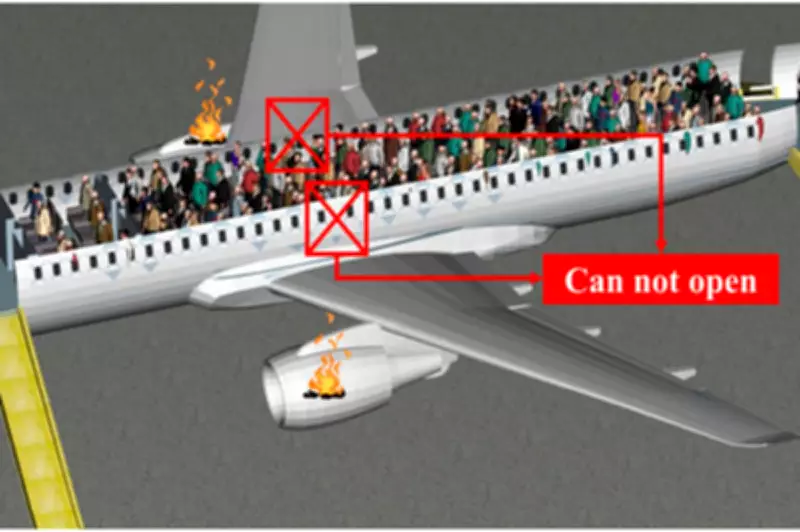
A new study has identified the most effective strategy for evacuating passengers from an aircraft during an emergency, particularly when a significant number of elderly individuals are on board. The research suggests that an even distribution of older passengers throughout the cabin, especially near exits, is crucial for minimizing evacuation time.
Evacuation Time Challenge
Aviation authorities typically mandate that all passengers must be able to evacuate and reach the ground within 90 seconds during an emergency. However, the increasing proportion of elderly airline passengers presents a growing challenge to meeting this requirement. Previous studies have indicated that cognitive decline in older individuals can impair situational awareness and delay decision-making during stressful evacuations. Additionally, reduced dexterity can be exacerbated under high-pressure conditions.
Simulation Study
In the new research, scientists simulated 27 different evacuation scenarios for a dual-engine fire on an Airbus A320, one of the most common narrow-body aircraft worldwide. They compared three cabin layouts with varying ratios of passengers aged over 60 and different distributions of these passengers. The simulations revealed that the fastest evacuation for a layout with 152 passengers, including 30 elderly individuals, occurred when the elderly were evenly distributed throughout the cabin.

Even with this optimal arrangement, the evacuation took 141 seconds for all passengers to reach the ground—significantly longer than the recommended 90-second benchmark. Researchers from the University of Sydney and other institutions noted that higher proportions of elderly passengers and poor seating arrangements led to longer evacuation times and uneven usage of exits.
Methodology
The team created full-scale computer-aided design models of the Airbus A320 cabin and used Pathfinder, an industry-standard evacuation modeling software, to simulate passenger behavior during a double-engine failure. While such an event is statistically rare, it falls under the category of critical emergencies that have occurred historically, such as the famous 'Miracle on the Hudson' involving Captain Chesley 'Sully' Sullenberger, who landed a commercial airliner on the Hudson River over a decade ago.
Implications for Airlines
The findings suggest that airlines could improve safety by offering additional safety briefings to elderly passengers and strategically seating them to optimize evacuation flow. Lead author Chenyang (Luca) Zhang emphasized that understanding how passenger distribution affects evacuation could help airlines proactively mitigate risks without compromising operational efficiency. Future studies aim to incorporate the behavior of children, infants, and pregnant women to further refine evacuation models.