Uruguay's Controversial Nazi Eagle: A WWII Relic Sparks National Debate
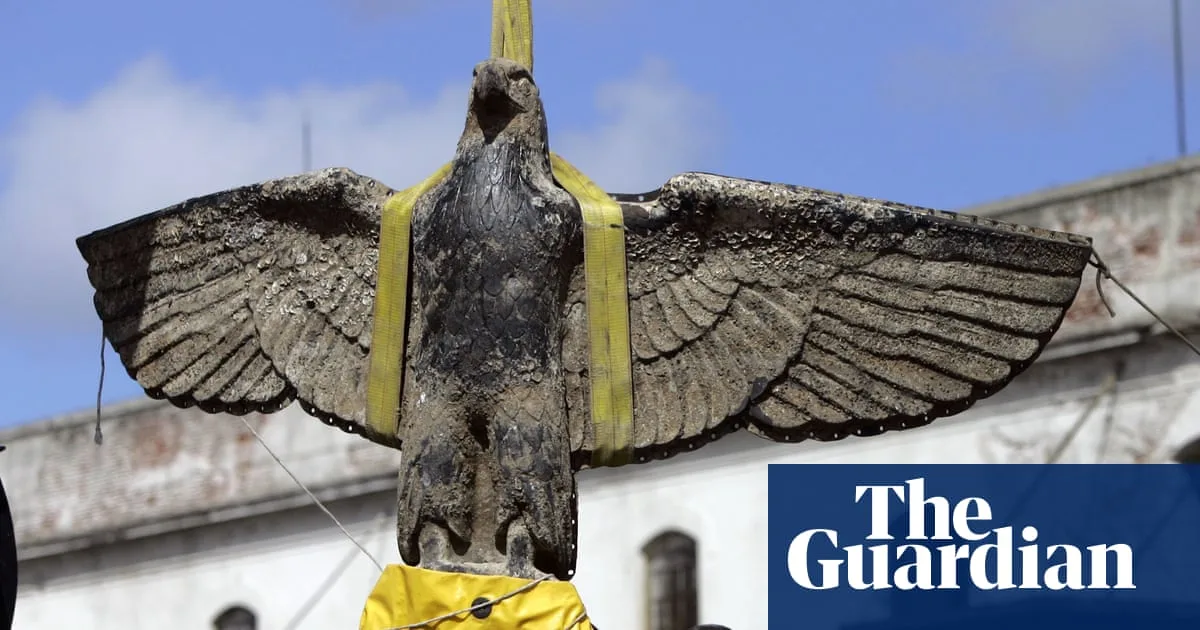
Uruguay is grappling with a profound historical and ethical dilemma regarding a salvaged Nazi eagle sculpture that once adorned the German pocket battleship Admiral Graf Spee. The enormous bronze sculpture, featuring an eagle clutching a swastika in its talons, spent nearly 70 years submerged at the bottom of the River Plate before its recovery in 2006. As the 20th anniversary of its salvage approaches, the nation remains deeply divided over its future, with proposals ranging from destruction to public exhibition.
The Eagle's Turbulent History and Recovery
The sculpture, standing over 1.8 metres tall with a wingspan of nearly 3 metres, was originally mounted on the stern of the Admiral Graf Spee. This 610-foot-long battleship sailed from Germany to patrol the south Atlantic just days before the 1939 invasion of Poland. In December of that year, the ship was severely damaged by British and New Zealand cruisers during the Battle of the River Plate, forcing it to limp into the port of Montevideo, Uruguay. Shortly afterward, the captain evacuated the 1,000-man crew and scuttled the vessel.
For decades, the eagle lay hidden in the murky depths of the river, until a team led by British marine archaeologist Mensun Bound and diver Héctor Bado embarked on a challenging recovery mission. "Diving in the River Plate is quite dangerous: the currents are absolutely furious between tides, and the visibility is probably the worst I've ever known. You're swimming in liquid mud," Bound recalled. After locating the Graf Spee in 2004, the team discovered the eagle completely covered in mud in 2006, leading to a complex salvage operation involving the removal of about 150 heavy, encrusted bolts.
Bound described the moment the Nazi symbol emerged: "We knew the swastika was there, but we weren't quite ready for it mentally. Everyone just stopped because, suddenly, we were looking into the absolute heart of darkness."
Public Display and Subsequent Controversy
Initially, the sculpture was displayed in the lobby of a Montevideo hotel, attracting thousands of visitors. However, reports of individuals making Nazi salutes or spitting at the sculpture prompted the Uruguayan government to intervene. Within weeks, the eagle was removed and placed into military custody at the Cerro fortress, where it remains stored in a crate to this day. Researcher Daniel Acosta y Lara explained, "The government didn't want the site to become a place of pilgrimage or to risk it falling into the hands of neo-Nazis."
Despite being hidden from public view, the eagle has never faded from attention. It became the center of a protracted legal dispute between the Uruguayan government and businessman Alfredo Etchegaray, who financed much of the expedition and is suing the state for £18.7 million in compensation. The controversy intensified in 2023 when then-president Luis Lacalle Pou announced plans to melt down the sculpture and recast it—only to reverse the decision days later following public outcry.
Divergent Proposals for the Eagle's Future
The debate over the sculpture's fate has produced several conflicting proposals. Some, including former president Lacalle Pou, have suggested melting it down and transforming it into a dove of peace. Others advocate for housing it in a museum with proper historical context, similar to how a comparable sculpture from Berlin is displayed at the Imperial War Museum in London.
However, the most contentious proposal comes from local politician Teresa Marzano, who unsuccessfully ran for governor of Maldonado province last year. Marzano campaigns for the eagle to be displayed on the seafront of the resort town of Punta del Este, mounted atop a structure resembling a ship's stern, surrounded by a moat, with a viewing platform for up to 100 visitors. Her promotional video features a 3D rendering set to an instrumental version of "What a Wonderful World."
"My project would transform the eagle into a kind of tourist icon," Marzano asserted, presenting her plan to the government in December 2024. She claims the project is advancing internally, though no formal response has been issued. Marzano argues that the display would not become a neo-Nazi pilgrimage site but instead promote education and boost tourism. "Our country is deeply republican and democratic and respects all religions ... We must ensure that future generations understand what happened," she stated.
Criticism and Ethical Concerns
Marzano's proposal has faced significant criticism. Acosta y Lara opposes the idea, noting that no part of the Battle of the River Plate or the sinking occurred near Punta del Este, which lies over 80 miles from Montevideo. "It doesn't belong there," he argued. "And more than that: imagine tourists arriving in Maldonado Bay and being greeted by that symbol."
Fabian Schamis, executive director of the Jewish Community of Punta del Este, emphasized the need for careful consideration. While not commenting specifically on Marzano's project due to its informal presentation, Schamis stated that "appropriate places" for exhibition "would be a museum or any space that clearly provides a historical context that allows people to understand it properly ... Otherwise, it should not be displayed at all."
As Uruguay continues to wrestle with this half-tonne relic of its wartime past, the fundamental question persists: how should a nation handle a symbol of such dark historical significance? The decision will not only determine the eagle's physical fate but also reflect Uruguay's approach to confronting and contextualizing one of history's most troubling chapters.