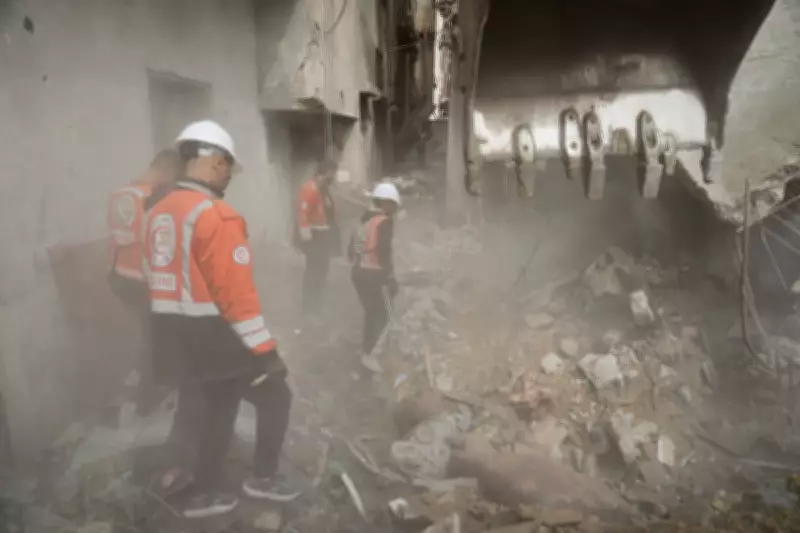
Israeli military strikes on Monday resulted in the deaths of three individuals west of Gaza City, according to Shifa Hospital, where the casualties were received. This incident occurred during a months-old ceasefire that has been marred by ongoing sporadic fighting.
Ceasefire Context and Military Response
The Israeli army stated that it conducted strikes in response to its troops coming under fire in the southern city of Rafah, which it described as a violation of the ceasefire agreement. The army emphasised that the strikes were carried out "in a precise manner."
The ceasefire, which is four months old and backed by the United States, followed stalled negotiations. It involved Israel and Hamas accepting a 20-point plan proposed by former U.S. President Donald Trump, aimed at ending the war that began with Hamas' attack into Israel on October 7, 2023. At the time, Trump claimed the plan would lead to a "Strong, Durable, and Everlasting Peace."

As part of the deal, Hamas released all living hostages it still held in exchange for thousands of Palestinian prisoners held by Israel and the remains of others. However, broader issues such as the future governance of Gaza were met with reservations, and the U.S. did not provide a firm timeline for resolution.
UN Concern Over West Bank Decision
In a related development, the United Nations top official expressed grave concern on Monday about the Israeli security cabinet's decision to deepen control over the occupied West Bank. Secretary-General Antonio Guterres warned that this move could erode the prospect of a two-state solution, according to spokesperson Stéphane Dujarric.
Dujarric stated, "Such actions, including Israel's continued presence in the Occupied Palestinian Territory are not only destabilizing but – as recalled by the International Court of Justice – unlawful." Israel's security cabinet approved measures on Sunday aimed at strengthening Israeli control over the West Bank and weakening the Palestinian Authority's limited powers.
Israel's far-right Finance Minister Bezalel Smotrich commented that the measures would facilitate Jewish settlers in pressuring Palestinians to relinquish land, adding, "we will continue to bury the idea of a Palestinian state." Israel captured the West Bank, Gaza, and east Jerusalem in the 1967 Mideast war, territories the Palestinians seek for a future state.
Rafah Crossing Operations Improve Slightly
Ali Shaath, head of the National Committee for the Administration of Gaza, reported on Monday that passage through the Rafah crossing with Egypt is beginning to improve after a chaotic first week of reopening. He told Egypt's Al-Qahera News that operations were better on Sunday, with 88 Palestinians scheduled to travel through on Monday, exceeding initial daily numbers.
The European Union border mission noted that 284 Palestinians had crossed since the reopening, including war returnees, medical evacuees, and their escorts. However, this falls short of the agreed target of 50 medical evacuees exiting and 50 returnees entering daily, as negotiated by Israeli, Egyptian, Palestinian, and international officials.
The Rafah crossing reopened last week for the first time since mid-2024, a key requirement of the ceasefire. It was temporarily closed on Friday and Saturday due to operational confusion. Palestinian officials estimate nearly 20,000 people are seeking to leave Gaza for medical care unavailable in its devastated health system.
Returnees described hours-long delays and invasive searches by Israeli authorities and an Israeli-backed Palestinian armed group, Abu Shabab, though Israel denied any mistreatment.
Casualty Figures and Broader Impact
Gaza's Health Ministry reported on Monday that five people were killed over the previous 24 hours, bringing the death toll to 581 since the October ceasefire. The truce facilitated the return of remaining hostages from the 251 abducted during the October 7, 2023 attack.
Hamas-led militants killed approximately 1,200 people, mostly civilians, in that initial attack. Israel's military offensive has since resulted in over 72,000 Palestinian deaths, according to the ministry, which operates under the Hamas-run government and is considered by the U.N. and independent experts as the most reliable source on war casualties.

This report highlights the fragile nature of the ceasefire and the ongoing humanitarian challenges in the region, with international concerns mounting over territorial disputes and access issues.