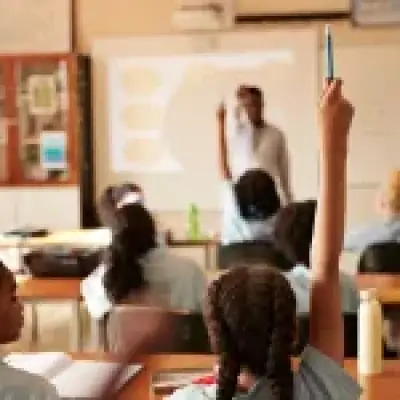
A teacher at a north London school is championing the use of artificial intelligence in the classroom and backs calls for a new qualification in the subject, as pupils as young as eight turn to chatbots for homework.
Kasia Suliga Wasielewska, who teaches at St Joseph's Primary School in Highgate, has been using ChatGPT 'heavily' since 2022. She now hands out ChatGPT-generated quizzes, has students chat with William Shakespeare bots and teaches them how to reverse-engineer AI images. Some lessons ask pupils to question chatbots such as Google's Gemini and fact-check the answers.
'Many of us teachers felt that shift, an increase in imposter syndrome as we started doubting our own voice and knowledge,' Kaisa told Metro. 'Recognising this made me rethink my entire approach, shifting from passive reliance to deliberate, productive use [of AI] in education.'
AI literacy from age eight
According to Kaisa, pupils as young as eight are using AI for homework, while from age 10 they code, build websites and design games. 'AI must support, not replace, the teacher's expertise,' she stressed.
It is why she teaches 'AI literacy' to youngsters to help them prepare for what many tech giants describe as an 'AI-driven future'. The Micro:bit Educational Foundation, which makes some of the AI tools Kaisa uses in class, wants the government to introduce an 'AI GCSE'.
'Just as we teach children to read and think mathematically, we also need to support them to understand how technologies, like AI, are increasingly shaping their lives,' said Tom Doust, the non-profit's chief of learning.
Mixed views among pupils and teachers
Teachers have faced similar debates before over computer literacy, internet literacy and social media literacy, but no consensus on AI has emerged. More than nine in 10 teens use AI, yet only 15% feel they have been given enough guidance on how to use it, according to a survey by Oxford University Press. Researchers warn that AI-powered learning tools can erode critical thinking through 'cognitive offloading', as teens use AI to 'think' for them.
Not all young people use AI, including some at St Joseph's Primary School. 'If you're using it for your homework, then AI is doing the work, not you,' said one Year 5 student. 'I only use it sometimes at home when my dad's cooking something and we don't know the instructions.' Other students prefer handwriting their revision notes, which researchers say improves reading comprehension, or worry about peers sharing personal information with chatbots.
'I think AI should be banned [from homework], so we can control our brains,' a Year 6 student said. 'There's no education in that,' a Year 4 pupil added. 'You can just look it up and then you have the answer.'
Calls for equal access
Another Year 4 student said they are not allowed to use ChatGPT at home because they do not know enough about the app. This worries campaigners such as Elizabeth Anderson, CEO of the Digital Poverty Alliance, who said 'it's only a matter of time before there's a GCSE in AI', but warned embracing the technology risks creating more inequality.
The alliance found that 30% of teachers have at least 10 pupils who lack access to a suitable device or reliable internet connection at home. 'There must also be provision for children who cannot access a keyboard device or broadband connectivity at home,' said Anderson, 'otherwise they will be at a major disadvantage which is built into the curriculum.'
The Safe AI For Children Alliance said a GCSE in AI could benefit young people 'if done well'. 'AI is such a transformative technology that any education related to it has to involve a holistic curriculum. Schools must also ensure that AI safeguarding education is delivered to all students, regardless of whether they choose to study AI.'
For Kaisa, restricting or banning AI, like mobile phones, is not the answer. 'We must teach children how to control technology,' she said, 'rather than letting technology shape how they think.' The Department of Education has been approached for comment.