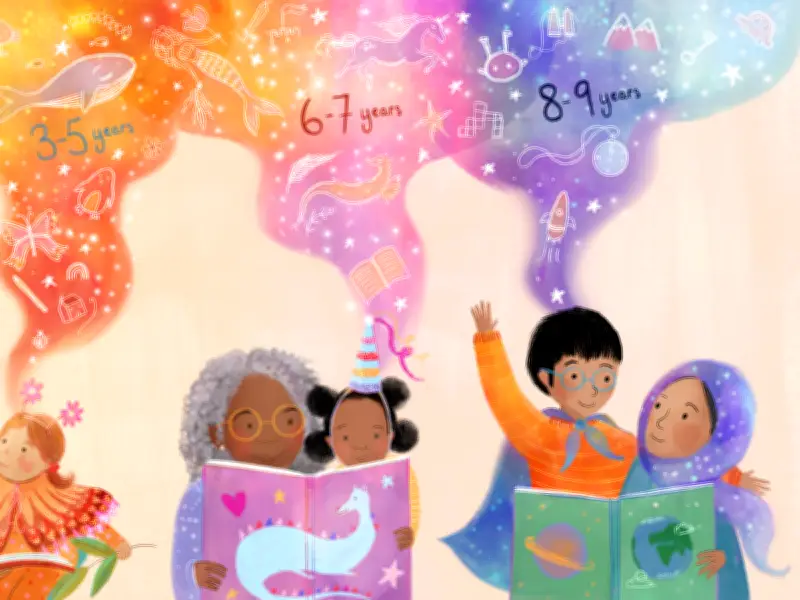
Two thirds of UK parents (66%) have discovered a previously unknown aspect of their child's imagination – through shared storytelling. The findings come from The Imagination Index, new research by Kinder Chocolate, which highlights the enchantment of co-created storytelling and the unexpected, delightful realms children's imaginations can venture into when given the liberty to steer the narrative.
Research into children's imagination
The Imagination Index polled 2,000 UK parents of children aged 3–9, delving into how children's imaginations evolve at various ages, how co-creating stories bolsters the parent-child bond, and what transpires when children assume control of characters, settings and outcomes.
To animate the findings, Kinder Chocolate has teamed up with illustrator Gillian Eilidh O'Mara, whose standout illustration encapsulates the imaginative worlds children occupy at different ages – from the creatures and playfulness of the under-5s, to the adventure-seeking 6–7-year-olds, to the bold, self-directed storytelling of 8–9-year-olds.

Illustrator's perspective
Gillian Eilidh O'Mara said: "Telling stories together is one of the most powerful ways to foster connection and imagination, and to empower families and communities to co-create the kind of world they wish to live in. While working with families for fourteen years on storytelling projects, I've had the privilege to see how this activity strengthens relationships, gives children confidence and improves enjoyment in storytelling."
"What I love most is seeing what happens when children are given the freedom to lead the story – shaping the characters, settings and adventures in ways adults would never imagine. Children are uniquely placed to invite us back into a magical world we may have forgotten about."
Benefits beyond the story
Every shared tale reveals a child uncovering something fresh about themselves and their surroundings. Mums and dads report that storytelling has assisted their youngster in acquiring new vocabulary (53%), enhancing listening abilities (49%), building self-assurance (46%) and demonstrating greater compassion (36%) – evidence that the advantages of collaborative storytelling stretch well beyond the narrative itself.
Almost half of parents (49%) report the most significant transformation in their child's literary tastes occurs between ages 3 and 5. Youngsters under five are attracted to animals and fun, with 36% favouring creature-focused tales.
Age-related shifts in storytelling
Come ages 6–7, fantasy (26%) and adventure (24%) dominate, while children start wanting to influence the narrative themselves, with 14% already selecting stories they've helped craft. By the ages of 8–9, children's eagerness to craft their own narratives has nearly doubled since their early years, increasing from 9% at ages 3–5 to 17%, with a burgeoning interest in mysteries (27%) and more intricate storylines, underscoring that children's imaginations are always one step ahead.
Spontaneous creativity
The most impactful storytelling moments often occur spontaneously and children's creativity doesn't require a budget. Over half (56%) have transformed a cardboard box into a story, and three quarters of parents (76%) report their child is more engaged when co-creating a story than when being read one.
Moreover, storytelling has long since transcended bedtime: 44% of parents utilise stories for learning, 43% during imaginative play and 36% during car journeys and daily transitions.
Strengthening the parent-child bond
Almost every parent (96%) asserts that shared storytelling strengthens their bond with their child. An additional 41% say it assists their child in expressing feelings they wouldn't otherwise share, and 29% say they're more likely to learn about their child's aspirations and dreams through stories than through direct conversation.
To illustrate the research findings, Kinder Chocolate collaborated with Dr Elizabeth Kilbey, one of the UK's foremost child and family clinical psychologists and a member of Kinder's Value of Play panel – an expert advisory group committed to promoting the role of play and imagination in childhood development.

Dr Kilbey said: "When children have the freedom to shape a story, something really important happens. They're not just consuming a narrative, they're expressing how they see the world, testing ideas, and processing emotions that might be difficult to put into words. In this way co-created storytelling is an emotional rehearsal. What strikes me most is how often parents discover sides of their child's imagination they'd never seen before."
"That's because when a child leads, they have the freedom to go wherever their imagination takes them. Digital play like Let's Story makes interactive storytelling accessible and easy to weave into daily life, helping to facilitate real, meaningful interaction between parent and child."