American forces have struck five “shadow network” oil tankers, sinking at least one, after Tehran’s troops targeted a US warship in the region, US Central Command has confirmed.
Strikes in the Gulf of Oman and near Kharg Island
American intelligence believed that the Islamic Revolutionary Guard Corps (IRGC) is using the secretive tanker trade to continue to fund their military operations. At least four IRGC-linked vessels were hit in the Gulf of Oman, and another close to Kharg Island was also attacked near a major oil terminal.
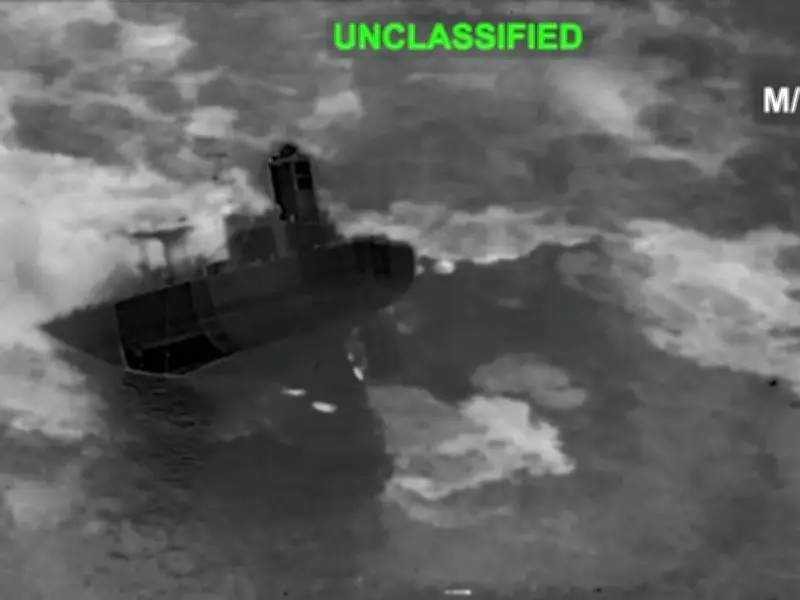
Tehran claimed revenge attacks were launched at a US base in Jordan, forcing the American military to shoot down missiles and the IRGC also opened fire on vessels in the Strait of Hormuz. Close-up satellite imagery issued by Central Command showed one Gulf of Oman Iranian ship being hit by US missiles as the conflict plunged into a long-term war, seemingly without end. It is believed the ship sank.

US strategy to choke Iran’s economy
Images revealed today by CentCom were aimed at displaying US military might, amid fears Washington cannot find a route to peace and Tehran refuses to back down. The latest Washington strategy for the worsening conflict is to choke Iran’s ports and economy as the population suffers a plunging economy and poverty.
Tit-for-tat exchanges of missiles have escalated in the past week, more than six months after the US and Israel launched their first assault on Iran on February 28. Jordan shot down 18 of the 20 Iranian missiles, while two of them fell in unpopulated areas, according to the Jordanian Armed Forces.
Iranian proxies and regional attacks
The latest worrying escalation happened after Iran targeted a US warship with ballistic missiles, which Centcom claimed it “successfully evaded”. US military chiefs said in a statement: “The US warship successfully evaded the attempted Iranian attacks and continued to patrol regional waters. No American personnel were harmed.”
Tehran’s shadowy IRGC networks were actively gathering supporters among their proxy systems in Lebanon, the Houthis in Yemen and Iraq to boost the threat towards the US. Mahdi Mohammadi, an adviser to Iran’s parliament speaker, wrote in June: “Iran has a hybrid strategy in the current war. We are not fighting on one front and we are not using one tool.”
Ahmed Nagi, senior Yemen analyst at the think tank Crisis Group, said: “The Houthis’ growing prominence during the Gaza war opened up a new horizon in Iraq. Many groups there became eager to support the Houthis, and in return, the Houthis started sharing their military expertise with Iraqi militias.”
This week, Yemen's Iran-backed Houthi rebels attacked energy depots and housing in several cities in Saudi Arabia, injuring 73 people and further de-stabilising the region. The drone and missile attack caused fires at oil facilities and installations that led to a temporary halt in operations, Saudi Arabia's military and energy ministry said.
Captured US submarine drone
In Tehran the IRGC claimed it captured a secretive US “submarine drone” after American forces admitted an unmanned maritime vessel had malfunctioned. American military chiefs say the drone was an older model and was not being used for sensitive operations.
Earlier, Iran celebrated its capture of a £2m American unmanned underwater vessel near the Strait of Hormuz. And the IRGC said it had “trapped one of the most modern, intelligent and unmanned submarines of the terrorist American army at the entrance to the Strait of Hormuz”.
The US military is investing heavily in unmanned naval systems, including underwater and surface vessels, as it seeks cheaper ways to monitor vast areas of ocean and gather intelligence. It is believed the captured vessel was a Dive -LD model which can operate for up to 10 days without returning to base and is designed to dive to depths of as much as 19,700 feet.