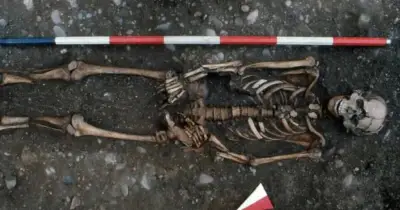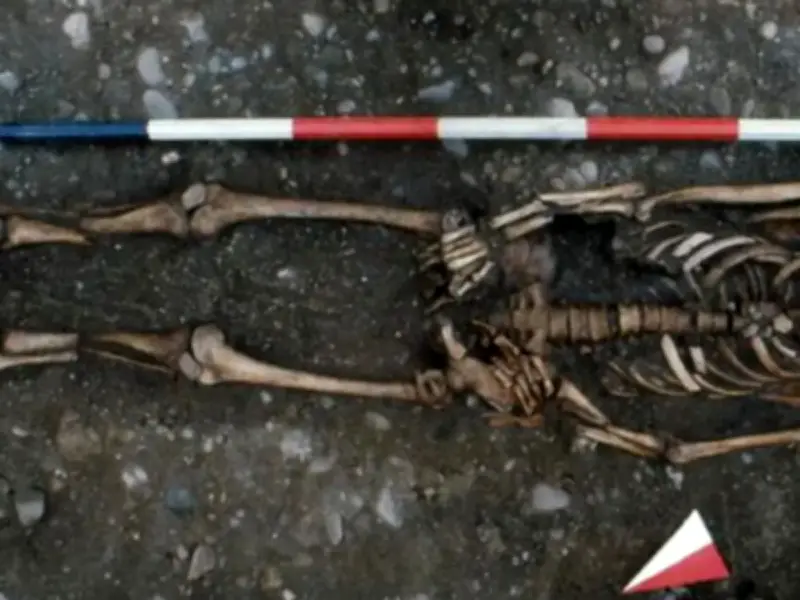
Archaeologists in Milan have uncovered the remains of a young man who appears to have suffered a botched beheading and the notoriously painful torture method known as the wheel. The discovery, reported in the Journal of Archaeological Science, may represent the first archaeological evidence of a human being tortured by the wheel.
The man, estimated to have been between 17 and 20 years old, was found by researchers from the University of Milan. Forensic analysis of his skeleton revealed unusual linear fractures at the cranial base of his skull, which the researchers believe resulted from sharp force trauma caused by a heavy weapon during a "clumsy decapitation."
Evidence of deliberate injury
The man is believed to have died during the 13th century and was buried near a cathedral in Milan, northern Italy. His wounds were almost identical on both sides of his body, with symmetrical injuries across both arms and legs, leading scientists to conclude the damage was deliberate.
Based on the injuries and historical records, researchers determined the man had been tortured using the wheel, also known as the Catherine wheel or the breaking wheel. This device was used throughout Europe during the Middle Ages to smash and snap limbs.
The torture process
The torture began by dropping a heavy wooden wheel onto the victim's limbs, starting at the shin bones and working upward. Once the body was battered, the broken limbs would be weaved in and out of the wheel spokes or tightly fastened to it with rope.
Additional pain was inflicted using blunt objects, fire, whips, or red-hot pincers, and then the wheel was mounted like a flag. The victim would hang there for days or weeks until death or execution.
Possible plague spreader
The torture technique was most often used against those accused of heinous crimes, but in northern Italy, this kind of torture was usually reserved for persons suspected of being plague spreaders.
"The victim of the wheel could have been considered as different by his contemporaries, and possibly this discrimination may have been the cause of his final conviction, as he could have been sacrificed, being a 'freak', by an angry crowd, as a plague spreader," the researchers write.