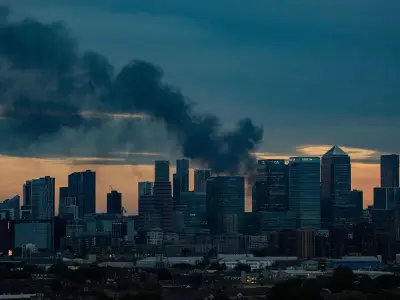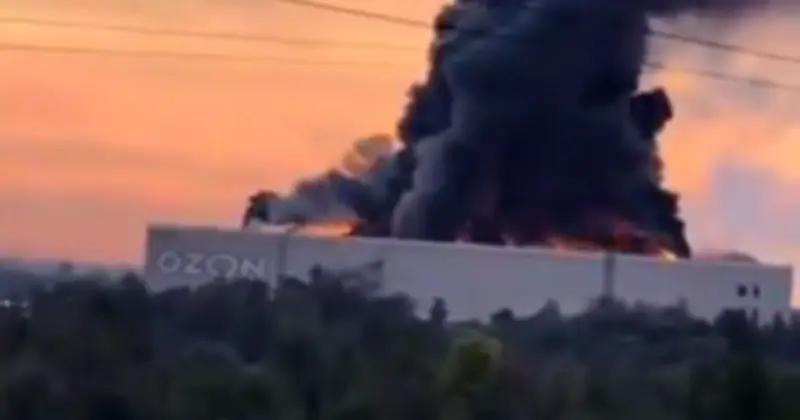
A major Ukrainian drone strike set a large Ozon logistics centre ablaze in Russia’s Samara region, marking the first confirmed attack on the country’s second-biggest online marketplace. Overnight into Saturday, drones hit the Ozon fulfilment hub in Chapayevsk.
Fire at Ozon hub in Chapayevsk
The complex, covering roughly 135,000 square metres and ranked among the company’s largest in the Volga region, burst into flames. Thick smoke rose over the industrial park as more than 500 employees were evacuated within minutes.
Ozon confirmed the strike, said operations at the site had been suspended indefinitely, and reported injuries. Regional Governor Vyacheslav Fedorishchev acknowledged the attack and said several people required medical treatment. Videos circulating on social media showed the scale of the blaze.

Refinery also hit in same wave
In the same overnight wave, the Novokuybyshevsk oil refinery, a Rosneft facility with a design capacity of about 8.8 million tonnes of crude a year, was also struck and caught fire.
The dual hits on commercial logistics and refining infrastructure underline Ukraine’s expanding long-range drone campaign deep inside Russian territory.
Expanding logistics campaign
The Chapayevsk attack comes after weeks of Ukrainian strikes that have devastated warehouses belonging to rival retailer Wildberries. Kyiv has argued that such logistics hubs form part of the logistical backbone supporting Russia’s military effort.
Ozon, like Wildberries, moves vast volumes of consumer goods but has also been linked by Ukrainian sources to dual-use supply chains.
Parallel strikes on Ukraine
The latest Russian attacks on Ukraine continue in parallel. At least two people were killed overnight by Russian drone and missile strikes. Ukrzaliznytsia head Oleksandr Pertsovsky said one of the rail company’s employees died in a ballistic missile attack on the railway in Kyiv.
Russia’s defence ministry claimed it had hit a locomotive depot. A separate drone strike killed one person in Zaporizhzhia. Those strikes followed Friday’s deadly attack on a shopping centre in Kryvyi Rih, President Volodymyr Zelenskyy’s hometown, which raised the death toll to 16 with nine still missing and more than 130 wounded.
Ukrainian officials described it as a double-tap strike. Large-scale Russian assaults have become routine this summer; the United Nations recorded at least 54 civilians killed and 202 injured in Kyiv alone in July.
Ukraine has responded by taking the war onto Russian soil. Long-range drones have repeatedly struck oil facilities, contributing to fuel shortages, and have now extended the logistics campaign from Wildberries to Ozon. For ordinary Russians, the sight of major warehouses and refineries burning brings the conflict closer to home.
Moscow continues to play down the economic impact. Yet the pattern of successful deep strikes—first on Wildberries hubs and now on a major Ozon centre plus another refinery—is becoming harder to dismiss as insignificant. The fires in Samara add another visible cost to a war that Vladimir Putin once insisted would remain distant from the Russian hinterland.