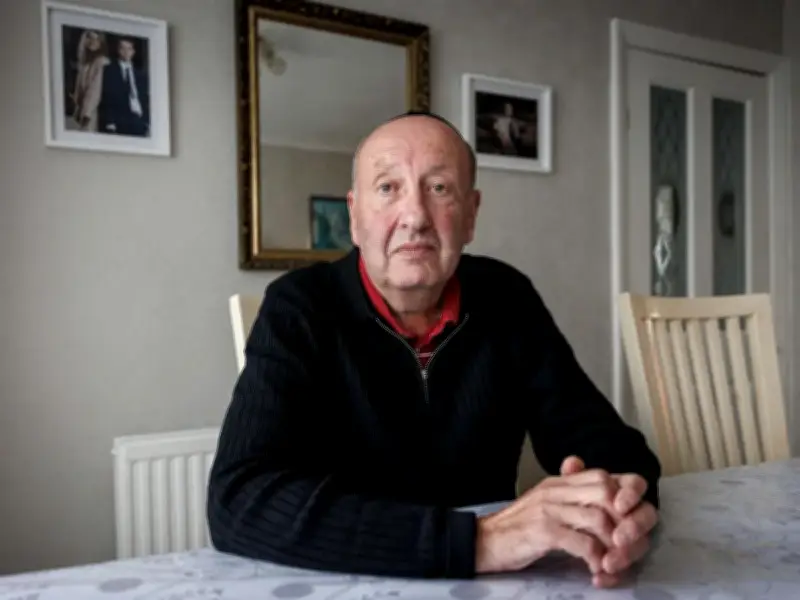
Alan Levy's first memory of October 2, 2025, is that it was a pleasant day – mild enough for him to leave home without a coat on his way to Heaton Park Shul. He was due to manage internal security for Yom Kippur, the holiest day in the Jewish calendar, and was keen to arrive on time for the first security duty, as he usually does on the Sabbath and holy days.
As he made his way inside, greeting friends, a colleague told him that a man had come to the gate earlier asking for directions to the White House, a social club further down Middleton Road. The man was given directions but did not follow them. Alan then spoke to Bernard Agyemang at the gate, who had seen the same man walk down the side of the synagogue. The man told another security guard he was 'looking for his car'.
“Bernard said, this isn't right,” Alan recalls. The CST, a security organisation for Jewish schools and places of worship, was called and told to notify the police.

The attacker returns
Alan made his way back to the front gate, where the same man reappeared. “I went up to him and said, ‘what are you doing here again? You've been given directions to where you want to go - why are you hanging around here?’”
“He said, ‘It's a free country, I can go where I like. What offence have I committed standing here on the pavement?’” Alan said he replied that the man had not committed an offence but asked why he was walking around the synagogue on a holy day, telling him to leave them alone. As he walked away, the man said: “you're very brave standing there behind the fence, aren't you?”
Over a more than two-hour interview with the Manchester Evening News, Alan never once utters the name of Jihad al-Shamie. He refuses to. The memory of his heavy-set physique barging into the bolted front doors, his knife smashing through the windows, and the rage and evil on his face through the glass are more than enough – images that still return to Alan in vivid flashbacks almost a year later.
Locking down the building
After chatting for another minute with fellow security guard Andrew Franks, who had seen the same man acting suspiciously opposite the synagogue gates, Alan decided to make his way inside. “Just as I was moving towards the doors, I heard the roar of a car engine,” he said. “It was like someone driving in first gear when they should have been in fourth.”
He turned to see a car come past and violently turn into Bernard standing by the gate. Bernard went down under the car. The same man got out holding a big knife, came around the car and attacked Andrew. Alan thought he had to get inside and lock the building down. “I ran inside and locked the door and he had followed me, he ran straight to the door to try and get in. I suddenly thought, I've got to make sure the back doors are closed.”
He ran into the main hall and shouted “we are being attacked, close the back doors”. Several people ran to barricade the front doors, including Rabbi Daniel Walker and Adrian Daulby. “There were about nine or ten of us, about three on each of the three doors,” Alan said. “He was trying each door in turn, shoulder barging each door and stabbing his knife into the window. He was a big, heavy-set guy, and the doors were moving but not opening.”
Andrew's dad was helping Andrew, holding towels to his neck which were soaked in blood. Alan ran to the office and called the police, who said they were seconds away. The attacker was shouting things, including: “This is what you're going to get for killing our children”. The rabbi shouted back that “we hadn't killed any children”.
Police arrive
Firearms officers were at the scene within three minutes of the first 999 call, made by a member of the public at 9:31am. “It felt like we had been holding the door for hours,” Alan remembered. “I saw evil in his face and in his eyes, shouting, stabbing a knife into the window.”
“What was going through my mind is, we've got to barricade these doors. We've got to stop him from getting in. Because if he gets in, there's going to be a massacre.” He said he had CST training years ago, which may have stayed in his subconscious: “You secure your building to try and help secure your people. But I never thought that at the time. I think it was just instinct.”

When police arrived, they shouted at the attacker to drop his weapon. “It looked like he was going to do it,” Alan said. “He bent down but I think he was actually praying. I think he knew he was going to be killed. He then got up and started moving towards the police. I heard gunfire, BAM BAM BAM. He went down and got up again after that, there was another round, BAM BAM BAM.”
Worshipper Adrian Daulby, who had acted quickly to lock the left-hand door and was helping to hold the door, was struck by a bullet and tragically died at the scene. Those inside did not yet know that the attacker had also stabbed 66-year-old Melvin Cravitz on the steps of the synagogue. He died of his injuries in hospital.
Seconds after the attacker was shot dead, there was more commotion at the back door, with some worshippers fearing it was more terrorists. It was in fact police. “They kicked the door into the office. All you could see was their eyes, they were in balaclavas waving weapons and saying: 'hands in the air'. I was standing with my hands up against the wall, I was too frightened to move.”
Resilience and remembrance
The men were eventually taken outside, searched, and then taken to Sedgley Park police station. Alan saw a friend on the cordon outside and asked him to tell his wife he was alright. His son Marc, chief executive of the Jewish Representative Council in Greater Manchester, did not know his father was alright until he saw him walking in the street on Sky TV.
Despite the shock and trauma, the worshippers were undaunted. “Rabbi Walker was keen that we continue to do the prayers. We read the Yom Kippur prayers in the street,” Alan said. A policeman and someone from the CST went to a local synagogue to get prayer books, and they read the prayers at Sedgley Park as well.
“It's my shul. We're not going to let an evil man like him stop us going to our shul to pray. We're a resilient and defiant people. We want to show that Jewish life will continue. Yes, it's a struggle. Yes, it's difficult for us, yes, people feel compelled to hide their Jewish identity because they're frightened. But we have to carry on, and we will carry on. We're not going to let someone like him or anyone tell us what we can and can't do, or try to drive us away.”
Almost a year on, Alan says he expects the mood at the Yom Kippur service on Monday September 21 to be sombre, but also poignant. It is to be attended by the Chief Rabbi Ephraim Mirvis, and there are plans to dedicate new Torah scrolls to Melvin and Adrian in the weeks after. “We want to try and move forward and do some positive things,” Alan said, “but we'll never forget what happened. Never forget Melvin or Adrian.”
“I knew them well. Melvin was a genuinely happy chap, a nice guy. He always wanted to help. If a family was bereaved, Melvin would deliver the special mourning chairs for them and make sure they had prayer books. Adrian was a quiet, unassuming guy. He would always be first in on a Saturday morning or a festival morning and would sit in his late father's seat. What have these guys done? Nothing. They've come to shul on Yom Kippur to pray, and sadly, they're not going to be able to do it this year.”