Violence has erupted in West Bank villages as masked settler gangs attacked farmers, torched cars and burned valuable olive crops. At least six people were injured, including two elderly victims and a journalist, in the flare-up that coincided with the harvesting of local olive groves.
Among those hurt were a 63-year-old woman and a 40-year-old man who were set upon by settlers. An American journalist reporting for the Washington Post was also injured. It is feared the burning of olive trees and cars has caused hundreds of thousands of pounds worth of damage.
Settler attack on olive harvesters
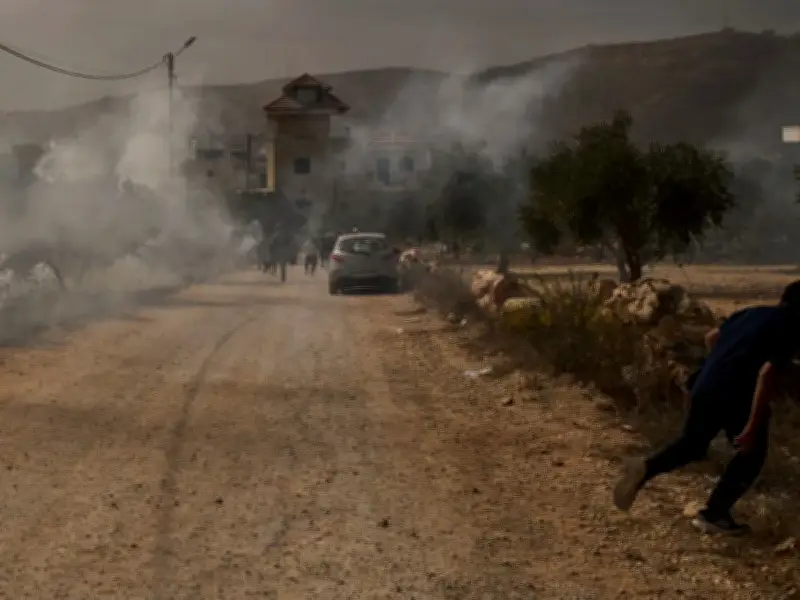
In one flashpoint, about a dozen settlers dressed in black charged down a hill near an outpost – illegal under international law – to a field where Palestinians and activists were harvesting olives. They torched about a dozen trees and hurled stones from slingshots at nearby Palestinians.
American photographer Heidi Levine, who was at the scene, was taken to hospital where she told reporters she "got jumped." United Nations officials say the past two weeks have already seen more attacks by violent Israeli settlers than during the entire harvest season last year. The organisation says this year levels of settler violence have reached an all-time high, at a time of soaring tensions between Palestinian groups and Israel.
Farmers describe attacks
"The settlers want to attack us and force us from our homes," said Moutaz Abdelhadi, 42, a farmer who witnessed an attack in the Abu Falah area. Witnesses reported that even after Israeli troops arrived on the scene, the attack continued and soldiers fired tear gas in the direction of Palestinian groups.
The sound of live gunfire could be heard in the area, and a photographer saw at least one armed settler fire a gun. In a separate incident earlier on Friday, farmers were set upon by settlers in the area of Turmus Ayya village, where three cars were burned. A group of farmers harvesting olives was then attacked by the settlers. Local man Salah Abu Niswa said the settlers "...snuck up like thieves, then they caught someone by himself and began to beat him." The attackers were believed to have been wearing masks and some were thought to have carried gas canisters.
Harvest restrictions and rising toll
Israel has imposed new rules on the olive harvest this year, prohibiting Palestinians from working in what is known as Area C, which is under Israeli security control and encompasses the majority of the territory's agricultural land. At least four Palestinians have been killed and more than 100 injured since the harvest season began earlier this month, according to Palestinian officials.
Israeli settler violence against Palestinians in the occupied West Bank has surged, with at least 170 attacks since September 27, around the start of the annual olive harvest. Settlers have been emboldened by the right-wing government of Prime Minister Benjamin Netanyahu, who has overseen a rapid expansion of settlements. Netanyahu has criticised the violence but has taken few steps to crack down on incidents that have drawn international condemnation and sanctions, including by Britain.
Elections loom amid tensions
Israeli elections are taking place on October 27 and are one of the most important in the nation's history, as they are the first since the 2023 Hamas attacks which sparked the Gaza War. Netanyahu, Israel's longest-serving premier, is seeking a seventh term but faces wide criticism for his handling of the wars, which have isolated Israel internationally.
Other issues facing Israelis include the security of the occupied West Bank, including the growth of settlements, and compulsory military conscription for ultra-Orthodox communities. Israel uses proportional representation to elect 120 members to the Knesset, Israel's parliament, although no single party since the nation was founded in 1948 has won a 61-seat majority. Instead, politicians and parties cut deals and form coalitions to win power.
The West Bank is home to some 500,000 settlers and at least three million Palestinians. UN bodies and most countries have labelled the settlements illegal under international law regarding military occupations. Israel rejects this, viewing the territory as disputed rather than occupied.