The National Federation of the Blind of the UK (NFBUK) has demanded that floating bus stops be scrapped in London, warning that it is only a matter of time before someone is killed.
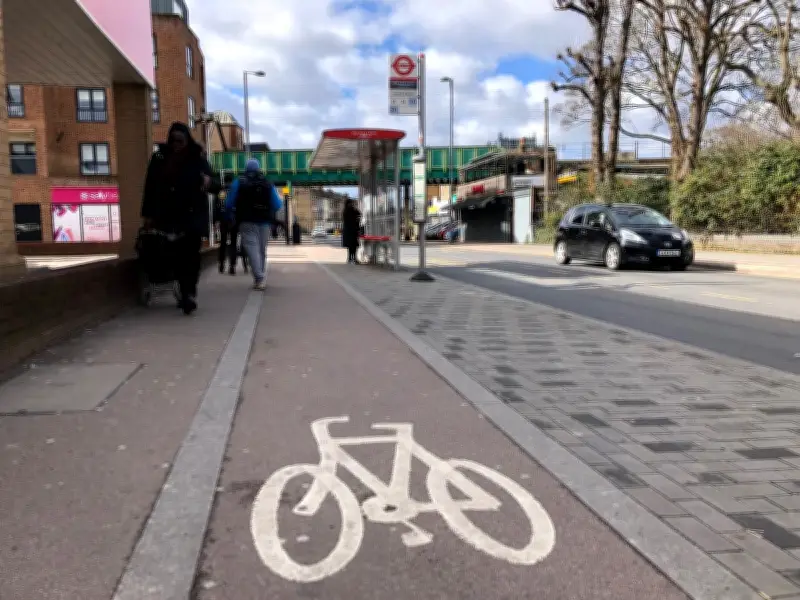
The charity has campaigned against the schemes for years, claiming they are massively impacting people's lives and criticising the “cruel” politicians for their lack of action. Floating bus stops were first introduced in London in 2013, with a cycle lane running between a bus stop and the pavement to allow cyclists to continue riding while passengers board or alight. Pedestrians must cross the cycle path to catch a bus.
Video goes viral
A video shared by the NFBUK on X has soared to almost 13 million views this week, showing cyclists zooming through designated crossings and almost colliding with pedestrians on a number of occasions. Sarah Gayton, the Street Access Campaign Coordinator for NFBUK, told The Standard that the video was recorded in 2025 on Farringdon Street in Central London, but that nothing has changed since.

She said: “Nothing's been resolved at all at Blackfriars. Cyclists are still going like crazy, not stopping, and blind people can’t hear them. The road noise runs parallel to the bus stop so it's not like a normal zebra crossing. Even if you wanted to try and hear the cyclists you can’t - it's a serious problem. Nothing has changed since we last put the video out. Some stop, but others whip round at speed. Its a dangerous, chaotic place - a discriminatory place.”
Mayor accused of breaking promises
Ms Gayton said she reshared the video this week to oppose the proposed Aldgate – Blackfriars Cycleway scheme. The City of London Corporation approved the cycleway in October 2024, with two-way protected cycle lanes on Queen Victoria Street, despite campaigners arguing that the floating bus stops posed a serious risk to visually impaired people. The government has since published new guidelines, and the authority concluded that its plans aligned with "best practice and [met] required standards" but added it would incorporate "additional mitigation measures to address user needs, especially for disabled people".
Ms Gayton described the decision as “devastating” for blind people and accused those at the top of breaking promises. During a conversation on BBC Radio London in February 2023, London Mayor Sir Sadiq Khan promised to meet Ms Gayton and fellow campaigner Hyacinth Malcolm to discuss the floating bus stop schemes, but any meeting is yet to take place. Ms Gayton said: “We have a mayor with a mission to supposedly create a better environment, but it has to be underpinned by accessibility to all. Tubes don’t go everywhere in London, and buses are needed to fill in the rest of the gaps. What do you do if you can’t use it? We’ve got a very cruel mayor here who is looking the other way on this issue.”
Ms Malcolm told The Standard: "Sadiq Khan and TfL keep saying that every journey matters - but it only matters if I can take the bus. The bus is my life and it's the only way I can travel."
Call for action
Ms Gayton also said that some of Prime Minister Andy Burnham’s posts on social media regarding disabled access have been “brilliant”, but that more action is needed. She said: “He can’t just keep tweeting his own stuff out and think everything's going to be fine and dandy. What’s the point in giving people a free bus pass if they can't use it?”
In July, the Telegraph reported that the Government’s disabled persons transport advisory committee (DPTAC) had demanded a halt to new floating bus stops because dangerous cyclists refuse to stop at their zebra crossings. The committee accused ministers of underplaying vulnerable pedestrians’ fears, and criticised the Department for Transport (DfT) for pandering to the cycling lobby. The 2025 document was released under freedom of information laws, and showed how the expert committee had repeatedly called for a “pause” on the controversial bus stops.

NFBUK has shot footage at many of the floating bus stops around London, with one shocking video showing the moment a bike crashed into a young child in Elephant and Castle. Despite reporting the incident, Ms Gayton said that the crash was not logged in the reported statistics. She said: “I think they are death traps. The behaviour I witness and what I capture on film is absolutely terrifying. Bus passengers are literally one step away from being knocked flying by these out of control riders.”
She said that, when filming recently at Blackhorse Road Station, an illegal e-bike rider flew up the cycle lane the wrong way. “It was only for the grace of god nobody moved at that particular moment in time as he literally appeared from nowhere,” she said.
Global incidents
Similar incidents have had devastating circumstances at floating bus stops around the world. A 60-year-old woman was killed in New York in October last year when two men sharing an e-bike ploughed into her while trying to cross a block. The woman had just alighted from a bus and was attempting to walk across the bike lane when the e-bike hit her. She was rushed to Brooklyn Methodist Hospital, where she died, while two men, aged 39 and 41, were taken to the same hospital in stable condition, according to police.
NFBUK have said that many with sight loss in the capital aren’t using buses at all due to the schemes, and as a result have seen their lives “shrink”. Ms Gayton said that she knows two blind people who live in social housing in the Blackfriars area who physically cannot go out any more due to the cycle lanes. She argued that people who stop using the bus stops will never be injured, but the negative impact of the growing social isolation it brings is still felt.
A DfT spokesperson said: “We have listened carefully to the concerns raised about floating bus stops from a wide range of groups. Following our pause on some floating bus stops in November, further research is being carried out to ensure accessibility is at the heart of these designs, and funding is available to help local authorities make changes to existing sites.”
A City Hall spokesperson said: “The Mayor and his team are committed to enabling safe and sustainable travel across the capital for everyone. That’s why we welcome recent statutory guidance on the provision and design of floating bus stops and the ambition to help ensure future installations are as accessible as possible for everyone, while protecting cyclists from motor traffic. Bus stop bypasses provide a safer route for everyone by physically separating buses and overtaking vehicles from people on bikes. We continue to engage with Londoners to understand their experiences and explore potential transport network enhancements as we build a greener, safer, better London for all.”
Ms Gayton added: “It’s like the wild west in London with these bikes. People are at their wits end. I’m not anti-cycling, but everyone is feeling these cyclists' behaviour. It cannot go on like this, something has to give.”