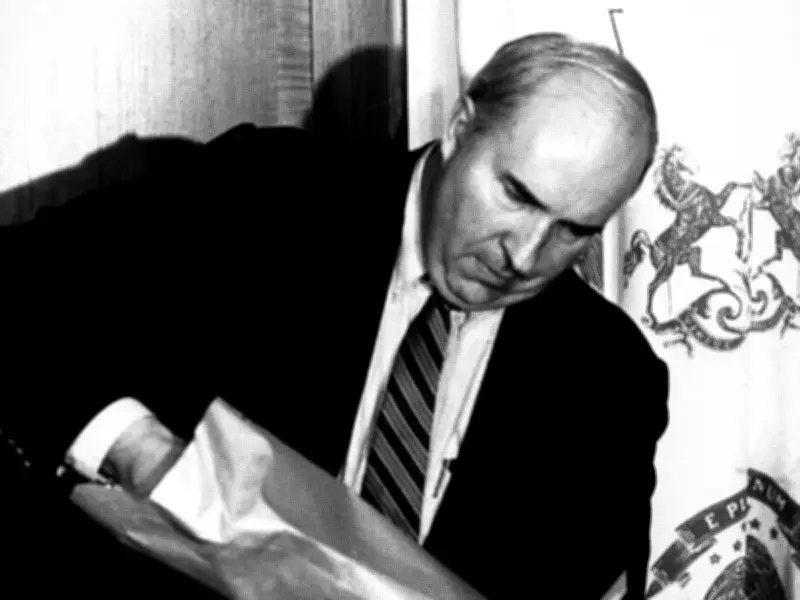
Pennsylvania State Treasurer Robert Budd Dwyer shot himself in the head during a live televised news conference on January 22, 1987, just before he was to be sentenced on bribery charges. The 47-year-old Republican died instantly, according to Dauphin County Coroner William Bush, as cameras recorded the act.
Dwyer, who had been convicted of bribery, pulled a high-powered revolver from a manila envelope and waved off frantic onlookers. Shocked reporters, photographers and aides screamed, "No, Budd. Don't do this," as he pulled the trigger.
Conviction and Sentencing
The day before the suicide, the state attorney general had ruled that Dwyer would lose his job after being sentenced for awarding a state computer contract in return for a promised $300,000 (about $800,000 in today's terms) payoff. He was scheduled to be sentenced by US District Judge Malcolm Muir and faced up to 55 years in prison and a $305,000 fine on 11 counts.

Dwyer was convicted of five counts of mail fraud, four counts of interstate transportation in aid of racketeering, one count of perjury and one count of conspiracy to commit bribery. He was first elected in 1980 and re-elected in 1984.
Suicide Note and Final Statement
In a suicide note released after his death, Dwyer wrote, "I've repeatedly said that I'm not going to resign as state Treasurer. Please tell my story on every radio and television station and in every newspaper and magazine in the U.S. ... Please make sure that the sacrifice of my life is not in vain."
Before pulling the gun, Dwyer read for more than 20 minutes from a statement proclaiming his innocence and criticizing the news media, the federal attorney who prosecuted him, and Muir, who he said had a history of imposing stiff sentences. He said Muir was known for his "medieval sentences. I face a maximum sentence of 55 years in prison and a $305,000 fine for being innocent. ... Since I'm a victim of political persecution my prison would simply be an American Gulag."
Reactions and Aftermath
Dwyer's son, Rob Dwyer, 21, said his father had given no indication of what he intended to do. "We're pretty broken up," he said, his voice breaking during a telephone interview. He said he heard the news at home with his mother, Joanne, 47, and sister, Dyan, 18. Rob explained Dwyer left a suicide note at home, saying, "He said he'd given up hope in a country that didn't believe in innocent men."
Senate President Pro Tempore Robert Jubelirer, who served with Dwyer when he was a state senator, said he had intended to call Dwyer after the sentencing to wish him well, "but in my wildest imagination I could never have expected anything like this kind of ending." State Senator Tim Shaffer, a friend of Dwyer's, said he was in complete shock. "This was so totally uncharacteristic of Budd because he was such an upbeat guy," Shaffer said. Dwyer spokesman Duke Horshock said of his boss, "He was down, he was angry about the verdict, but he seemed to be on an even keel."
When Dwyer took the gun out of the envelope, several reporters pleaded with him not to do anything. He waved off someone who appeared to move toward him, saying, "No. This will hurt someone." Philadelphia Inquirer reporter Fred Cusick, who was sitting on the floor at the front of the room, said, "I should have run and grabbed him when he pulled out the envelope. I knew that was it."
Most reporters and Treasury Department officials thought Dwyer was going to announce his resignation. He indicated during the news conference that the last page of his statement would reveal his decision, but said that page would be distributed later because he didn't have enough copies. Horshock released the page later. In it, Dwyer said, "After many hours of thought and meditation, I've made a decision that should not be an example to anyone else because it is unique to my situation."

Shortly before his suicide, Dwyer handed sealed envelopes to three aides, telling them they contained instructions for "later." Treasury spokesman Greg Penny said his envelope contained an organ donor card. Dwyer's corneas were removed for possible transplant. The other envelopes included funeral instructions and a letter to Gov. Robert Casey, in which Dwyer asked that his wife be appointed to fill the rest of his term. Casey spokesman Robert Grotevant said the governor, a Democrat who took office Tuesday, would not nominate Mrs. Dwyer.
Arthur Patterson, a social psychologist and associate professor at Penn State University, said Dwyer's public suicide may have been his way of punishing those he felt responsible for destroying his life. "It was a way to get back at everyone," Patterson said. Acting US Attorney James West, who prosecuted Dwyer and six others in the case, called the death "a great tragedy. I certainly stand by the case the government put in, and the jury's verdict." Former state Republican chairman Robert Asher, also convicted in the case, said Dwyer was "very upset because he felt and always told me he was innocent but people did not believe him."