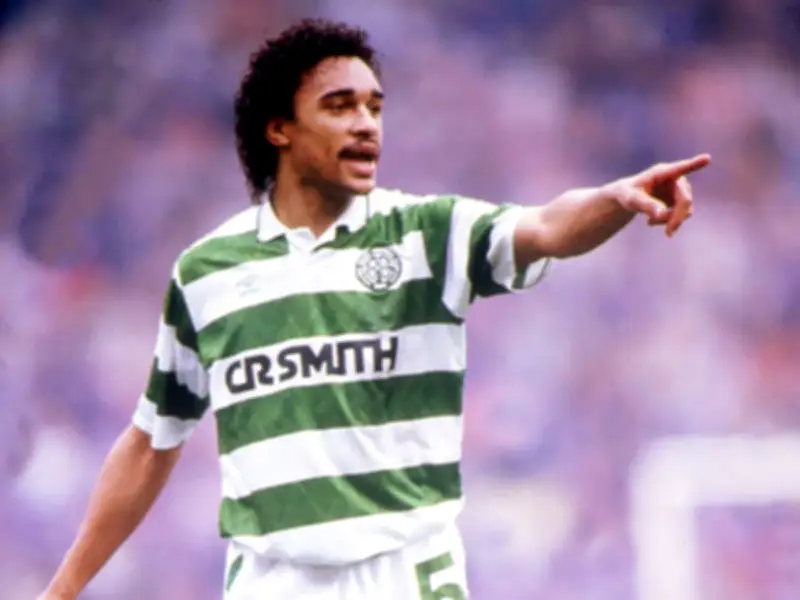
Former Celtic star Paul Elliott has said that the racist abuse he suffered in Scotland was "horrific". Elliott, the Premier League's first black captain, once took a bite out of a banana thrown at him by a bigoted fan – before scoring the winner against his team.
He was targeted by a thug who hoped the abuse would destroy his concentration – but instead he picked up the banana, took a bite and threw it back into the crowd before going on to score the decisive goal.
Refusing to Show Weakness
Speaking in support of the Hand of Hope anti-racism campaign, Elliott said the incident was an attempt to make him "show weakness" – but he refused to let it affect him.

He said: "It caused a lot of laughter in the ground, scoring the winner threw it back in that racist's face. After the match I told reporters that the extra potassium had made me play like a colossus. But the intention was to break me. I knew I couldn't show weakness."
His comments come as the new Premier League season kicks off with racism on the rise.
Inspired by Bukayo Saka
Elliott, who had spells at Chelsea and Aston Villa, was speaking in support of the new campaign, inspired by a touching gesture to Bukayo Saka, who was subjected to horrific racial abuse after missing a penalty in England's defeat to Italy in the 2020 Euros Final.
The loss robbed England of a first major trophy in nearly 60 years. Jadon Sancho and Marcus Rashford were also abused after missing in the shoot-out.
Now world leading artists have created 39 paintings honouring top athletes who have defied the racists, featuring Saka, Thierry Henry, Vinicius Jnr, Lewis Hamilton, Tiger Woods, Serena Williams and LeBron James.
The artists include Hayden Bone, who has been Arsenal's official club artist for the past five years. The artworks are set to go under the hammer, hoping to raise £100,000 for causes including anti-racism, and to encourage youth art worldwide.
Last night Hayden said: "The World Cup showed that racism in football is an ever-present curse. If art and football can combine to beat the haters, then we can turn the tide. What happened to Bukayo was evil but he never let them win."
The Hand of Hope Gesture
The Hand of Hope was a gesture made by England's Head Performance Chef Omar Meziane, who recalled: "It was a shattering moment, I instinctively reached out to Bukayo. His eyes were empty, I knew what was coming. I am honoured that this simple act of kindness has kickstarted a crusade against hatred."
Pioneering Elliott, who is Vice Chairman of Charlton Athletic Club and advises the English FA and Europe's governing body UEFA, added: "Saka deals with it in what I call the 'Saka way'. He is a racism assassin. In my 20s, I reacted badly to racism. He responds through his performances and character.
"That's what I love about him. He is the most amazing human being and you couldn't have a better role model. People like me talk and go on platforms. I am an activist and a lobbyist, but there is a different way to do it and that is the Saka way. What he does is reflective of his mindset, his character and his confidence in himself. That is incredibly powerful. That is such potent messaging."
Saka's redemption was complete in the triumphant World Cup third place play-off against France, signing off his country's campaign with a hat-trick, the last goal from the spot.
Vinicius Junior and John Barnes
Paul added: "He is a pivotal figure for the England football team. A potent symbol of our nation's enduring battle with empty-headed extremism and the inspiration behind the thought provoking Hand of Hope artwork.
"He has seen extreme adversity and the euphoria of scoring a hat-trick and representing his country. The art is simple but innovative and sends a very strong and powerful message."
He also praised Real Madrid and Brazil star Vinicius Jnr, who was racially abused during a Champions League game against Benfica last season – the club then managed by his new boss Jose Mourinho. "I really felt for Vinicius Junior when he broke down in a press conference. A world class player with great individual talent.
"But racism can break anyone and people don't realise the effects it can have if you let it.

"It dehumanises you. What he has done by speaking out with great elegance and eloquence is him saying what is going on is unacceptable and he should not have to put up with it.
"Four billion people a year watch the Premier League, millions more worldwide, it is colossal. But I see the upside of that because I see all the great role models – the likes of Saka and Vinicius Junior.
"You have generational people who made a great difference then and there will be ones in the future, to educate, mobilise people and create social change."
The paintings also include the notorious incident when Liverpool and England star John Barnes famously backheeled a banana thrown at him during an Everton v Liverpool derby.
That moment has been caught in a series of unique paintings for Hand of Hope.
It made a big impression on Paul: "I was disgusted but not surprised. But you use it to inspire you. Only someone with a first touch of John could anticipate that was going to happen. And he had the perfect manner and emotional intelligence to deal with that. Only he had the first touch to divert the banana midstream.
"It is remembered as a notorious incident, has achieved the polar opposite reaction."
Scotland and Sectarianism
Then came Scotland. Lisbon Lions legend Billy McNeill signed Paul for Celtic. Paul went on: "In Scotland it was racism combined with sectarianism. I was Celtic's first black player in the modern era, the first black Player Of The Year. But you already had sectarianism inbuilt. There was this dark side, a hundred years of history before me and that perpetuated racism.
"My childhood friend Mark Walters was playing for Rangers. That added to the whole intensity, we were the two pioneers, two high profile black players playing for the biggest clubs in Scotland. We had the most horrific abuse, I even got abuse from a minority of Celtic fans.
"I remember how some of our fans utterly abused Mark and vice versa. People even asked me socially: 'Why are you talking to him?' I said he was one of my best mates in football since playing together for England at 15. Now they have seven or eight black players. It's become the norm.
"I was 25 years of age and what was the best way to get people onside? The quality of what you do on the field of play. It was all those accolades I won there , leveraging my power to make that contribution and say to people: 'Don't judge me by the colour of my skin but by my ability on the pitch'.
"My memory is that most of them were the most wonderful people you could ever meet in terms of their humour, their fun loving. Now it's fantastic. They have embraced diversity.
"Look at the number of black players across the Scottish Premier League, I am very proud of that because it's the legacy of what I achieved, giving other clubs the confidence to go out and sign black players. It's the same with Mark as well.
"I am also proud of how many people say they remember me with such affection. I go back every year to the Player Of The Year awards. They are wonderful people but it's like everywhere, the majority are decent, it's the minority."
Paul was soon on the move back south to Chelsea: "Ken Bates signed me for Chelsea, and we all know the reputation Chelsea had over the years for the way black footballers were treated. Bates was a great man. He recognised that Chelsea had a big problem.
"He told me I was a leader on and off the pitch and a way to drive much-needed change at his club. Chelsea and Millwall fans were at the vanguard of the old National Front many years ago and it was quite ironic that I was eventually bought by Chelsea some years later and would be their and the Premier League's first black captain."
A Mindset of Resilience
Racism is bad enough out on the streets but the law can respond. Inside football stadiums it is so intensified, when thousands of people are using highly inappropriate language. It can make some people, it can also break them. In a way it made me.
"I was raised by two very strong Jamaican women in my mother and grandmother and we stand on the shoulders of these giants. My family came into the country as part of the Windrush generation. They understood about struggle, about abuse on the streets, about not being included in society."
The defender, who played in the hooligan heyday, went on: "There will always be racism. You need here and now punishment. There has to be zero tolerance. There has to be a sanctioning on behaviours but part of that has to be a pathway to rehabilitation. It's a process.
"Those women gave me the strength and resilience to understand so when I got involved with football I realised the problem isn't football but society and that followed me. It inspired me to go to the next level and show the racists that they wouldn't affect me.
"They have broken others but wouldn't break me. That mindset was the catalyst to have a successful career. It's not going to stop. If you think about the world, football is the most powerful medium to challenge behaviours, challenge stereotyping and bring people together. Then you have society.
"Football grounds are self-policed better, their reporting mechanisms are better, you have a different generation of fans. More women, more people with disabilities, more young children watching matches, It's more outward facing.
"Football is in a much better place. In my generation racism was unequivocally overt, Now it is covert. That comes from subtle nuanced behaviours. It comes from social media to exclude and marginalise people.
"There aren't the big voices and monkey chants anymore. There is more sophistication about it now. I say to many people you haven't walked in our shoes or lived our experiences."