Four travellers survived five days stranded in the Australian outback after their car became bogged in thick mud. The group, led by Brendan Cook and his partner Mel, with friends Matt and another Mel, had been travelling the Birdsville Track when they ignored a 'road closed' sign and turned onto a small track near a creek.
Car sinks into saline mud
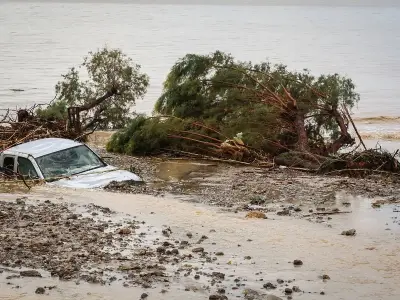
While on a nighttime 'spotlighting' mission, the car's wheels spun in thick, sticky silt. The next morning, they found the vehicle sunk up to its axles. Brendan described the mud as 'hard on top from the baking sun', but beneath the surface, the silt was 'really thick and horribly saline, disgusting, stinky and sticky'.
They spent an entire day in 45-degree heat trying to free the car, without success. By the end, they were hot, covered in mud, hungry, and worried about their water supply. They had a limited supply of food and water in the vehicle, and from early on, they realised they needed to be careful about consumption.
Desperate measures in extreme heat
On the following day, they used their tool kits to dismantle a barge, taking rusty poles and scrap metal to place in front of the tyres for traction. The conditions were gruelling, with flies so bad they had to wear mesh hoods. While the men worked, the women trekked miles to a water tank, only to find it empty. They dug a hole to collect hyper-saline water and tried boiling it, but it wasn't enough to keep them hydrated.
By the second day, they had run out of clean water. All that remained to eat were apples and muesli bars. With no cellphone service and the main road 12 miles away, there was little chance of a car passing. They hoped that when they failed to turn up for work, someone would raise the alarm.
Walking out against survival rules
On their fourth night, they decided to leave the car, going against a fundamental rule of outback survival. Brendan noted that most people found dead in the outback are not near their car. The group split up: Matt and Mel stayed with the vehicle, while Brendan and the other Mel set off on foot towards the road at nightfall. They heard dingoes all night, which Brendan described as 'terrifying'.
The following morning, they saw their first car in five days. The driver slowed down, looked at them, and sped away. They hadn't realised that other travellers might be scared of them. Exhausted and dehydrated, they built a structure across the road from tree branches and an old sign to make the next driver stop.
Rescue by Sydney couple
Hours later, a couple from Sydney arrived. Initially, they refused to give Brendan and Mel a lift, not trusting the dirty, haggard strangers. After negotiations, the drivers agreed to find Matt and Mel at the bogged car before returning. They handed over bottles of water and left. Hours later, they heard two cars approaching – the couple had found their friends and helped tow out the car.
Brendan expressed immense gratitude: 'We're incredibly grateful to that couple. Without the willingness of others to stop, help and share their expertise, the outcome could have been very different.'
When they returned to civilisation, they headed straight for the nearest bar, where they ate, drank, and told their story. But when the four returned home, nobody had realised they were missing. Brendan said, 'That was a surprising moment. You tend to assume that if something goes wrong, someone will notice fairly quickly. It was a reminder that in remote environments you can't rely on others knowing where you are or when to expect you back.'
Brendan and Mel have since married and moved to New Zealand, where Brendan is Chief Executive of Nelson Airport. They are now much more careful when camping with their two sons. Brendan hasn't been put off outdoor adventure but changes how he prepares for wilderness trips. He added: 'The lesson I learned from the desert experience however has remained a constant today. I always leave the house prepared, carrying a little extra food and ensuring my comms equipment is in good working order.'