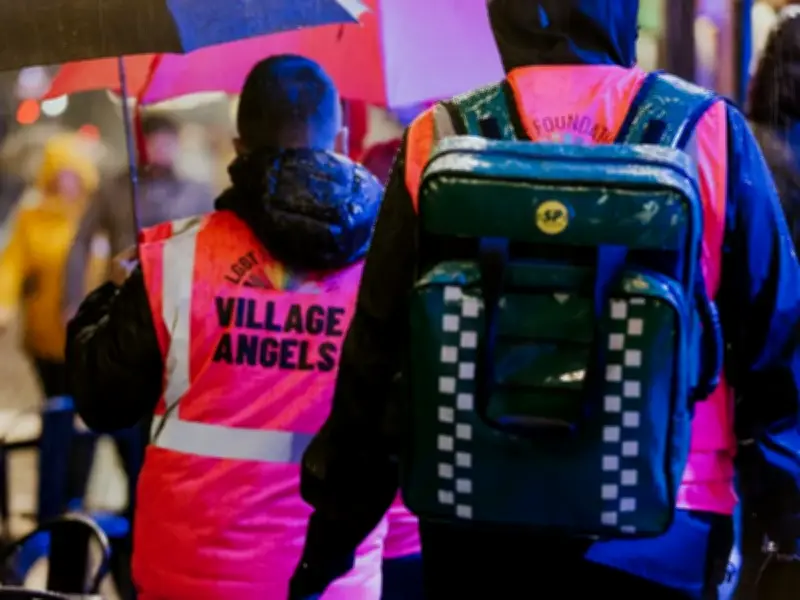
Walking through Liverpool city centre in a fluorescent pink high-vis jacket feels slightly surreal, especially when everyone around you is dressed for a night out and you are part of a group carrying first aid kits and sick bags. That was the situation when we joined the Village Angels on their Saturday night patrol on September 5, a volunteer group providing support and assistance to vulnerable people, from responding to mental health crises to administering first aid or helping them get home safely.
Extending the pilot
The project is run by LGBT Foundation, the UK's leading LGBTQ+ health and wellbeing charity, and was initially introduced in Liverpool as an eight-week pilot. It has now been extended and is supported by Merseyside Police, the Police and Crime Commissioner, and Liverpool City Council.
Their presence is intended to complement the existing network of people and organisations working to keep the city centre safe at night, but their approach is distinctive because it is based as much on conversation, reassurance and community as on intervention.

A night on patrol
We joined the Village Angels at 9pm in their Bold Street office, and after being welcomed and initiated into the group, we listened as team leader Kay discussed the plan for the night. Our time with the group would last only a couple of hours, while the volunteers themselves would remain on the streets until 3am, and after a debrief and wrap-up session, they would finally get home around 5am.
Over the course of the evening they recorded 139 interactions with members of the public, ranging from simple conversations and directions to more serious interventions involving people who are distressed or struggling to make their way safely through the night.
Each volunteer has their own reason for signing up. Some are motivated by personal experiences that left them feeling unsafe and want to ensure others don't, while some embrace the social and community aspect of the group. However, they are all guided by a very simple philosophy: if somebody needs help, they help them, regardless of who they are, where they come from or whether they are night-time revellers or workers finishing their shift.
We began our first patrol on Bold Street before making our way towards Mathew Street, through the Cavern Quarter and towards the Pride Quarter around Victoria Street, and eventually doubling back towards Concert Square.
Visibility and vulnerability
One thing you notice is that other people notice you immediately. Some smile, some wave, some stop to ask questions and others simply look on quizzically as you pass by, the flashes of pink clearly standing out beneath the neon signs and street lights. For the Village Angels, this visibility is precisely the point. They want people to know they are there, and, more importantly, they want people to know that if something goes wrong, there is somebody they can approach.
As the night gathers pace, the transformation of the city becomes increasingly obvious, with restaurants giving way to bars and clubs, queues forming outside venues and groups of friends moving between streets in various stages of anticipation, excitement and intoxication. The Angels move through it all with an attentiveness that is easy to miss if you are simply walking through the city yourself. They are constantly looking, not in judgement, but with the trained awareness of people who know that vulnerability can present itself in various different forms.
The interventions are often small, almost mundane, but that is part of what makes the work so valuable. A bottle of water, a plaster, a conversation, directions, a check that somebody has friends nearby or a quiet word with someone who is beginning to struggle can make the difference between a difficult moment passing without incident, and a situation escalating into something much more serious.
Facing challenges
On Mathew Street, out of nowhere, someone shouted a homophobic comment in our direction, then scurried off into the night when challenged. It was a particularly uncomfortable moment because these are people who have given up their own Saturday night to help make Liverpool safer for others, only to be subjected to exactly the sort of behaviour the Angels hope to protect people from.

The remark came from one person, but it illustrates a wider problem that remains part of the reality of nights out for members of the LGBTQ+ community. The Angels are highly visible precisely because they want people to feel safer, yet that visibility can also make them a target for the minority of people intent on intimidating and abusing others, and making the city less safe for those hoping for a nice time.
What is striking, however, is how quickly the moment passes and how little it dents the group's determination to do what they came here to do. The vast majority of the interactions are positive, and the volunteers told us afterwards that this is what sustains them. Numerous individuals, groups and couples approached them to say thank you, to tell them how reassuring it is to see them on the streets or simply to have a chat, and those moments, the Village Angels explain, more than compensate for the occasional abuse.
Responding to a question about why she joined up, team leader Kay said: "I volunteer with the Village Angels to give back, but it has given me so much more in return. Supporting others has brought me a deep sense of community and belonging. Facing new challenges through volunteering has built my self-assurance, giving me the courage and resilience to tackle personal hurdles with confidence."
Another volunteer told us they decided to join after their friend was assaulted, an experience that left them wanting to do something tangible to make the streets safer. Asked whether they felt fear while out on patrol, one of the volunteers explained that as a young woman visiting the city centre, she is used to dealing with that fear, and hopes future generations won't have to.
Community and coordination
That sense of community extends beyond members of the LGBTQ+ community. The Angels may have been established by the LGBT Foundation and may have particular expertise in supporting LGBTQ+ people, including reporting hate crime and connecting them with specialist support, but their offer is deliberately universal. Liverpool's night-time economy belongs to everyone, and keeping it safe requires more than one organisation or one approach.
The Village Angels are part of a much wider network formally linked with Merseyside Police, Liverpool City Council, Liverpool BID Company, City Watch, venue staff, security teams and other organisations working behind the scenes and on the streets. Like the individuals working for those other organisations, the Village Angels are DBS checked, and also trained in first aid, mental health support, and de-escalation.
It is this combination of approaches that helps Liverpool maintain its reputation as a destination where people can come to enjoy themselves without having to feel that safety is an afterthought. Liverpool is like every other city in that there are serious challenges around keeping city centres safe, especially during the night time and particularly at weekends when tens of thousands of people come in to enjoy Liverpool's hospitality, entertainment and events.
But the city has retained its Purple Flag status since 2010, an international accreditation recognising towns and cities with a diverse, well-managed and safe night-time economy, and the achievement is not simply about what happens when the lights are on and the city is busy with visitors. It is also about the people who remain when most of those visitors have gone home.
For the Village Angels, that can mean dealing with emotionally difficult situations for hours at a time, and the organisation recognises that the volunteers themselves need support. Regular debriefs, aftercare following shifts and ongoing support between patrols are built into the programme because helping vulnerable people can itself be emotionally and psychologically demanding, and requires the right training.
To achieve the required level of safety, there are several coordinated initiatives operated by Merseyside Police, Liverpool City Council, and local businesses, including the introduction of clearly identifiable Halo Points which provide safe spaces where people can quickly access support and reassurance. Additionally, there is on-street support with Village Angels, and trained Violence Against Women and Girls (VAWG) Champions, the SOS Liverpool initiative which connects people to trusted services, and coordinated communications between security staff outside venues.
There is also a strong police presence, as well as City Watch, licensed venues which receive safety training and support, and a range of commissioned safeguarding and welfare services. These organisations operate within recognised frameworks and have clear links to the agencies responsible for public safety and safeguarding, and include groups like the Village Angels.
By the time we left the Village Angels at around 11pm, the city was only beginning to reach its busiest period, and the team still had several hours ahead of them, moving through the streets in their pink high-vis jackets while Liverpool became progressively louder and more crowded around them.
On a Saturday night, Liverpool can feel wonderfully chaotic. It is loud, colourful, occasionally messy and full of people enjoying themselves, and that is precisely what makes the city such an attractive place to spend a night out. But beneath the laughter, music and drinking is an established network designed to ensure that when something does go wrong, people are at hand to offer support. It is a vitally important network involving brave and dedicated individuals and groups, some of them in pink high-vis jackets.