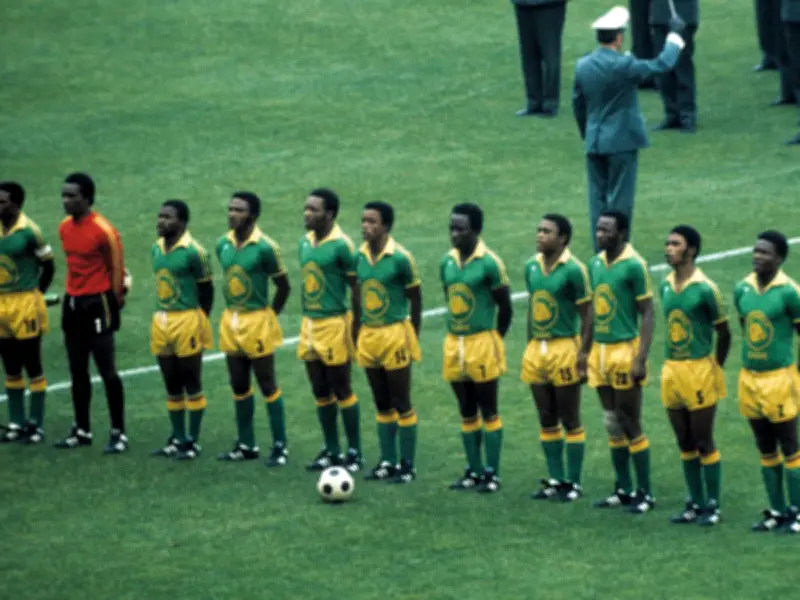
The 2026 World Cup marks the first tournament that DR Congo have played since they featured in the 1974 tournament as Zaire. And it’s fair to say the country has enjoyed a much better time of it than their appearance in West Germany, as the Leopards prepare to face England on Wednesday evening in the round of 32.
Zaire failed to score and shipped 14 goals in three defeats as they went down as one of the worst-ever teams to qualify for the World Cup, despite winning the African Cup of Nations in March of the same year. But it isn’t their dreadful results that are most remembered - rather one of their players being accused of "not knowing the rules" during a match against reigning champions Brazil.
The Infamous Free-Kick Incident
The farcical moment saw Mwepu Ilunga come running out of the Zaire wall from a free-kick and boot the ball up the other end of the pitch, despite Brazil’s superstars still working out who would take the effort. Everyone looked at Ilunga in bafflement, including his team-mates and the referee.
Critics at the time said it was an example of indiscipline in African football and tarnished the team’s reputation in the football world, after their previous result in the tournament was a 9-0 hammering by Yugoslavia. On English commentary, John Motson described it as a “bizarre moment of African ignorance”. And that was how it would be characterised for years to come, as the incident was referred to in derogatory terms such as “African amateurism”. It even earned Zaire the nickname of “clowns of football”.
The Real Story: A Deliberate Protest
Speaking to World Football, Ilunga later said his stunt was no act of stupidity. "I did that deliberately. I was aware of football regulations. I did not have a reason to continue getting injured while those who will benefit financially were sitting on the terraces watching." The player explained he had hoped to be sent off by the referee as an act of protest. "I know the rules very well, but the referee was quite lenient and only gave me a yellow card."
Despite racist assertions at the time that Ilunga was not aware of the laws of the game, the experienced player, who won a number of domestic and continental titles at club and international level, said he used it as a means of political protest.
The Political Context: Mobutu's Regime
Totalitarian dictator Mobutu Sese Seko knew the value of sport during his reign between 1965 and 1997, during which he changed the country’s name from Congo to Zaire in 1971 and presided over widespread human rights violations. He used sport as a means of political gain, including holding the ‘Rumble in the Jungle’ fight between Muhammad Ali and George Foreman in Kinshasa in 1974.
After Zaire had become the first country from sub-Saharan Africa to qualify for a World Cup with a 100% record, capped by winning the AFCON, Mobutu was delighted and invited the team to the presidential mansion. “You have to remember that for many of us, who’d been raised in poverty, meeting Mobutu was like meeting a god,” Ilunga told the author Jon Spurling for his book Death Or Glory: The Dark History Of The World Cup.
Brand new cars were promised to the squad, houses, and around £15,000 in today’s money was rewarded in cash. Excellent resources in West Germany were also assured for the tournament. But the money promised to the players dried up as officials from the government and national association piggy-backed on the ride. While the squad was completely humbled by the talent of their opponents, partially due to laws stating national team players must remain in Zaire.
Threats and Desperation
A commendable 2-0 defeat to a Scotland team boasting Kenny Dalglish, Denis Law, Billy Bremner and Joe Jordan was followed by the 9-0 hammering by Yugoslavia, which before kick-off, had seen government officials claim that Yugoslav authorities had convinced the team to hand over their gameplan. The entire turmoil resulted in a meeting taking place before the game where the players discussed boycotting the fixture. But they needn’t bother as they found themselves 6-0 down at half-time.
Serious threats were made to the players if they repeated the same performance against the eventual champions, as Ilunga recalled, they were told that if they lost by more than three goals, they would “never see Zaire or your families again”. He said: “They’d come with a message from Mobutu. He says you have all brought shame on to the country of Zaire. You are scum, and sons of whores. The great leader says that if you concede more than three goals against Brazil in the final match, you will never see Zaire or your families again. Your leader is disgusted in all of you.”
Ilunga's Final Act of Defiance
Furious with the reaction towards the squad, Ilunga told L’Equipe in 2014, a year before his death: “We were really unhappy. We had just spent two months far from our families, without anyone by our side. There weren’t the same forms of communication as there are today. And they take our money? You don’t do that. “At the same time, it was also an opportunity that I took to provoke the referee. I wanted him to give me a red card. I said to myself: ‘I’m not playing anymore.’ Why would I stay on the field and take the risk of not returning home when the others — the people who took our money — are watching us peacefully from the stands?”
When the squad returned home, the promises of money, cars and homes disappeared and many fell into poverty. “Many of us live like tramps,” Ilunga told Spurling. “If I could do it all again, I’d rather have worked hard at becoming a farmer.” However, in his later years, he was able to laugh about the incident. He appeared on David Baddiel and Frank Skinner's 'Fantasy Football League' show in 1998, starring in a famous 'Phoenix from the Flames' segment as he recreated the moment.