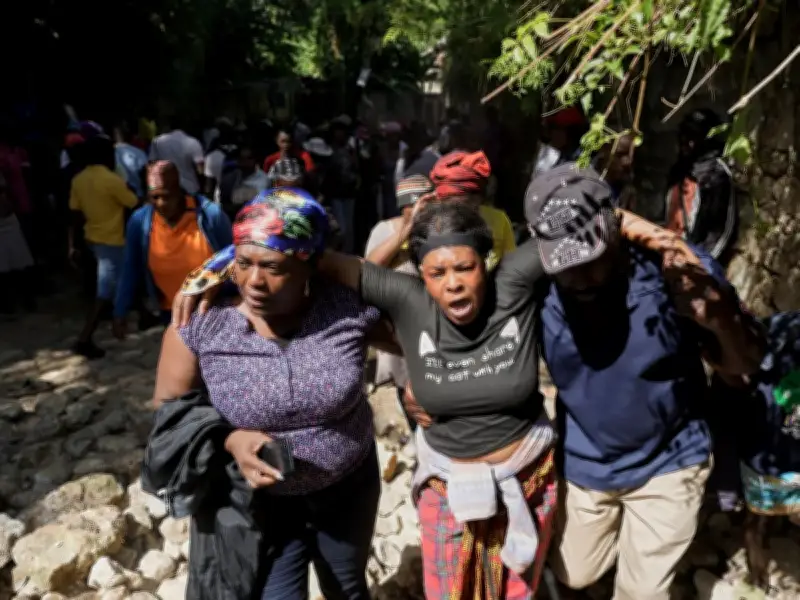
At least 47 people were killed and more than 50 others kidnapped when armed men attacked the community of Kenscoff, nestled in the hills above Port-au-Prince, on Sunday, August 23. The attack, described as one of the largest mass kidnappings in Haiti in recent years, has shattered the belief that security in the country was improving, according to the United Nations.
Attack Details and Immediate Aftermath
The assault on Kenscoff, a community that had largely avoided the worst of Haiti's gangland violence, resulted in the deaths of at least 47 people, including five children, according to the United Nations Integrated Office in Haiti (BINUH). More than 50 others were kidnapped. A gang leader has threatened to kill the hostages if authorities kill any gang members during efforts to secure the area.
Kenscoff resident Marc Paul, 42, said gangs kidnapped his brother, stepmother, stepfather, and two cousins. His 16-year-old niece was also kidnapped and raped but managed to escape and reunite with him. "I had to run over bodies," he said, recalling his flight from the attack. "I can't sleep knowing all these people died." Paul's family had already lost their home to a previous gang attack in January 2025, but he said it was not as violent as Sunday's attack.

Gang Threats and Police Response
In a video posted on social media, a gang leader identified as Izo 2, also known as "Didi," threatened Haiti's National Police director, Vladimir Paraison. "Paraison, if any of our soldiers are hurt, I will kill all of them," he said, referring to the hostages. Romain Le Cour, head of the Haiti Observatory at the Global Initiative Against Transnational Organized Crime, said Izo 2 leads the armed group in Kenscoff on behalf of and in coordination with Izo, or Johnson André, one of Haiti's most powerful gang leaders.
Le Cour described the threat of executing hostages as a trap: if forces don't act, they have failed to protect the hostages; if they do act and hostages die, the gangs will blame the state. He said the attack could be aimed at forcing Haiti's police and the U.N.-backed gang suppression force to disperse their limited resources. "They don't have enough personnel. If you force them to deploy more troops, it would inevitably be at the expense of other areas," he said.
Wider Implications and Government Response
The attack may also be a show of force and a message to Haiti's government and police as the country prepares to hold general elections on December 13, the first in more than a decade. "This is a message to the government and the police that their claims of protection do not match reality," Le Cour added. "The gangs are saying: when we choose to attack, we can, and we will succeed."
Kenscoff Mayor Jean Massillon said on Tuesday that gangs set fire to 25 homes and killed two government employees, including his cousin, who served as his security detail. "The atrocity of this crime reminds us that we have to continue working stronger every day to bring peace to the community," Massillon said. "I'm optimistic that the state will continue working to eradicate the gangs in Kenscoff."
U.N. Secretary-General António Guterres condemned the attack on Tuesday, noting that 22 of the victims were reportedly executed in a church compound where they had sought shelter. "The relentless gang attacks on communities and the loss of lives underscore the alarming security conditions in Haiti," he said.
Background and Statistics
Gangs are coveting Kenscoff because it allows them to surround and control the upscale community of Pétion-Ville and alternate routes connecting Haiti's capital to its southern region, said María Fernanda Arocha, a researcher with the nonprofit Armed Conflict Location & Event Data. Between January and August this year, security operations had managed to reduce violence in Kenscoff by two-thirds prior to the attack, she said in a statement.
"While security forces have concentrated their efforts on operations aimed at regaining control in the central areas of Port-au-Prince, criminal groups have instead sought to expand into rural communities that are vulnerable due to the limited response capacity of the police, but which remain strategic hubs," she added.

Some survivors accused the government of not providing enough protection prior to the attack, accusations that Haiti's National Police rejected. The police issued a statement Tuesday saying Paraison ordered an investigation to establish the truth about the attack "whether due to complicity or negligence." He also ordered additional specialized units to the area, saying "It is an obligation to protect the civilian population."
Armed men control an estimated 70 percent of Port-au-Prince and swathes of land in Haiti's central region and beyond. Gang violence has displaced a record 1.5 million people across Haiti, where more than 3,050 people were reported killed from January to June, according to U.N. statistics released Tuesday. The U.N. noted that nearly 800 rapes were reported from April to June, with 87 percent of those cases representing collective rapes. At least 81 people also were reported kidnapped during that time period, according to a new U.N. report.
"These figures represent only a portion of the total number of people kidnapped," it stated. "In many cases, victims' relatives do not report kidnappings to the police or service providers and choose to negotiate directly with the kidnappers, believing that this approach allows for a quicker release and avoids possible reprisals." The number of kidnappings reported from April to June represents a more than 40 percent increase compared with the previous quarter.