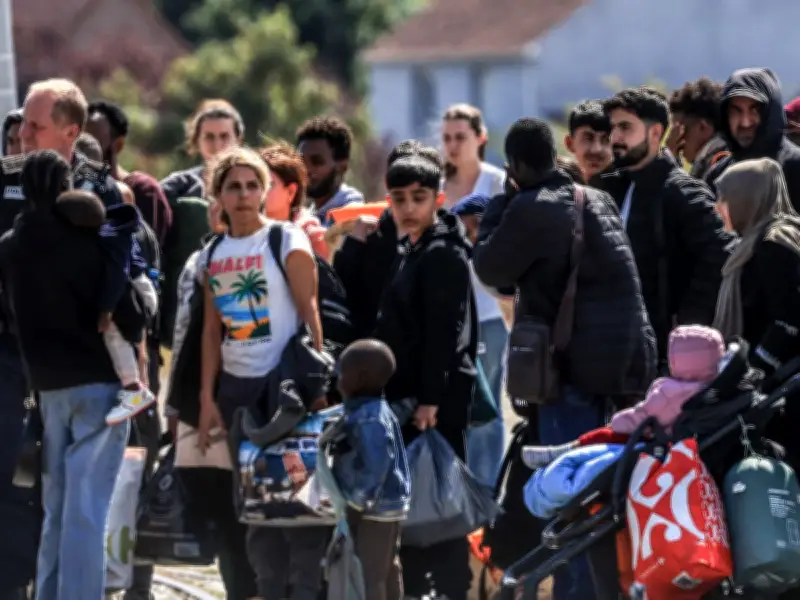
Exclusive images reveal the human face of the Channel boats crisis, showing young children, including some in pushchairs, being bussed to board mega-dinghies bound for Britain. Investigators tracked a group of around 50 migrants, including small children and women, earlier this week as they travelled about 40 miles south-west from France’s largest migrant camp at Loon-Plage, near Dunkirk, to Ecault Forest, close to Boulogne.
The group had paid around £1,200 each to make the final leg of their journey to the UK. They also paid extra for lifejackets, sold at stalls in the Loon-Plage camp for up to €50 (£42) – almost double the price in nearby shops.
Charity reports rise in women and children
Katie Sweetingham, Head of Operations at charity Care4Calais, says she has seen increasing numbers of women and children, including babies, at the camp since the UK government indefinitely paused family reunion applications in September last year. She said: “Lots of women and children would use that scheme to be reunited with their loved ones in the UK and now that option is not available. So they have to get into a boat and make that dangerous crossing.”
The journey observed on Thursday seemed complicated. After being taken from the camp to a bus stop in Loon-Plage, the group boarded a bus to Gravelines. Following a lengthy wait, they then took a second bus from Gravelines to Calais, before boarding a train to Boulogne, where they got on another bus to the edge of the forest.
French police follow but do not intervene
On getting off the final bus, they made their way along hiking paths to a makeshift dwelling inside the protected natural site, which includes various camping spots for caravans. They appeared to be guided by a tall man, believed to be Kurdish, who had a distinctive tattoo on his right hand. French police, including armed gendarmes, followed the migrants throughout the four-hour journey, including walking with them into the forest, but made no attempt to stop them.
Good weather has led to perfect sailing conditions so far this summer, causing a spike in crossing attempts by gangs. Four migrants, including three women, have died in separate boat tragedies in the Channel in recent days. With favourable conditions expected to continue until at least September, there are fears of more tragedies.
Smugglers exploit new launch sites
Investigators say traffickers are increasingly exploiting the Opal Coast, south of Boulogne, to launch dangerously overloaded rubber boats following a crackdown further north in Calais and Dunkirk. They use new mega-dinghies bought from manufacturers in China. Despite being completely unfit for open seas, the boats are used to transport more than 150 migrants at a time, netting the gangs up to £200,000 for a single trip.
Ordering a mega-dinghy previously took months and involved a 5,500-mile journey by road, via countries including Kazakhstan and Turkey, costing traffickers at least £10,000. However, at least one factory is now offering direct delivery by plane to France, in packages measuring just 2m x 1m x 1m. The vessels are advertised online as Huge Large Super Inflatable Pontoon Rescue Boats, and cost just £1,200, but are billed as designed for 40 people, not 150. The maximum delivery time is just two weeks.
Charity warns of increased danger
Katie said: “We’ve heard about the bigger dinghies from the people we support. It’s a recent change. It just goes to show that all of the border security measures, largely funded by the UK, don’t do their stated aim of stopping the crossings. All they do is make people that are organising the crossings change their business model, which is now the larger boats, making it much more dangerous for the people that are attempting crossings.”
Katie says she and her team regularly meet children as young as 13 trying to cross to Britain without adult supervision. She said: “It’s usually going to be those younger people that are targeted for driving the boat and then on entry to the UK they’re much more likely to be criminalised and not believed for their age.”
Recent tragedies highlight risks
A week last Thursday, a boat overturned in the water near Ecault Forest, causing the death of a man and leading to the near-drowning of a baby. The same day, three women in their 20s, 30s and 40s drowned after an inflatable dinghy with more than 100 people on board capsized near Loon-Plage.
Katie said: “More people are dying trying to make the journey. A lot of them speak to us and say they’ve been on a boat and they’ve seen their friends die in front of them, but then they will say ‘what else can I do?’ There’s no other way for that person to be able to reach safety in the UK to be able to gain asylum other than to repeat that journey again and try again.”
Average boat occupancy more than doubles
Figures have just revealed the average number of migrants crammed per boat has more than doubled over five years. Analysis found 66 migrants on average have been packed on to each of the 219 vessels to cross the Channel successfully this year, carrying 14,561 passengers in total. An average of 27 per boat was recorded for the whole of 2021, when 1,064 vessels carrying 28,526 migrants made it to the Kent coast.
A source said: “These so-called mega-dinghies are hugely profitable and the smugglers are getting hold of them very easily. Their emergence means a huge number of people can be moved at one time, but always in extremely and increasingly dangerous circumstances. Frankly, it is a nightmare development for the authorities.”
An Egyptian man yesterday began a one-year prison sentence in France after being convicted of trying to smuggle a record 173 migrants into Britain on a 40ft mega-dinghy that burst into flames in the Channel. An Iraqi-born people-smuggler, named by police as Rasoul Halo, was on Tuesday also imprisoned for a year, for smuggling an inflatable boat on to a beach. Halo, who was found with three passports including a British one, claimed he was just helping a friend with a delivery.