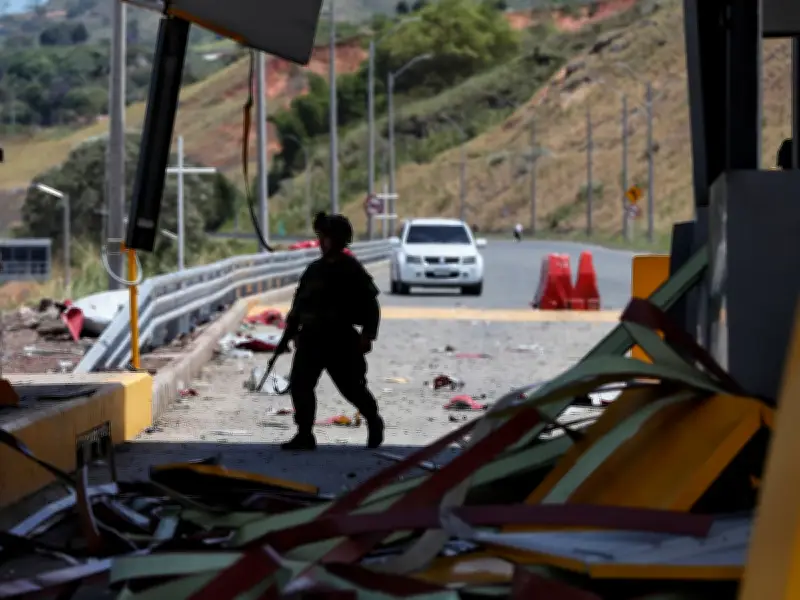
A car bomb exploded in Colombia the day after the country's new president took office. The blast targeted a toll plaza on the Pan-American Highway in the south-west, causing minor injuries to two security guards.
Attack blamed on FARC dissidents
The Colombian army blamed the attack on two dissident groups of the now-defunct Revolutionary Armed Forces of Colombia (FARC). These splinter groups have refused to honour a peace agreement signed a decade ago with the Colombian government.
One of the guards reported that the explosion came from an abandoned vehicle after the driver fled on a motorcycle. The attack occurred on the road connecting the departments of Cauca and Valle del Cauca, whose capital, Cali, hosted Friday's swearing-in ceremony for President Abelardo de la Espriella.
President's warning and response
During his inaugural speech, the conservative politician warned illegal groups that "they have two paths: submit to the rule of law or confront the security forces."
Armed forces descended on the scene, with the army stating on Saturday that soldiers were securing the area and using trained dogs to search for other explosive devices. Transportation Minister Elsa Noguera condemned the attack and said work was under way to restore traffic in the area.
"Colombia will not kneel before violence, nor will it allow the destruction of the infrastructure that connects our regions," she wrote on social media.
Prison transfer and political context
Also on Saturday, de la Espriella announced the transfer of 117 prisoners linked to the previous administration's peace talks to eight maximum-security prisons. According to the country's corrections agency, the measure aims to "regain permanent control of the prisons" and "contain any capacity of criminal organisations" to coordinate illicit activities from within prisons.
De la Espriella has rejected the dialogue with armed groups promoted by his predecessor, Gustavo Petro. With no prior political experience, the 48-year-old lawyer and businessperson narrowly defeated Ivan Cepeda, a progressive senator and Petro ally, in a June runoff election in a polarised political climate.
His term begins with a robust opposition led by Petro, who refused to acknowledge his victory and insisted on alleged fraud despite the official declaration from the electoral authority and the positive assessment from international observers.