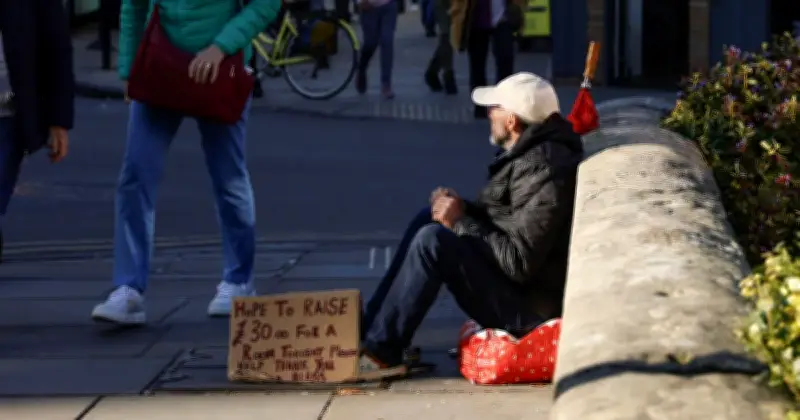
Cambridge, one of the UK's wealthiest cities, has a significant rough sleeping problem, with 40 people counted on the streets each night by the charity Jimmy's. The figure comes on top of 81 people in its accommodation, and many more are thought to be sofa-surfing or sheltering on night buses and in hospital A&Es.
Just a stone's throw from King's College, some of the city's most destitute sleep in shop doorways on cobbled streets. Jimmy's outreach workers pick many up and give them shelter to help rebuild their lives. For most, their situations are more complicated than just losing a home. Many drink alcohol to numb trauma and mental pain, starting a vicious cycle that is hard to stop.
Wealth and inequality in Cambridge
Property prices in Cambridge average £475,000, while the average rent is £1,806, according to the Office for National Statistics. The Centre for Cities Outlook 2026 report ranks Cambridge second in the country for workplace earnings and seventh nationally for living standards, yet it is frequently labelled as the most unequal place in the UK.
Natasha Davies, chief executive of Jimmy's, says: "It's an incredibly wealthy city, but homelessness and street rough sleeping are everywhere. You cannot walk through the golden mile within this city without coming across somebody with a sign asking for cash or a sleeping bag, or all of their possessions around them."
Cameron Holloway, leader of Cambridge City Council, wrote last year that the city's inequality has become a "depressing truism". He said rapid economic growth has created huge wealth for some, while others struggle with soaring house prices and a feeling that the 'Cambridge Phenomenon' is far from their day-to-day experience.
Complex needs and services
Davies says those falling into homelessness have increasingly complex problems. "Gone are the days of the wanderer type of individual who just simply hasn't got anywhere to live," she says. "What we're seeing is individuals with really complex needs arriving in our services."
Jimmy's has a round-the-clock emergency centre in East Road and a complex needs hostel in Newmarket Road, with a two-year waiting list. Among those using its services is Tyrone Scott, who came to the centre in November after losing his home when his mother died. He moved to a modular home provided by Jimmy's in April and volunteers at the charity.
Davies says mental health problems are often the root cause of homelessness. "Generally, the addiction issues we see are a mechanism of coping with mental health issues," she explains. "There's a lot of self-medication... and then it becomes this perpetual cycle."
Plans for a new centre and national pledge
Jimmy's says it has outgrown its ageing East Road premises and is raising millions for a new purpose-built centre. The plans include full-size studio apartments, co-located NHS and treatment services, a café, and social enterprises. The new premises need to be ready when the lease on the current building expires in 2032.
Prime Minister Andy Burnham, who studied at Fitzwilliam College 35 years ago, made eradicating rough sleeping his first promise on the steps of Downing Street and wants all rough sleepers off the street at Christmas. Davies recalls: "I think the whole sector took a sharp intake of breath when that was the first thing that was announced."
However, Davies notes: "We haven't seen any of the funding come through yet. We'd like to see some action now." She believes ending rough sleeping is "absolutely achievable", citing Finland's "housing first" policy, but warns: "The moment it falls down is when you take your foot off the gas, and you stop funding it."
Sarah Hall, a Jimmy's volunteer for 13 years, doubts Burnham's pledge will be achieved. "You can't just put vulnerable people anywhere," she says. "The whole system needs a boot. Everyone knows there isn't any money. It's about the Government not building enough homes in the first place."
Davies calls the situation "a national shame" and says: "If one person has nowhere to go but sleep in a shop doorway, it is a comment on our society." Of those who come through Jimmy's doors, she says: "They are joyful. They are hilarious. They are funny. They are wily individuals. They have so much potential and so much ambition and so much hope for their futures."