The US federal government is sweeping up protesters against Cop City, a police training center outside Atlanta, in its push to prosecute what it calls “antifa” – even as state attempts to prosecute activists over the same incident failed for the second time this week.
The case offers insight into the Trump administration’s drive to link the idea of anti-fascism to terrorism, drawn into focus by the decades-long sentences given to protesters against US Immigration and Customs Enforcement (ICE) in the Prairieland trial in Texas, also this week.
State Cases Dismissed Twice
“It’s the federal government creating a boogeyman and then finding incidents to match,” said Xavier de Janon, an attorney who represented Dr Hannah Kass, one of the three defendants named in the Cobb county, Georgia, case that a judge dismissed on Monday.
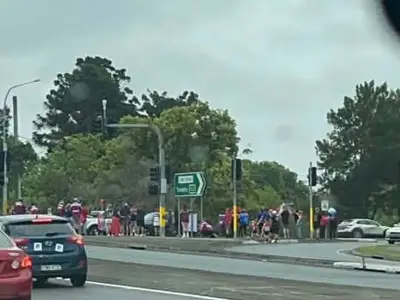
The federal and state cases center on a protest outside the offices of Brassfield & Gorrie, the lead construction company behind the police training center. On 12 May 2022, about 50 protesters gathered at the suburban Cobb county location, with banners and chants. At some point, several allegedly set off fireworks and caused damage to the company’s property. Those actions led the state attorney general, Chris Carr, to include three people in the criminal conspiracy, or Rico, indictment of August 2023. Several years later, in December, a Fulton county judge dismissed the indictment. The state has since appealed against the dismissal.
Then in April of this year, the state tried to indict the same three people, over the same acts, in neighboring Cobb county. Judge Robert E Flournoy dismissed that case on Monday, writing in his decision that the defendants’ constitutional due process rights had been violated by the “inordinate delay between the time the crimes charged here were allegedly committed and the bringing of the Indictment”.
Federal Indictment Under Trump Initiative
Nonetheless, the Department of Justice indicted two of the three – Katie Marie Kloth and Tyler John Norman – earlier this month. The justice department press release said the action was “part of the National Security Presidential Memorandum 7 initiative”. Released by Donald Trump in September, the initiative is aimed at combating “violent and terroristic activities under the umbrella of self-described ‘anti-fascism’”. That same week, on 22 September, Trump also issued an executive order labelling “antifa” as a “domestic terrorist organization”. The indictment refers to “explosives” and “fire” – a reference to fireworks protesters set off – and “riot and civil disorder”.
On hearing of the federal indictment, De Janon thought of the Prairieland case. A jury had already found defendants guilty of material support for terrorism and other charges in March. “Perhaps because of the Prairieland verdict, [the federal government] felt emboldened to try again,” he said.
Language and Narrative in Prosecution
“The Cobb county protest matches the narrative of what they’re looking for,” he added. “It’s similar to what they did with Prairieland – they’re crafting a certain narrative on protests and trying to indict based on the narrative,” he said.
Will Potter, an author and film-maker who has researched government responses to protest, pointed to the language used in the current administration’s efforts. “Fireworks become explosives. Communities become ‘antifa cells’. The power of language is going to become central to everything the government is doing moving forward,” he said.
The role language plays in the attempt to transform ideas gathered under the umbrella of anti-fascism into terrorism – and the realities named and ignored by the effort – was highlighted at the Cobb county hearing earlier this month where Flournoy dismissed the case against the Cop City protesters. At one point, state prosecutor John Fowler was describing the protesters at the construction company and their black clothes and masks, part of his attempt to depict their criminality, said De Janon. The judge interjected: “Oh, that sounds like ICE.”
Historical Context of Labeling Protesters
Arun Kundnani, an author of several books on political violence and radicalism, noted that government efforts to label protesters as terrorists date back at least to the 1970s, when the label was wielded against the Black Panthers and others. The same tools were then used against Muslims in the US post-9/11, he said. “If you want to criminalize protesters, you link them to a terrorist group,” he said. “Antifa exists as a concept – but not as a terrorist organization. They know if you characterize antifa as a terrorist organization, it enables all kinds of criminal prosecution,” he said.
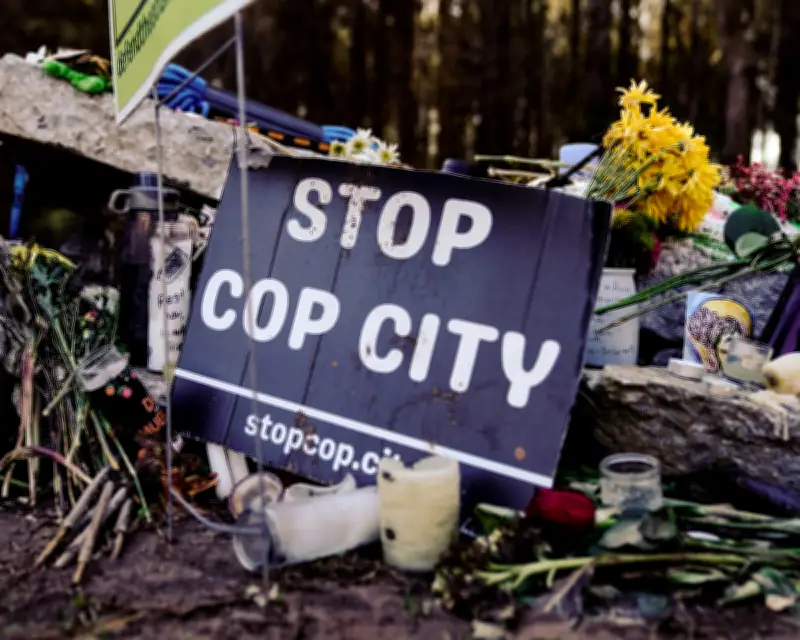
The movement against Cop City “obviously has symbolism … and is important to the Trump administration,” Kundnani added. “With its opposition to law enforcement, it has attracted heavy prosecution.” Opposition to the $109m police training center, which finally opened last spring, came from a wide range of local and national organizations and protesters, centered on concerns around police militarization and clearing forests in an era of climate crisis. Atlanta police said the center was needed for “world-class” training and to attract new officers.
Ongoing Legal Battle
In the case of the Cobb county protesters against Cop City, the “heavy prosecution” has meant withstanding what will soon be five years of one jurisdiction failing to convict them of any crime, followed by another, also met by failure, and now another. Potter pointed out that the stakes involved in such efforts are higher after the Prairieland sentences. “One thing we have to come to terms with right now is that the idea, ‘these are outrageous cases, they’ll never hold up in court’ is not the point. Even if they don’t hold up, the government might modify the case and keep on going,” he said.
Nonetheless, De Janon noted that the FBI and other federal agencies have been investigating the same acts in Cobb county since 2022, along with the state of Georgia – and “the same due process protections that got this case dismissed at the state level should definitely apply for the federal prosecution.” De Janon added: “If the federal government knew about these incidents since they happened and also did not prosecute until they figured out a strategy … then it’s the same due process violations and perhaps they’re even clearer because they waited and waited and waited until the iron was hot to strike” – meaning the Trump memorandum and executive order and the Prairieland sentences.
“The bottom line is people are being criminalized because they don’t want a fascist government, because they want a democratic government, because they want freedom,” he said.