More than two dozen protesters were arrested outside the Supreme Court on Wednesday as the appeal against the ban on Palestine Action began.
Huda Ammori, activist and co-founder of the group, launched the legal battle following the Government’s decision to ban the group under anti-terrorism laws.
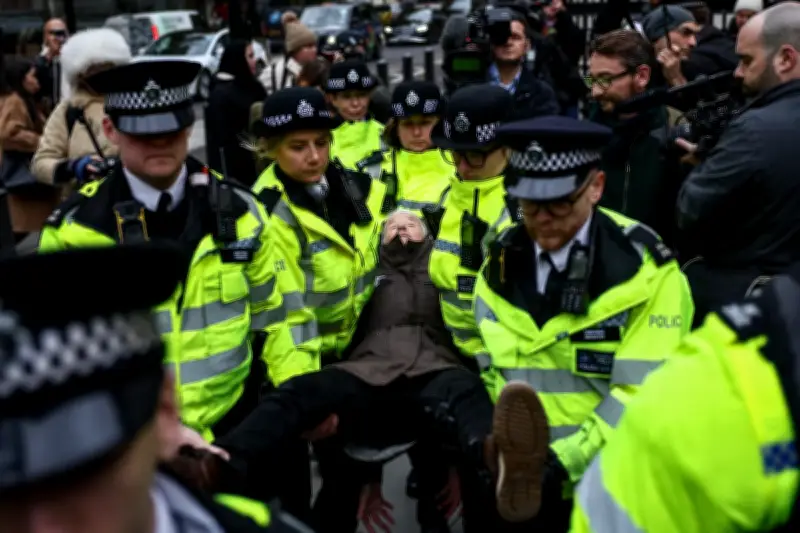
Before the hearing started on Wednesday morning, a group of demonstrators assembled outside the central London court, with police officers seen carrying several people away into nearby vans. The Metropolitan Police later confirmed that 25 people had been arrested.
Protest signs and celebrity support
Demonstrators were seen holding placards with the words: “God help us authors who support Palestine and Palestine Action”, aping the words of Sarah Helm, the wife of a national security adviser who posted the statement on X in October. Protesters inserted different words instead of “authors” on their signs, including “normal people”, “students” and “sons of Holocaust survivors”.
Harry Potter actor Alfred Enoch held up a sign reading “this is democracy not terrorism” as other demonstrators were removed by police. He told the Press Association that he hoped the ban on Palestine Action was dropped, adding: “You can see the chilling effect it’s had. I think it’s part of a wider erosion of rights of protest, which is fundamental to a democracy. People don’t even feel safe enough to come out and say that.”
Legal arguments in court
In written submissions in court, Raza Husain KC, for Ms Ammori, argued that only three of the 385 actions carried out by Palestine Action over a five-year period were assessed as meeting the definition of terrorism under part of the Terrorism Act. He continued: “This was solely on the basis that they involved ‘serious damage to property’. In other words, the Home Secretary’s advisers assessed that less than 1% of Palestine Action’s direct action protest activities over five years fell within a definition of terrorism.”
Mr Husain added that the ban has led to “the total destruction of a protest group which enjoyed widespread support from across civil society”.
The case came to the Supreme Court after Ms Ammori challenged then-home secretary Yvette Cooper’s 2025 decision to ban the group at the High Court, with three judges finding in February that it was unlawful. But five Court of Appeal judges overturned the decision in June, finding the ban was lawful and a “justified and proportionate” interference with freedom of expression rights.
Home Office and Jewish groups respond
The Home Office, which is opposing the appeal, has said the Court of Appeal made no legal error. In further written submissions, Sir James Eadie KC, for the Home Office, said the Court of Appeal had rejected Ms Ammori’s attempt to portray Palestine Action as a “non-violent direct action protest group”. He added that the group’s ban does not prevent public support for Palestine or opposition to Israel and the Israel Defence Forces, and that there are still “vocal large-scale and frequent expressions of support for the pro-Palestinian cause” with only direct support of Palestine Action restricted.
In written submissions on behalf of the Community Security Trust and the Jewish Leadership Council, Adam Wagner KC said the UK Jewish community is “especially vulnerable to Palestine Action’s violent activities” as activists had attacked “Jewish charities and Jewish-owned businesses”. He said lifting the proscription would “re-arm and revitalise a sinister and dangerous movement” and could serve as a “green light” for perpetrators of “violent antisemitism more broadly”.
The hearing, before Lords Reed, Sales, Lloyd-Jones, Briggs and Stephens, is to last two days, with a decision expected at a later date.