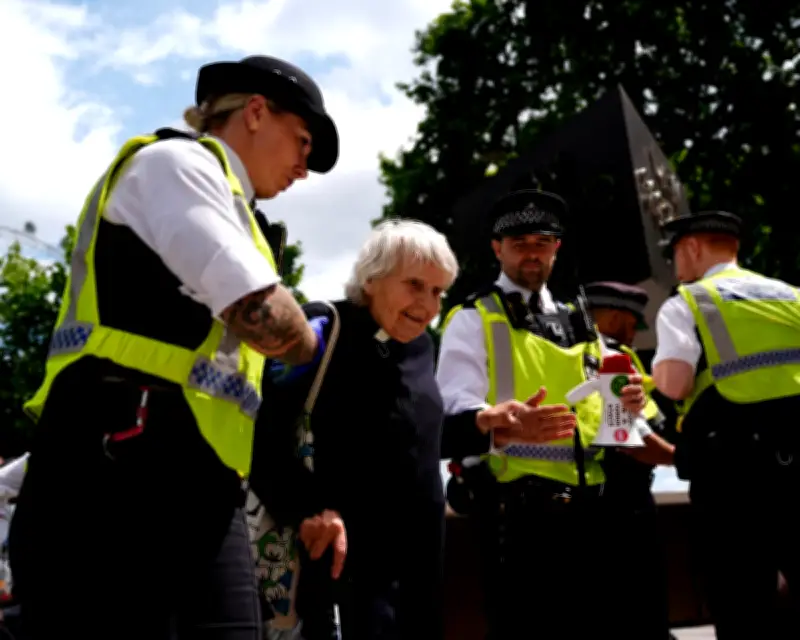
84-year-old Reverend Sue Parfitt, a retired Anglican priest, and 13 other activists were arrested under the Terrorism Act on Sunday after stepping onto a cardboard box outside New Scotland Yard to invite support for the banned direct action network Palestine Action. The arrests occurred on the one-year anniversary of the proscription of Palestine Action, the first direct action protest group banned under the Terrorism Act.
Arrests Under Terrorism Act
The activists were arrested under section 12 of the Terrorism Act, which carries a maximum sentence of 14 years' imprisonment. As a courtesy to the advanced age of some protesters, elders were not handcuffed. The arrests were part of a significant escalation by the campaign group Defend Our Juries, whose Lift the Ban campaign has already resulted in more than 3,400 arrests of peaceful protesters holding cardboard signs reading "I oppose genocide. I support Palestine Action."
Background of the Ban
Former home secretary Yvette Cooper announced the ban on Palestine Action in June 2024, days after two members broke into RAF Brize Norton and defaced two military aircraft with spray paint, causing an estimated £7 million in damage, according to the Ministry of Defence. The group stated they "interrupted Britain's direct participation in the commission of genocide and war crimes across the Middle East."

Legal Challenges and Convictions
Palestine Action has fought the proscription through the courts. In February 2025, the High Court ruled the ban was wrong, but in June, five appeal judges overturned that decision, declaring the ban lawful. Last month, four Palestine Action activists received prison sentences of four to eight years for breaking into Elbit Systems UK, a British subsidiary of Israel's largest privately owned arms manufacturer, and causing grievous bodily harm to a police sergeant. The judge ruled a "terrorist connection" to their offending, a determination that had never been used before in a case involving property damage, according to legal affairs correspondent Haroon Siddique.
Escalating Tactics
Defend Our Juries shifted tactics on Sunday. Previously, holding cardboard signs could result in six months' jail time. Now, the 14 activists asserted their membership of the proscribed group and invited support for it, offences under Sections 11 and 12 of the Terrorism Act that must be heard before a jury and carry up to 14 years in prison. The group has also shared social media videos of individuals inviting similar charges, including 69-year-old Marji, a retired tax adviser and grandmother of seven, who wrote "Palestine Action" on a freezer label stuck to her English Heritage membership card. Haroon Siddique noted, "They're daring the authorities to prosecute them under section 11 or 12 as opposed to section 13, because they might well feel that if it goes to a jury trial, juries will acquit them." None of the 48 video-makers have been contacted by police so far.
Impact on the Right to Protest
Civil liberties groups warn that the definition of terrorism is becoming dangerously broad. While the Terrorism Act includes serious property damage, many lawyers argue it was never intended to capture groups like Palestine Action or Greenpeace. Haroon Siddique highlighted concerns: "What constitutes serious property damage? We've seen climate protesters smashing windows of banks – where do you draw the line?" Labour has introduced further protest restrictions since coming to power, including allowing police to consider the "cumulative impact" of repeated protests and a new offence of concealing identity during protests. Research by Queen Mary University of London found custodial sentences for direct action are increasing in length and frequency, creating "a new breed of political prisoners."
Human Consequences
Eight Palestine Action activists went on hunger strike in late 2025 to protest pre-trial detention conditions and the ban. They are recovering slowly but have lasting symptoms, including memory problems, according to Haroon Siddique.

Future Challenges
Huda Ammori, co-founder of Palestine Action, has pledged to challenge the ban in the Supreme Court and the European Court of Human Rights. An additional domestic challenge will be heard in Scotland later this week, where campaigners hope to argue that the arrest of sign holders violated their human rights. With an imminent Labour leadership change, the approach of Andy Burnham, who has declined to describe the destruction of Gaza as a genocide, will be watched closely. Trudi Warner, a Defend Our Juries observer, said of the protesters: "These people were saying clearly 'We are not terrorists'. Palestine Action opposes genocide in Gaza – it takes its moral responsibility seriously. I would encourage the UK government to do likewise."