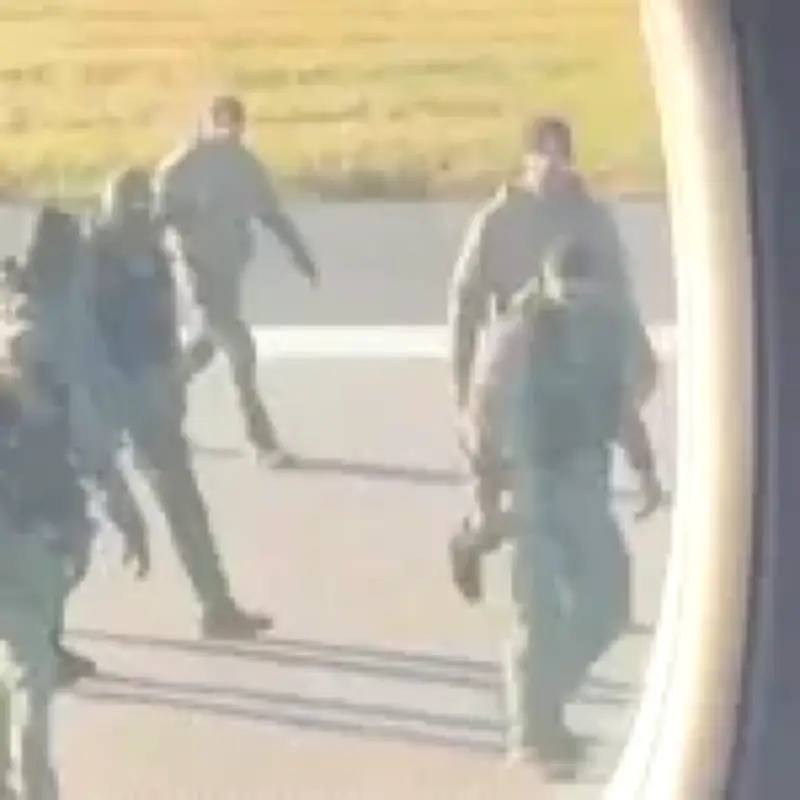
At least 25 planes were forced into emergency landings across Europe yesterday after bomb threats that the government has called malicious hoaxes. The incidents followed several flights, including some departing from the UK and Ireland, being subject to hoax security alerts earlier this week.
The threats were made by a group calling itself Fighters of the Male State, which reportedly threatened to 'turn the skies red' with explosions. The group claimed to be targeting a 'feminist regime' and stated they hoped to 'make our mark on history'. It is not clear if they are linked to Male State, a Russian far-right misogynistic online hate group.
How airlines respond to threats
Police and staff at the affected airports confirmed that searches revealed no explosives, adding there was no evidence the threats were genuine. According to Joji Waites, director of flight safety, policy and regulation for the British Airline Pilots' Association, threats are initially assessed as either credible, partially credible or not credible.
If deemed credible, the flight crew is informed immediately and the captain takes charge of deciding the next steps, guided by a safety checklist. Planes still on the ground will be evacuated, while those already in the air will prioritise landing as soon and as safely as possible, Mr Waites told the Associated Press.
Cost of diverting flights
'Pilots are highly trained and skilled professionals,' he added. 'Their expertise is invaluable in ensuring passenger safety and keeping aviation one of the safest forms of transport there is.' Airlines, airport operators and law enforcement generally follow guidelines developed by the European Union Aviation Safety Agency and the International Civil Aviation Organization, which conducts audits to ensure compliance.
Aviation security expert Philip Baum said that when threats are called in, airline employees are instructed to keep the caller on the line and gather as much information as possible. Many of the threats received this week were sent by email, with enough information for authorities to determine that aircraft needed inspection.
Mr Baum, a visiting professor of aviation security at Coventry University, said diverting a flight because of an unruly passenger or a bomb threat can cost nearly £200,000. The costs may be lower in this case because most of the disrupted flights were short-haul, where there is less likelihood of overnight delays, he said.
Threats may test defences
Jacob Funk Kirkegaard, senior fellow at the Bruegel think tank in Brussels, said the intent with these threats 'appears to be to sow chaos, uncertainty, about the reliability of air traffic across Europe'. The threats could also be testing the relative response time and level of coordination among authorities in different countries, with the aim of identifying weaknesses for future attacks.
'Do the authorities in Poland respond at the same speed and with the same urgency, et cetera, as the authorities of Italy, for instance?' Kirkegaard said, comparing such threats to a 'stress test' of the system.
Compensation unlikely for passengers
Passengers disrupted by hoax bomb threats to flights are unlikely to be eligible for compensation, the aviation regulator has said. The Civil Aviation Authority (CAA) said bomb hoaxes would likely be classed as an 'extraordinary circumstance', meaning it is unlikely compensation would be paid to passengers.
The CAA's website says the term 'extraordinary circumstance' refers to situations where delays or cancellations have been caused by issues that are 'not the responsibility of the airline', including security risks. Rory Boland, editor of Which? Travel, said threats are 'incredibly alarming' for passengers, and that whilst they may not be entitled to compensation for any disruption, airlines still had a duty of care towards their customers.
'As these threats are out of the airline's control, passengers would not be eligible for compensation,' he said. 'However, airlines still have a duty of care and passengers have a right to food and drink or a hotel stay, depending on the length of the delay. Passengers will have the choice of being refunded or rerouted at the earliest opportunity. However, in these exceptional circumstances, passengers may experience longer delays, particularly if the destination airport is temporarily closed to allow the threat to be assessed and managed.'