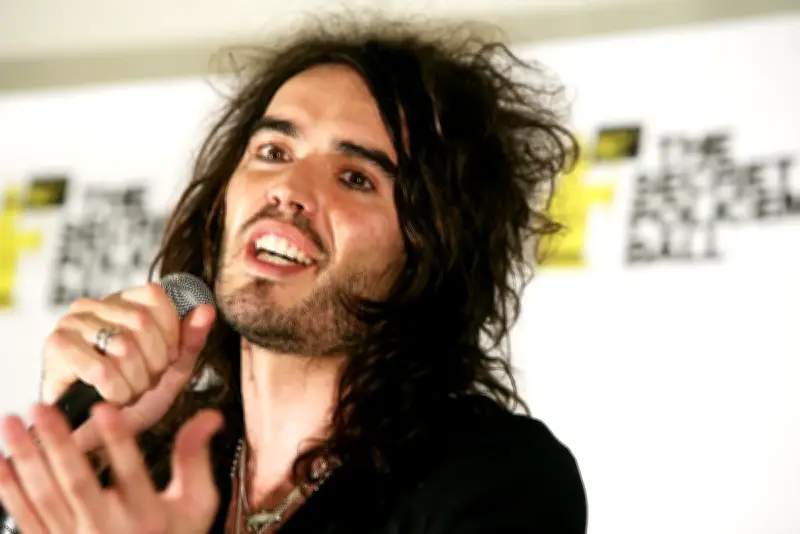
Television and radio bosses have been accused of enabling rapist Russell Brand's behaviour following his conviction on Thursday. Brand was found guilty of one count of rape and three counts of sexual assault after a trial at Southwark Crown Court.
Revelations from the trial have raised questions as to how Brand was allowed to get away with his campaign of sexual misconduct for so long. A number of showbiz executives are now being accused by charities of turning a blind eye to Brand's antics and facilitating a toxic environment.
Court hears of assaults at MTV, Choice FM and Channel 4
During the trial, the court heard that one victim was dragged to the toilet by Brand at a bar in Soho in 2004 when she worked for MTV. The victim said that "lad culture" meant she did not report her interaction with Brand at the time, telling the court: "He was a celebrity and it would be his word against mine. I just thought the odds weren't in my favour." She claimed she told her producer two years later when Brand was rehired by the channel.
The comedian also sexually assaulted a worker at Choice FM - now rebranded as Capital FM - at her place of work in 2005, pinning her up against a wall and "sloppily" kissing and groping her. The court heard that Brand's entourage did not intervene in the attack, laughing as the attack unfolded.
Another complainant said she was working for Channel 4 in 2009 when Brand sexually assaulted her by forcing her to give him a massage. Brand's associates, named in court as Jack Bayles and Gareth Roy, were understood to have laughed while the attack happened. The victim claimed she reported the assault to bosses, but nothing was done, and Brand continued to appear on Channel 4 for the next ten years.
BBC under pressure over handling of complaints
Mr Bayles went on to become Channel 4's Commissioning Editor of Comedy, commissioning hit-shows like Derry Girls, Stath Lets Flats, and This Way Up. He left the broadcaster in 2017. Mr Roy continued to work with Brand into the late 2010s, co-hosting a podcast with the convicted comedian.
The BBC has also been caught up in the Brand allegations, facing fresh pressure over its failure to control its stars. Brand has previously claimed that Lesley Douglas, BBC's then-controller of Radio 2 and 6 Music, "loved me and gave me lots of room – so I took that room" during the mid-2000s. He claimed this had included allowing him to use the BBC's disabled lavatories for sex with radio competition winners.
An internal report published in 2023 found that numerous complaints about Brand had been ignored, while many staff were reluctant to come forward because they feared bosses would back him. The corporation published another detailed report in January, looking into eight allegations of misconduct while Brand worked at the broadcaster.
Charities and prosecutors condemn enabling culture
Liz Kershaw, the radio DJ who spent more than 30 years working for the BBC, accused the corporation of having "enabled Brand's behaviour". Writing for The Telegraph, she said: "Maybe his enablers should finally have been brought to book. Media executives, comedy club promoters. His agent. After all, as Brand once said, 'people will let you be a nutter as long as they are making money out of it'."
In a statement following his conviction, a BBC spokesperson said: "Firstly, the thoughts of everyone at the BBC are with the brave women who came forward and told their stories which led to a conviction in this case. There can be no place for the abuse of power. Across the industry, we must work together to ensure that anyone who suffers at someone else's hand feels able to report it, that their concerns are taken seriously and that they are listened to. We published a detailed report in January 2025 into how complaints about Russell Brand's conduct were handled. This looked at eight allegations of misconduct while he worked here between 2006 and 2008. It was of great concern to us that some people felt unable to raise concerns about Brand's behaviour. We apologised to those impacted, for both the culture and failings at the time, and we reiterate that apology again today."
A probe was also launched by the production company behind Big Brother after ex-employees claimed it was an open-secret he was a predator. In its June 2024 report, production company Banijay UK, formerly Endemol, said that runners on spin-off show Big Brother's Big Mouth were tasked with fixing meetings for him with members of the audience he fancied, leaving them feeling like "pimps". One ex-staff member said it felt like they were "taking lambs into slaughter", while another claimed that Brand flashed her in his dressing room in 2004. The company admitted in the report that Brand would walk around naked in front of colleagues but it was brushed off as "Russell being Russell". No formal complaints were raised at the time but there was evidence that junior employees made informal complaints which were not escalated. CEO Patrick Holland said he was "extremely sorry" to anybody who did not feel properly heard.
A number of women's charities have condemned Brand's offending and the toxic entertainment and media culture that facilitated the sexual violence. Deniz Ugur, deputy director of the End Violence Against Women Coalition (EVAW), said the "incredibly difficult" challenge of reporting rape and sexual assault to the police can be "heightened when the perpetrator has a significant amount of wealth and status and a network of power". She added: "What we see with powerful perpetrators is that there are often others around them [who] enable abuse or are complicit in it through cultures of silence. These institutional cultures are found across the entertainment industry, media and beyond, and prevent survivors from accessing justice. Perpetrators with power, wealth and status are often able to weaponise the law to silence survivors and even the media, through legal threats and NDAs."
Women's Aid slammed the broadcasters in their duty of care towards employees, branding the verdicts "a wake-up call to broadcasters." "Too often we have seen men like Russell Brand manipulate their way out of consequences and evade prosecution by asserting their power and money dangerously," the charity's chief executive Farah Nazeer said. The charity Refuge added: "The sickening crimes committed by Russell Brand demonstrate how perpetrators in the public eye are often able to act with impunity – with devastating consequences for the survivors affected."
Detective Superintendent Andy Furphy said: "We can see from the pattern of Brand's behaviour how it escalates in the early part of his career, the imbalance of power created as a result of his status and his celebrity. I think this is potentially a watershed moment where we look back and think about that laddish culture during that period of time and what was appropriate and what wasn't."
David Roberts, a senior crown prosecutor, said: "Russell Brand was predatory and used his celebrity status to commit sexual crimes. He was a manipulator with an insatiable desire to get what he wanted, regardless of whether consent was given or not. I would like to thank all the women in this case for their courage in coming forward and seeing this sexual abuser brought to justice. As his career took off, he seized opportunities to assault the women around him. Although his tactics varied, at the centre of every assault was an abuse of power and sexual greed, with a complete disregard for the impact of his actions."
Metropolitan Police commissioner Sir Mark Rowley has also said the 'power of celebrity' had silenced Russell Brand's victims for years, and he expects 'many more' women to now come forward.
In a statement, Mr Bayles said he was sorry but doesn't remember the sexual assault. "I am appalled and sickened by Brand's actions and have co-operated fully and voluntarily with the investigation and endeavoured to assist as best I can," he said. "However, I do not remember the incident that took place 17 years ago in 2009. But I acknowledge that I clearly missed something at the time and did not see nor recognise that it caused distress. For that I am sincerely sorry." He said at the time of the offence he was in the early stages of his career, calling it "a frantic, pressured and toxic working environment".