Katy Perry was removed from the prosecution case against Russell Brand, and jurors were blocked from hearing details of his addictions to drink and drugs during his trial at Southwark Crown Court.
Brand, 51, was found guilty of rape and three counts of sexual assault on Thursday, November 5, following a trial involving allegations made by six women. During the trial, his victims revealed how he had forced them into sexual activity, sometimes within seconds of them first meeting, using his fame to pursue a goal of sex with 5,000 women.
The disgraced comedian is set to face years in prison for his crimes. His wife Laura, 39, bowed her head and gripped her chair tightly as the verdict was read out, before being rushed from court by the couple's bodyguard.
Prosecution case edited
Prosecutors wanted to mention popstar Katy Perry when opening the case against Brand over allegations of rape and sexual assault during 10 years of his showbiz career. But the Grammy-nominated singer was removed from lead prosecutor Riel Karmy-Jones KC's speech after submissions made by Brand's legal team. The prosecutors also agreed not to bring up Brand's past religious interests, prior to his recent conversion to Christianity.
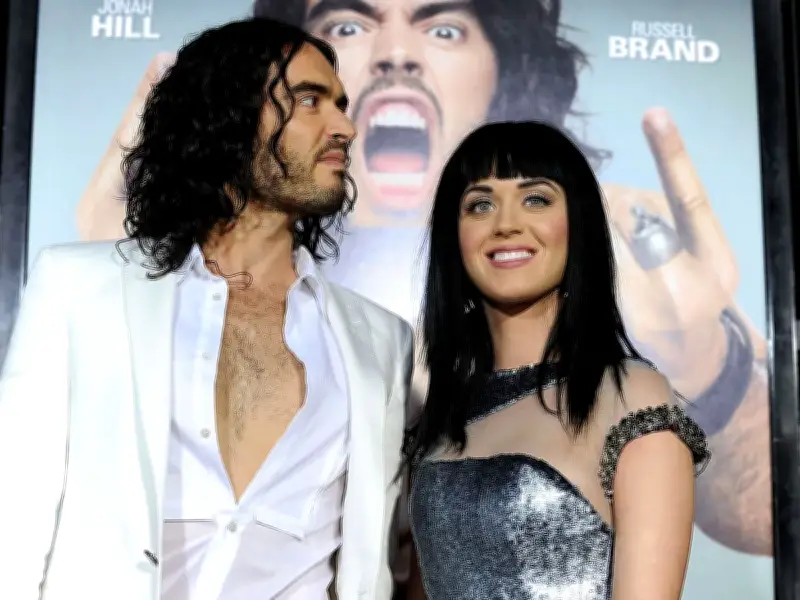
He and Perry were married in a traditional Hindu ceremony in Rajasthan, in India, in 2010, at a venue close to a tiger sanctuary. But in the last two years, Brand has converted to Christianity. It now forms the centrepiece of his podcast and online content, and at times during the trial he was seen praying in the dock.
In legal submissions before the trial began, Ms Karmy-Jones set out: "The prosecution recognise that matters post 2009 involving his relationship with Katy Perry may be sensitive, as may his previous faiths, and we are content to remove these from the opening."
She also agreed to remove mention of Brand's baptism in the River Thames in Henley in 2024, in a ceremony attended by TV presenter Bear Grylls.
Drug use and alcoholism excluded
When Brand gave evidence, he mentioned his short-lived marriage to Perry and said it was at that point that he achieved "staggering fame". They started dating after they first met on the set of Get Him to the Greek and then later reconnected at the 2009 MTV Video Music Awards, but by the end of 2011 their marriage was over.
The CPS has confirmed that Perry was not asked for a witness statement during the investigation into Brand. Senior crown prosecutor David Roberts said: "We followed all reasonable lines of inquiry in statements that would have been relevant to the specific charges and I'm satisfied that all reasonable lines of inquiry were covered."
In pre-trial arguments, which can be published now the case is over, it was revealed that details of Brand's drug use and alcoholism would not feature in the case. The prosecution wanted to rely on Brand's "dependency" on drink and drugs, but defence barrister Ian Winter KC objected to the argument being ventured.
"Putting aside the illogicality of the suggestion that dependency issues mean he would engage in non-consensual sex, none of the complainants assert that Mr Brand was under the influence of drugs or alcohol at the time of their encounters with him," he told the judge.
Evidence allowed and blocked
Brand's former assistant Helen Berger was allowed to give evidence of Brand's "insane sexual appetite", but her statement was edited to omit her assumption that he had a sex addiction, as well as reference to Brand's past treatment at a sex addiction clinic.
Brand's former friend Mark Pinheiro was also blocked from discussing the comedian's substance abuse, including a suggestion that his mood had soured during the 1999 Labour Party conference – when he was accused of raping a woman – because his cannabis had been thrown away. He was later found not guilty of that charge.
Brand's team failed to block the jury from hearing evidence from Ms Berger of him getting "depressed" after sex, his penchant for sex in toilets and dressing rooms, and evidence that he would "switch off the charm" when a woman mentioned she was in a relationship.
Prosecutors wanted to use evidence from one of Brand's former flatmates, Andrew Dobson, that he would tell female friends "don't go there" about the comedian, as well as Mr Pinheiro's reported comment: "Russell's not right, is he?"
Extracts from Brand's book, My Booky Wook, were read out to the jury by Ms Karmy-Jones KC, including lines where Brand had referred to himself as "guilty" after sex, and suggested that he had a "birthright" to orgasm. But his follow-up book, My Booky Wook 2, was kept out of the case, after the defence team pointed out it had been published after the last of the allegations in 2009.
The 2023 Dispatches documentary, Russell Brand: In Plain Sight, loomed large over the trial, and formed a cornerstone of Brand's defence argument that all the evidence against him had been tainted by the reporting. But jurors were chosen who had never seen the documentary, and it was never aired during the four-week case.
Verdicts
Jurors found Brand guilty of raping a 21-year-old fan whom he met following a stand-up performance at the Hammersmith Apollo in 2009. He was also convicted of sexually assaulting an MTV worker at a Soho bar in 2004, a Capital Radio employee in 2005 and a Channel 4 worker in 2009.
However, Brand, who had denied all charges, was acquitted of three other charges, including an allegation of rape dating back to 1999 and an allegation of attempted indecent assault involving another MTV employee in 2001. The jury also found him not guilty of a separate allegation of oral rape involving the MTV worker he sexually assaulted in 2004.