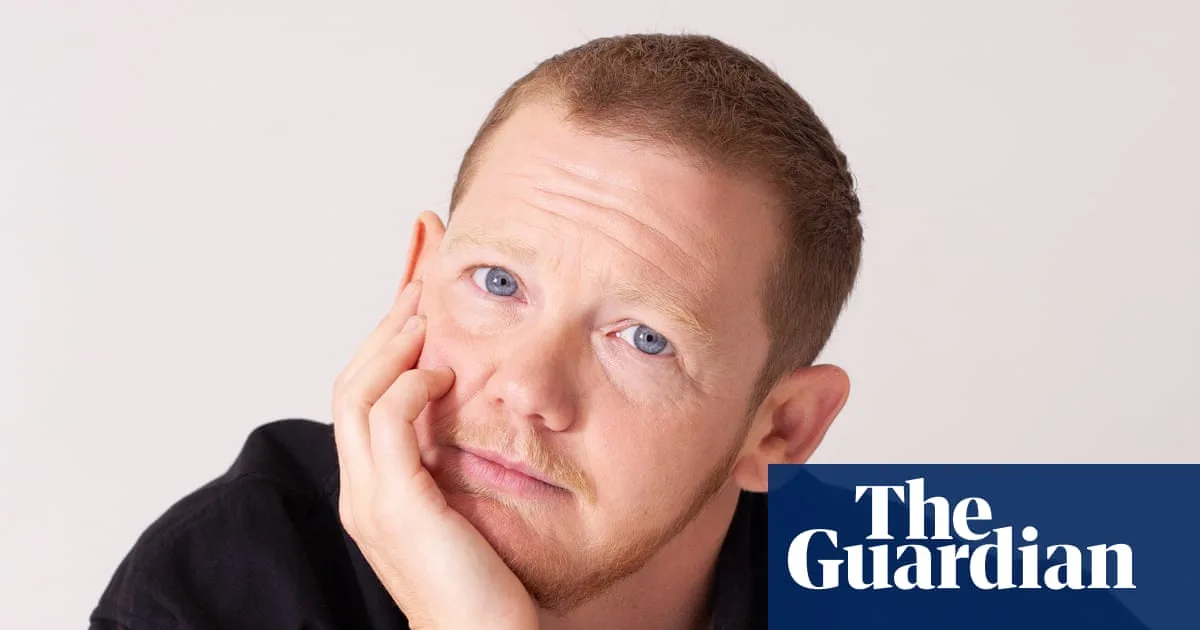
Ten years after his debut novel, the poet and musician has written a follow-up exploring self-discovery and a life lived on the edge. He talks about sexuality, pronouns and drawing strength from the literature he loves.
Kae Tempest sidles into a pub near his house on a weekday afternoon and orders a pint of mineral water. At his side is Murphy, an enormous, 14-year-old Alaskan malamute dog with startling blue eyes who settles down on the floor next to his master and goes to sleep. 'He's all right,' Tempest says. 'He's very friendly. He won't even put his nose up.' The rapper, performance poet, playwright and novelist has a ginger beard and is wearing Timberland boots, baggy jeans and a black hoodie over a blue-and-white striped collared shirt. His hair is hidden by a cap. Years ago, his dramatic russet hair was long, but he cropped it when he dropped the 'T' from his first name and came out as nonbinary, a watershed moment in his gender transition. Now testosterone has deepened his voice and his journey has reached its final stage – from they/them to he/him.
As Tempest has been famous since his late 20s, showered with accolades ranging from Mercury nominations for two of his albums (including his debut, Let Them Eat Chaos) to becoming the youngest poet ever to receive the Ted Hughes award for the epic performance poem Brand New Ancients, this odyssey has taken place in public. On his song 'I Stand on the Line', from his last album Self Titled, Tempest vividly describes the anxiety of having to deal with the hostility of some people's reactions to his 'second puberty' ('Out in the limelight like, please, nobody look at me / I'm looking for myself, all I'm seeing is the bitterness / Coming my way when I'm using the facilities'). So is it a heavy burden to be such a visible trans person? 'It's just my life,' Tempest replies, his voice a soft south London growl, much quieter than the thrilling, declamatory style of his performances. 'I'm just glad to be alive. How beautiful,' he adds. 'Because you felt like you might not be at some point.'
Tempest's second novel, Having Spent Life Seeking, is full of characters who are also living precariously on the edge. It tells the story of Rothko, who has returned to Edgecliff, their seaside hometown, having spent 15 years in prison. Rothko's mother Meg (who gave them their nickname because as a child they used to go as 'red as a Rothko') is a chaotic alcoholic and user of hard drugs; their father, Ezra, is unable to contain the anger and pain within his household. Rothko finds some solace in a teenage love affair with schoolmate Dionne, but it's complicated by the pair's society-induced shame about their sexualities and Rothko's gender identity.
Like Tempest, Rothko is on a voyage of self-discovery, and their pronouns change over the course of the story: they/them for the bulk of the narrative; she/her when being misgendered. 'When their pronouns switch in someone else's imagination or address of them, it's intentionally a bit of a misstep, you know?' Tempest says. 'Hopefully you get that feeling of missing a step on the stairs, which is how it feels.' Rothko's pronouns give rise to grammatically unconventional sentences like: 'It was their first heartbreak. And they'd done it to themself.' 'That's just how it feels to me,' Tempest says. 'It doesn't feel like “themselves”.' He is proud of a euphoric moment towards the end of the novel when Rothko says 'I'm a man' and is thereafter referred to as he/him, which Tempest describes as 'the power of a new pronoun … I would hope that people that have no experience of anything remotely like this will feel the relief and release for that character.'
As readers of his 2020 book-length essay On Connection will know, Tempest is a fervent believer in the power of art and literature to make us experience the inner lives of people with whom we might think we have nothing in common – and also, he tells me, 'to make us see more clearly our own internal experience'. His touchstones when writing Having Spent Life Seeking included Patrick Hamilton's Hangover Square ('You don't spend much time with the characters, but they walk on and off and you know so much about them') and Leslie Feinberg's Stone Butch Blues, a classic but frustratingly hard-to-find queer bildungsroman about a gender nonconforming lesbian. 'When I first encountered that text it was probably the first step of my journey towards accepting myself as I really was.'