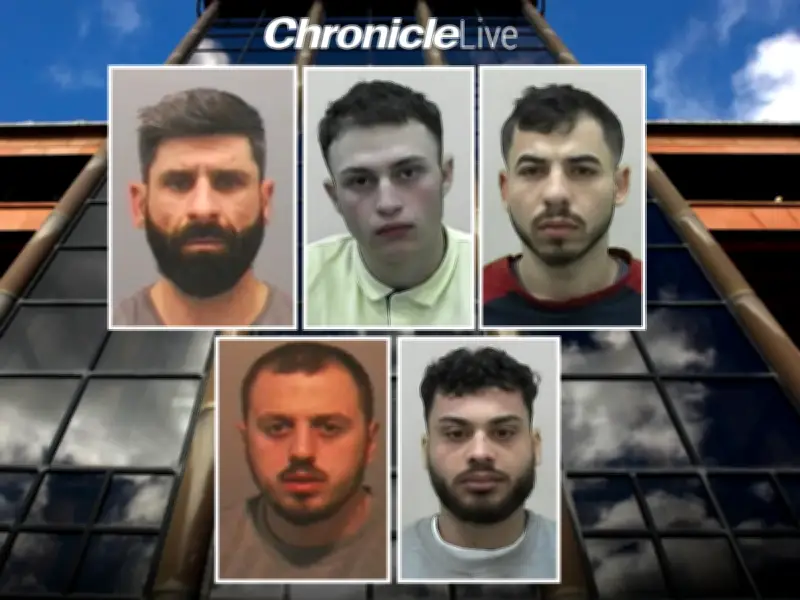
An investigation has found that authorities did not see the warning signs of a Gateshead grooming gang that raped teenage girls and missed opportunities to stop the sexual abuse earlier. Five men, four from Romania and one from Albania, were jailed for a combined 39 years last December for the rape and sexual exploitation of six girls, aged between 13 and 16.
Codrin Dura, Leonard Paun, Bogdan Gugiuman, Klaudio Aleksiu, and Stefan Ciuraru were found guilty of offences that took place between 2015 and 2019 and had targeted vulnerable girls in Saltwell Park. A new report has now been published outlining a series of missed chances to tackle their crimes.
Survivors' testimony highlights failures
The Gateshead Safeguarding Children Partnership (GSCP) has published a learning report featuring testimony from survivors of the abuse, who said that schoolteachers “had to know what was happening but seemed to accept it” and that a lack of action after they spoke up “made me sad and not heard”. One victim said: “I felt I couldn’t tell anyone as nothing had been done when I did – it massively undermined my trust in things being done properly.”
The offending initially involved younger males, known to the girls through school, organising meetings at a local park. The girls were introduced to older men, given alcohol and drugs, and then subjected to “repeated demands, blackmail, intimidation, controlling and aggressive behaviour and some were subjected to sexual abuse and physical violence”.
Missed opportunities before Operation Vulcan
A report released by the GSCP concluded that professionals “didn’t understand immediately how serious this was early on and didn’t see the warning signs” when some girls had tried to tell adults what was happening to them. It found that, while some concerns were dealt with, more action was needed and opportunities for a coordinated, multi-agency response were missed. The report said that different services did not always share information or work together well, meaning that the abuse “potentially continued for longer than it might have done”.
It identifies a series of incidents that occurred prior to the Operation Vulcan in July 2019, the police investigation that ultimately snared the perpetrators. This included a number of reports made to a school in early 2019 from pupils that sexual abuse and harassment was taking place on premises as well as outside of the school grounds – none of which were referred to either police or children’s services.
Specific incidents and recommendations
In July 2018, police responded to reports of two males who were described as possibly Eastern European and were with a “very drunk” young girl. Police officers found the intoxicated child, with no men present when they arrived, and left her in the care of friends, but submitted no child concern notice (CCN) and did not make follow-up enquiries. And, between 2018 and the commencement of Operation Vulcan, more than 18 police CCNs were submitted regarding one individual child linked to missing episodes and concerns. It later emerged through Operation Vulcan that this was a “critical period” during which she was being subjected to child sexual exploitation and abuse. After that child disclosed information to police in April 2019 that directly indicated child sexual exploitation, the review found that “more robust multi-agency action should have followed” to launch an investigation “which could have led to earlier safeguarding, prevention and intervention opportunities”.
The GSCP report states: “There were a number of opportunities where practitioners could have been more curious around the presenting circumstances or the information that was shared by wider partners and/or failing to record such. There were indicators of actual or potential harm that should have led to a more robust approach. This included occasions where organisations could have sought information from wider partners to understand more fully the lived experience of the child involved. This was particularly so in relation to one child where a number of partner agencies were involved. Similarly, there were missed opportunities to seek further information from the child and family, potentially driven by professionals’ reluctance to confront cultural issues.”
The report adds that, one of the girls reported what was happening to a trusted adult, police, social workers, schools, health professionals and wider services “worked together to protect and support the girls”. It praises the bravery of the victims in telling their stories and said that the children ultimately felt “believed, protected, and empowered” once trust had been built. The learning report contains 19 recommendations, many of which the GSCP said had already been actioned. They include enhanced training on the signs of child sexual exploitation, ensuring that the child’s voice is better embedded into agencies’ activities, and that individual child-specific strategy meetings are held in all cases of complex and organised child sexual exploitation and abuse involving group-based offending to ensure that each victim’s unique needs are addressed.
Helen Fergusson, chair of the GSCP, said: "The experiences detailed in the Operation Rhene independent report are deeply concerning and serve as a stark reminder of the devastating impact of child sexual exploitation on young people's lives. We are grateful to the victim-survivors who shared their experiences to help us understand what happened and what needs to change. Their courage has not only contributed to securing justice but has also provided invaluable learning that will help us to continue to improve how we safeguard children and young people in the future. We are hopeful that publishing the learning report will help with the early identification of this type of offending, serve to increase confidence and provide opportunities for earlier reporting of similar offences and that it will help us to respond more swiftly to safeguard young people."