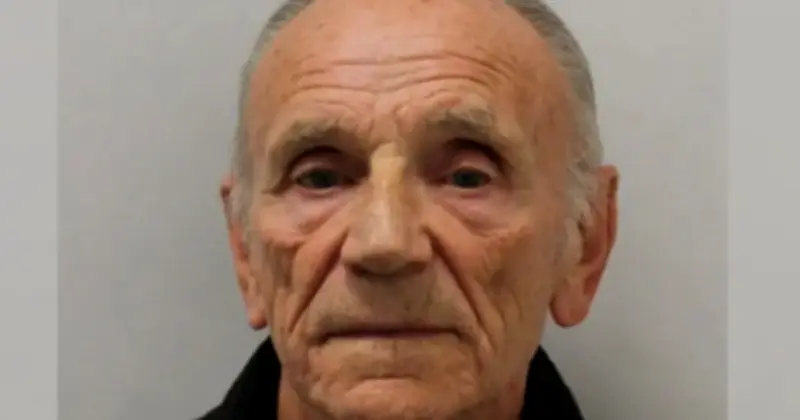
A woman sexually assaulted by notorious rapist and murderer Ronald Evans has said she fears being raped and murdered if he is freed at an upcoming parole hearing. The victim, attacked by Evans in 2022, described how his eyes “glistened” and turned “black” before the incident, and said she feels like a “sitting duck”.
Evans's long criminal history
Evans, 85, spent 50 years in jail for killing 21-year-old Kathleen Heathcote in 1963 and committing multiple sex offences between 1977 and 1979 in Bristol. He was released on licence in 2018 and moved to London, where in 2022 he coerced a woman into his flat and groped her after admitting to killing Ms Heathcote, which he claimed was accidental. In 2023, Evans was imprisoned again for that attack.
A parole hearing is set to take place in public on January 15, and the victim said she is terrified he will be released. She told the Express she has been told of a coming home party for Evans in Brent, West London.
Victim's fears and support network
The woman said: “Earlier this year, somebody said to me — it was a friend of his: ‘Did you get your invite?' I said: 'To what?' 'To the party,' they said, 'The welcome home celebration party.' I said: 'For who?' They said: 'Oh, for Ron.' I said: 'No, I didn't, and I don't want one either.'”
She added: “They're thinking he's coming home. They still support him. They still protest his innocence. He's an innocent man, and I'm the vindictive, lying woman who put him in jail. And to this day, they still support him.”
The victim said she is scared that, if Evans comes back, he would “be supported by his close friends”. “He's a real threat to me,” she added.
Concerns about safety and police response
“These type of predators, like this monster [...] they have an ecosystem that sustains them,” the victim said. “People who turn a blind eye, who allow it to go on, let them go unchecked, and they're able to flourish and thrive and commit their crimes. And many blind eyes are turned.”
She is “scared” and feels like a “sitting duck”. The woman said: “People say: 'Oh, he's old.' He's old, but he's strong and he's very capable. And when people are that way heinously criminally minded, they find enormous strength. It's in his nature, it seems, that he won't be able to change who he is. My genuine fear is that what he did to me wasn't his end goal. The end goal was rape [and] murder; that's his ultimate thrill. He's got nothing to lose. He'll only go back in jail.”
There is an exclusion order in place, the woman said, and she has instructions to call 999 if she feels in danger. She added: “I have no faith that if I call 999 and he's here and I see him, they'll even bother turning up. Somehow, I want to impress upon my local police: if I do see him within the exclusion zone, or he makes contact via a third party, if I call the police, don't dismiss me, please attend.”
Parole board statement
HH Michael Topolski KC wrote on behalf of the Chair of the Parole Board for England and Wales: “This is a complex, serious and unusual case. The oral hearing of Mr Evans’ second recall on life licence is due to be heard on 15 January 2027. By then Mr Evans will be 86 years old. He was sentenced to life imprisonment for murder when he was 23 years of age. He has remained in prison for the majority of the ensuing 63 years. He is said to be one of this country’s longest-serving prisoners.
“His tariff expired on 6 June 1975. While at liberty on licence, he committed several offences against women. The application for a public hearing has been made by a journalist who has written and broadcast extensively about Mr Evans for a number of years. The application is supported by three of Mr Evans’ ten victims. Mr Evans opposes the application for a public hearing. His objection is said to be not one of principle but of capacity and candour.
“He believes he could not speak freely or adequately about all the matters the panel will need to consider if he was required to do so before an audience. He appreciates he will be required to give evidence about intimate personal matters including his sexual interests and activities.”
He added: “I have found that there are significant features in this case that do set it apart from other cases when it comes to increasing public understanding of the parole process. I cite the gravity of his offending over several decades; his age and health; the fact that decades of imprisonment and years of interventions have not (it is suggested) resulted in a sufficient reduction in risk leading to consistent offence-free behaviour in the community remains a continuing concern.
“I find that there is a clear public interest in the public being enabled to see and better understand how a panel of the Board conducts its proceedings and reaches its conclusions in this complex case.”