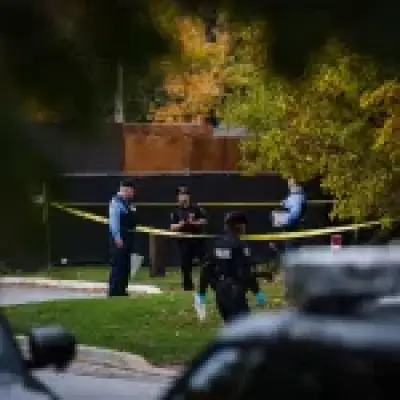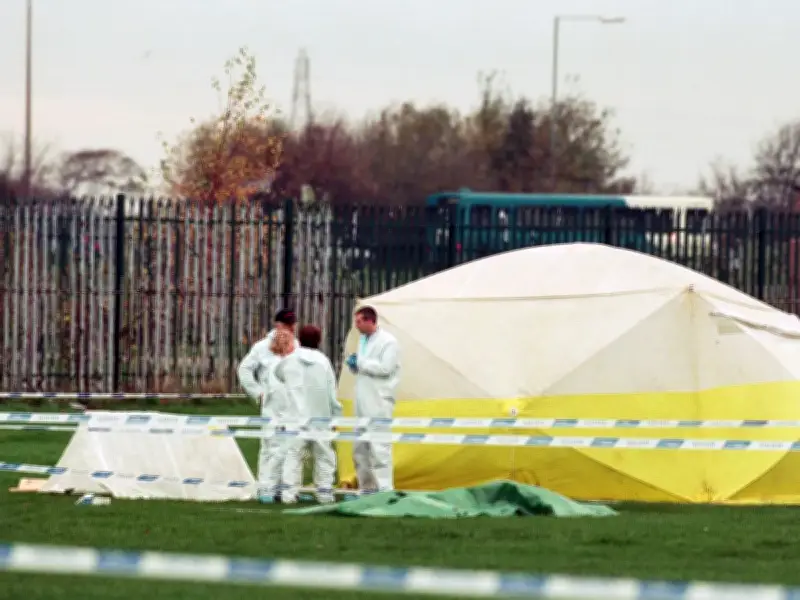
The body of 15-year-old Michael Moss was found on a playing field near Litherland Moss Primary School at around 8am on November 13, 1999. The teenager, who lived at the nearby Sterrix Lane children's home, had been seen just seven hours earlier, "giggling but happy" after a night out with his brother. He had been beaten, stabbed, and slashed to death with a broken bottle.
Floral tributes to Michael, a former pupil of Holy Family High School in Thornton, piled up at the fence around the field. One read: "Mossy, you were too nice, too young to die, such tragic circumstances. I'm so, so sorry. goodbye mate." Another read: "To Mossy. I'll never forget you, I'll always love you."
Investigation and arrests
As the community mourned, a police investigation moved rapidly. Before the day was out, three boys were already in custody - and blaming each other. From the very beginning, reporting on the case was frustrated by the young ages of the suspected killers. Aged just 16 and 15 at the time, legal restrictions meant their identities were strictly protected.
The teenagers were among the first to be tried under new rules drawn up by the Lord Chief Justice following the James Bulger trial, which the European Court of Human Rights ruled was a breach of the young defendants' human rights. The Crosby Herald reported "special arrangements" were being considered for the youths, including a guided tour of the courtroom before the trial. Barristers were banned from wearing their wigs and gowns to avoid intimidating the defendants, and it was proposed that sessions of the four-week trial be limited to just one hour.
Trial begins for anonymous killers
The trial began at Liverpool Crown Court on July 5, 2000. The motive, the prosecution said, was "festering jealousy" - Michael had recently started going out with the ex-girlfriend of one of his alleged killers, later identified as Alan Bentley. Michael's girlfriend testified Bentley had threatened to "boot (Michael's) head in" just days before the murder. Tearfully, she described how Bentley had once boasted of bashing Michael on the head with an iron bar.
On Bonfire Night, a week before the murder, she said Bentley phoned her and "sounded quite drunk and in a bad mood". She said: "He asked me if Mossy had been down today and I said no, and he said 'he has, you liar'. Then he said 'when I see him I'm going to kill him, I'm going to boot his head in everywhere'."
On the night of November 12, the court heard, Michael had been out playing snooker with his older brother, then went to a friend's house for some beers. At the same time, Bentley was having a party with his friends, later named as Mark McKeefrey and Graham Neary. Fuelled by six litres of cider, they hatched a plan to lure Michael to his death.
Bentley made two calls to the Sterrix Lane care home at 11.45pm and 12.15am looking for Michael, but he was not in and did not return until 12.30am on November 13, when he was "giggling but happy." Another of the boys returned to the care home at around 1am and persuaded Michael to go out onto the playing fields. Michael, who had been getting ready for bed, got dressed and left at around 1.10am, promising he would be back in 10 minutes - he never returned.
Michael was stabbed and slashed with broken bottle
Michael's body was found on the playing field near Litherland Moss Primary School at around 8am on November 13, 1999. Prosecutor Anthony Gee said: "It was a murder which involved systematic and extreme violence. Violence for its own sake over a prolonged period before Michael Moss eventually died.
"During the course of the attack Michael Moss, who was quite defenceless, overwhelmed and outnumbered, was punched, kicked and stamped upon over his entire body and particularly around his head. Virtually the whole of the victim's body was bruised, and there were fractures underlying those bruises to the ribs, other bones and fractures to many of his facial bones.
"The force of the kicks delivered to Michael Moss's head was such that he suffered a separation of two vertabrae in his neck. The defendants acting together inflicted substantial and extensive stab and slash wounds over Michael Moss's entire body, probably using a broken bottle. After leaving the dirt-covered body in the muddy field one of the three had made a 'desultory and incomplete' 999 call to the ambulance services saying it could be found near the swings and slides of the playing fields, but the details were insufficient for them or the police to find Michael initially."
Over a period of two hours, Michael was stripped naked, stabbed, and slashed with a broken bottle. His attackers also attempted to cut off his left ear and poured vodka on his wounds in a re-enactment of a violent scene from the Quentin Tarantino movie "Reservoir Dogs".
Bentley, McKeefrey and Neary were all arrested on November 13 after Neary's mum, suspecting her son knew something about the murder, took him to Crosby police station. Forensic examination of the boys' trainers and clothes linked them to the murder. Footprints were found on Michael's body and on a T-shirt that had been dumped in a pool of water.
In interviews, Bentley, McKeefrey and Neary all tried to downplay their part in the attack, and pinned the blame on each other. In a bizarre turn, Bentley claimed Michael had consented to the attack so he could claim criminal injuries compensation in order to buy a motorbike. But Michael's devastating injuries spoke for themselves. All three boys were found guilty of murder and were detained "at Her Majesty's pleasure".
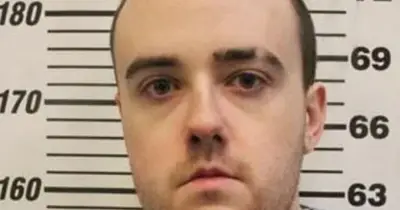
Following their convictions, restrictions preventing them from being identified were lifted, and their mugshots released. A fourth boy, who could not be named for legal reasons, admitted a charge of violent disorder and received a two-year supervision order.
Killer teens 'had struck before'
In July 2000, the Crosby Herald dropped another bombshell, a fact which was not revealed in court: Alan Bentley and Mark McKeefrey had "struck before". The report revealed: "In March 1998, Bentley and fellow accused, Mark McKeefrey, attacked a 15-year-old school pupil so badly he had to be hospitalised. It was a chilling precursor to the murder of Michael Moss - occurring within a stone's throw of the very spot where Michael died." The attack resulted in Bentley and McKeefrey being expelled from high school - but no action was taken by police.
Detective Sergeant Roy Woodall said: "No complaint was made to the police. The victim felt that, as he did not have contact with them outside of school, expulsion would be sufficient."
Graham Neary, meanwhile, was already known to the police. The eldest of the three accused, he received a police caution for stealing a bike from a high school in March 1999. He had also turned up at school with stolen railway detonators, and he was expelled and sent to a special educational unit. There he met Alan Bentley, who he had known for just a few weeks before the murder. He claimed he did not know Michael, and only met Mark McKeefrey on the day of the murder. He claimed he only joined in on the attack out of fear for his own safety, but this excuse did not wash with the police, who said he "had a much bigger part to play".
He was the only one of the defendants to show emotion during the trial, crying at the start of his evidence and collapsing in his mum's arms when the verdict was returned. But DS Roy Woodhall said: "Were they tears for Michael Moss, or himself?"
'There is no justice for the families'
In May 2002, Graham Neary won the right to appeal against his murder conviction. But three senior judges at London's Court of Appeal rejected the notion that his conviction was unsafe. Two years later, in May 2004, Neary's 10-year sentence was reduced to nine years by the Lord Chief Justice of England and Wales, Sir Harry Woolf, because he played a lesser role. The Chief Justice also ruled that Bentley and McKeefrey's tariffs should have been set at 12 years, not 10, but declined to increase them "at this late stage."
Michael's mum Liz Moss said: "I'm very, very disappointed. Lord Woolf feels he can't increase their tariffs and I want to know who has caused the delays. This is like a life sentence for me, but the boys who tortured and murdered my son only get 10 and nine years. This sends a message out to kids that they can get away with murder, because you will only receive 10 years in prison. You will also get a good education and be able to find a job when you come out. It's not fair on those who stay out of trouble. McKeefrey and Neary have taken GCSEs while they have been locked up. My son won't be able to take his GCSEs. There is no justice for the families."